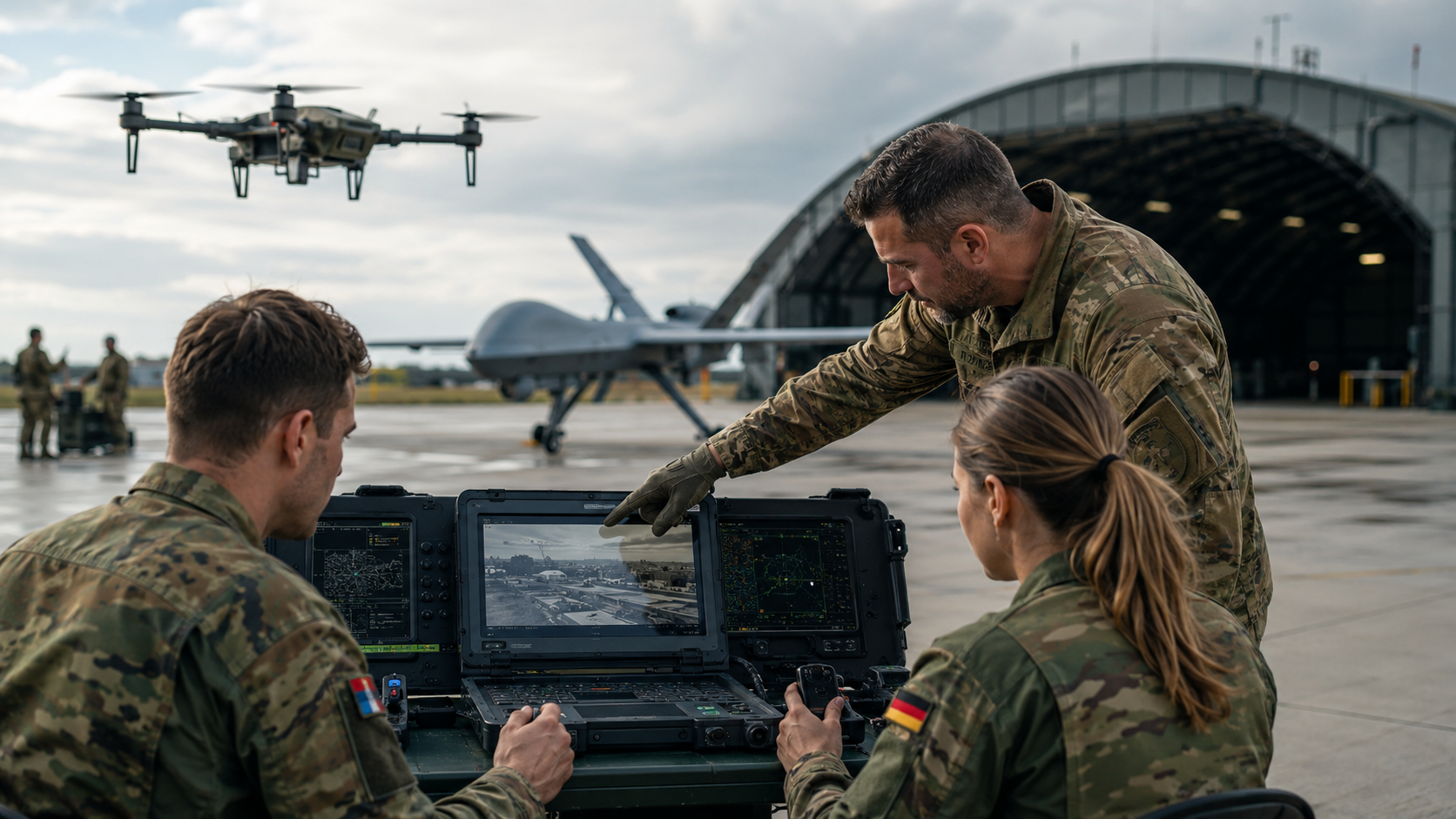
NATO has launched one of its most ambitious drone-related initiatives to date. While investment in technology will attract most of the attention, the Alliance’s ability to develop instructors, common standards and a scalable training system may ultimately determine whether its new capabilities become operationally effective.
At the NATO Summit Defence Industry Forum in Ankara on 7 July 2026, Allies announced the launch of NATO’s Drone Edge, a major initiative intended to accelerate the Alliance’s ability to produce, operate and counter uncrewed systems.
The commitments are substantial. NATO Allies plan to invest more than USD 40 billion in counter-drone capabilities over the next five years and to train five times as many drone operators in their armed forces by the end of 2027. NATO is also developing a counter-drone marketplace intended to provide Allies with easier access to systems that have been tested for NATO compatibility.
The investment figure will naturally dominate the headlines. Yet the second commitment may be more difficult to deliver.
Equipment can be purchased, production lines expanded and new systems introduced. Building a sufficiently large body of trained operators, instructors, technicians, mission planners and commanders is a different challenge. It requires not only funding, but also common standards, training infrastructure, access to airspace, realistic operating environments and a system capable of adapting as quickly as the technology itself.
What exactly is a drone operator?
The first challenge is definition.
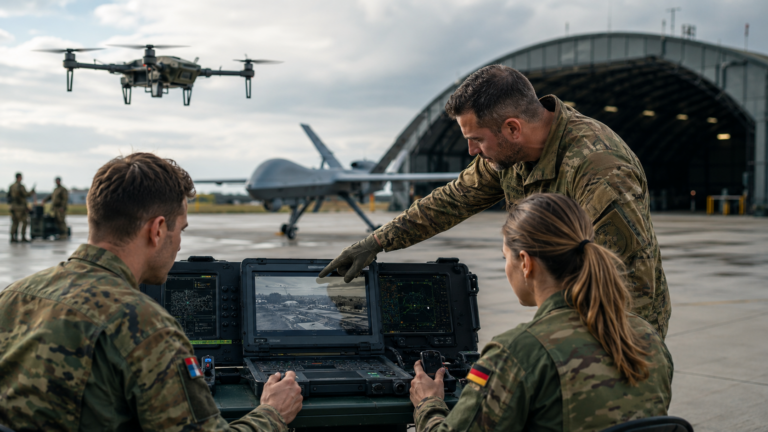
The term “drone operator” can describe very different roles. It may refer to a soldier operating a small tactical reconnaissance aircraft, a crew controlling a larger remotely piloted ISR platform, an operator working with a loitering munition, or personnel involved in detecting, identifying and defeating hostile uncrewed systems.
Each role requires a different combination of technical knowledge, tactical understanding and practical experience.
Operating a small uncrewed aircraft at unit level is not the same as managing a long-endurance remotely piloted system integrated into controlled airspace. Nor is flying a platform equivalent to employing it effectively as part of a wider intelligence, targeting or command-and-control architecture.
The publicly available Drone Edge announcement does not specify the current training baseline, the intended number of graduates or the categories of operators included in the fivefold increase. It therefore remains unclear whether the target refers primarily to annual training capacity, the overall number of qualified personnel or a broader family of drone and counter-drone specialisations.
Establishing a common taxonomy will be essential. Without it, individual nations could meet nominal training targets while producing personnel with very different levels of competence and operational readiness.
Flying is only one part of the mission
A modern drone training system cannot concentrate solely on controlling an aircraft.
Depending on the platform and mission, operators may need to understand mission planning, airspace coordination, sensor employment, data links, target identification, electromagnetic interference, cyber security, intelligence processing and integration with other land, air and maritime assets.
They must also be able to operate when satellite navigation is degraded or unavailable, when communications are disrupted and when adversaries actively attempt to detect or take control of their systems.
Training must therefore reproduce the operational environment, not merely the technical functions of a particular platform.
This creates a difficult balance. Basic training must be standardised enough to support safety and interoperability across the Alliance. At the same time, tactical training must remain flexible enough to reflect rapidly changing technologies, threats and lessons from current conflicts.
A syllabus designed around a particular generation of equipment can become outdated before a full training cycle is completed.
The Alliance will consequently need a process through which operational lessons can be assessed, validated and introduced into training much faster than under traditional military aviation models.
NATO Flight Training Europe provides a starting point
NATO does not need to build the entire structure from the beginning.
The multinational NATO Flight Training Europe initiative, or NFTE, was established to create a network of training facilities for fighter, helicopter, fixed-wing and remotely piloted aircraft crews. It allows participating nations to use training capacity available in other Allied countries rather than maintaining every element nationally.
Finland, France and Sweden joined the initiative during the Ankara Summit, bringing NFTE membership to 20 Allies. The network now includes 16 training campuses across eight countries and is reported to offer 22 different training courses. NATO has confirmed that NFTE will be expanded further to support the Drone Edge training objective.
This multinational structure offers several advantages. It can reduce duplication, give smaller air forces access to specialised facilities and support the development of common procedures among nations that may later operate together.
However, expanding an existing aviation training network into a system capable of supporting a fivefold increase in drone training will require more than adding places to current courses.
The spectrum of uncrewed systems is considerably wider and develops more rapidly than the traditional categories of military aircraft. Training may need to range from short courses for tactical users to complex multi-crew programmes comparable to established military aviation training.
The network must also determine which elements can be shared across NATO and which will remain platform-, service- or nation-specific.
The instructor bottleneck
The most immediate limitation may not be the number of students, but the number of qualified instructors.
Increasing training output requires experienced personnel who can teach, supervise and evaluate new operators. Those instructors must themselves be familiar with current systems and operational practices. Removing the most capable operators from active units to become instructors can also create short-term readiness gaps.
A credible expansion plan therefore needs a strong train-the-trainer component.
NATO and participating nations will have to develop instructor standards, qualification pathways and mechanisms for regularly refreshing knowledge. They will also need to decide how experience gained by individual Allies can be shared without allowing national procedures, security restrictions or platform differences to become barriers.
Industry can contribute technical expertise, particularly during the introduction of new systems. But manufacturer-led product instruction cannot replace military mission training. Armed forces must retain the ability to teach operators how to employ systems within a contested, multinational and multi-domain operational environment.
The objective should not be to create personnel qualified only for one piece of equipment. It should be to develop operators able to understand the wider mission and adapt when platforms, payloads or threats change.
Simulation will be indispensable
A fivefold increase in training cannot rely exclusively on live flying.
Airspace availability, weather, equipment wear, safety restrictions and the cost of operating larger systems will limit how much training can be conducted on real platforms. Live training may also be unable to reproduce some of the most demanding electronic warfare, cyber or counter-drone scenarios safely and repeatedly.
Synthetic training can allow students to practise mission planning, system failures, communications loss, electronic interference and complex multi-asset operations before moving into live environments.
It also makes it possible for personnel in different countries to train together without deploying every system and crew to one location.
NATO has already established a Distributed Synthetic Training Environment initiative intended to connect national simulation capabilities and enable multinational virtual training. Linking this effort with the expansion of drone training would be a logical step, particularly for collective mission rehearsal and training in complex scenarios. The connection is an editorial inference rather than a publicly announced element of Drone Edge, but the two initiatives address closely related requirements.
Simulation, however, must not become a substitute for realistic field experience. Operators still need to understand physical system preparation, deployment, maintenance limitations, communications behaviour and the effects of terrain and weather.
The most effective approach will combine classroom learning, simulation, live flying and participation in larger exercises.
Interoperability must go beyond equipment
NATO frequently emphasises the need for interoperable systems. Drone operations demonstrate why interoperability must also include people, data and procedures.
Two Allied systems may be technically compatible but still unable to contribute effectively to the same mission if their operators use different reporting formats, command relationships or target-identification procedures.
Common training can help establish a shared operational language.
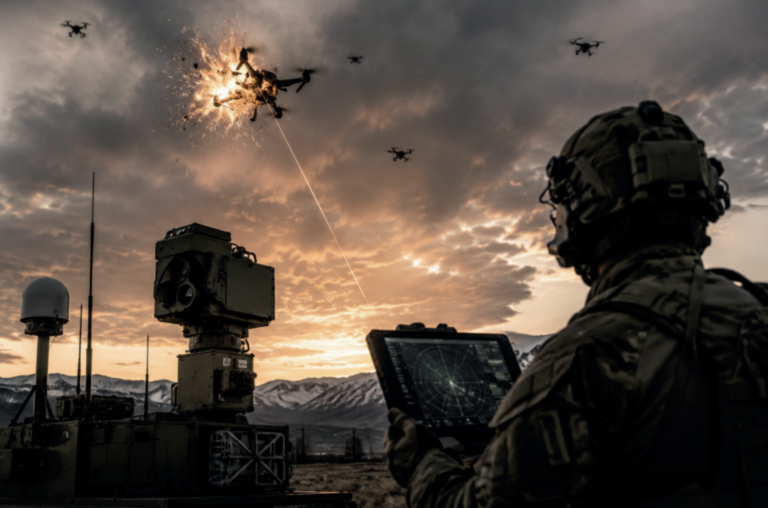
This will be particularly important for counter-drone operations, where sensors, command-and-control systems and effectors may come from several countries and manufacturers. During a NATO counter-drone exercise in the Netherlands in May 2026, approximately 300 participants tested more than 60 commercial systems and 40 command-and-control software applications. Forty companies from 11 Allied nations participated alongside representatives from Ukraine and Australia. The scale of the event illustrates both the speed of innovation and the complexity of connecting multiple systems into a coherent defensive architecture.
Training must prepare personnel to operate within that architecture, not simply behind the control station of an individual system.
A role for smaller companies
NATO’s Drone Edge declaration explicitly recognises the importance of small and medium-sized enterprises and the Alliance’s wider innovation ecosystem in delivering affordable and effective solutions.
Their contribution should not be limited to manufacturing aircraft, sensors or counter-drone effectors.
Smaller companies and specialised training organisations may be able to develop simulation tools, modular courses, instructor support, data-analysis systems and rapidly updated training content more quickly than traditional large programmes.
This could be particularly valuable in an area where technology and operational methods change continuously.
The challenge will be to create procurement and accreditation processes that allow innovative solutions to enter the training system while maintaining security, quality and common standards.
Measuring success
The number of trained operators will be an important metric, but it cannot be the only one.
A meaningful assessment of Drone Edge should also examine the number of available instructors, the ability of graduates to operate in multinational environments, the time required to introduce new operational lessons and the proportion of personnel who remain current and mission-ready after completing their initial courses.
NATO will also need to understand whether the training system is producing the right mix of specialists.
A rapid increase in basic operators will have limited effect without sufficient numbers of maintainers, mission commanders, intelligence personnel, electronic warfare specialists and instructors.
Ultimately, the Alliance is not simply seeking to create a larger population of people capable of flying drones. It is attempting to build an operational ecosystem able to employ and counter uncrewed systems at scale.
That is a significantly more demanding task.
The Drone Edge initiative represents an important acknowledgement that technological capability depends on human capability. Its success will therefore be measured not only by the systems NATO Allies purchase, but by whether they can prepare people to use them effectively, adapt them quickly and integrate them into collective defence.
The hardware race is already under way. The training race may prove even more decisive.
About the Author