Aircraft orders will dominate the news from Farnborough. The deeper question is whether the aerospace and defence industry can actually deliver, integrate and sustain the capabilities that operators now require.
When the Farnborough International Airshow opens on 20 July 2026, announcements measured in aircraft numbers and billions of dollars will quickly take over the news cycle.
Orders matter. They reveal demand, shape production plans and influence the future of individual aircraft programmes. But they do not provide a complete picture of where the aerospace and defence industry is heading.
The most significant developments at Farnborough may not be the largest contracts announced during the show. They may instead be found in agreements covering maintenance, training, industrial cooperation, supply-chain resilience, systems integration and access for smaller technology companies.
Farnborough 2026 will run from 20 to 24 July at the Farnborough International Exhibition and Conference Centre in Hampshire. Its official programme reflects the breadth of the challenges now facing the sector, with dedicated themes covering global security, advanced technology and artificial intelligence, supply chains, finance, sustainability and the future workforce. The Defence Summit will address modern warfare, NATO, drones, next-generation combat air and international defence partnerships.
For those trying to understand the direction of aerospace rather than simply count its orders, five signals will be particularly important.
1. Can manufacturers deliver, not merely sell?
The first question is no longer whether demand exists.
Across commercial and military aviation, manufacturers are managing large order books while customers continue to face pressure to replace ageing aircraft, expand capacity and introduce new operational capabilities.
The challenge is converting demand into aircraft that are delivered on time, supported properly and available for service.
Embraer provides a useful example of this wider test. The company arrives at Farnborough with the E195-E2 and KC-390 Millennium on static display, while the KC-390 is also scheduled to participate in the flying display on Monday. Eve Air Mobility will present a full-scale eVTOL mock-up and simulated flight experience. Embraer reported 109 aircraft deliveries during the first half of 2026, approximately 20 per cent more than during the equivalent period in 2025, alongside a record backlog.

These figures demonstrate momentum, but they also illustrate the wider question facing every successful aircraft programme: how can production be increased without compromising quality, supply-chain stability or customer support?
For military operators, delivery of the aircraft is only the beginning. Operational capability also requires spare parts, maintenance infrastructure, training, mission equipment, software support and qualified personnel.
Recent developments around the C-390 programme show how attention is increasingly shifting towards this complete support environment. Embraer has concluded the first C-390 maintenance event for the Hungarian Air Force at OGMA, signed support arrangements for Hungary’s fleet and expanded discussions on local maintenance and industrial capabilities in countries including Poland and Greece.
At Farnborough, the most revealing questions for any manufacturer will therefore be:
How quickly can it deliver? How reliably can it support the product? Where will maintenance be performed? Who will train the crews and technicians? And how much operational availability can the customer realistically expect?
A large order creates a headline. A functioning support system creates a capability.
2. Is industrial cooperation producing real capability?
Defence procurement is increasingly connected with national industrial policy.
Customers are not only evaluating the performance and cost of a platform. They are also asking what participation their domestic companies will receive, whether maintenance can be performed locally and what technical knowledge will remain in the country throughout the aircraft’s service life.
The distinction between meaningful industrial cooperation and symbolic offset activity will be one of Farnborough’s most important underlying themes.
A particularly relevant moment for Central European visitors will take place on Monday, when a christening ceremony for the Czech Republic’s C-390 is scheduled at the Embraer static display. The Czech Republic ordered two C-390 Millennium aircraft in 2024.
The acquisition was accompanied by an industrial cooperation agreement intended to increase Aero Vodochody’s workshare within the C-390 programme, support knowledge and expertise exchange with LOM PRAHA and deepen cooperation with Czech universities.
The importance of such arrangements should not be measured only by their announced financial value.
Their real impact lies in whether they generate long-term engineering competence, qualified employment, transferable expertise and industrial capacity that can support future programmes.
The same test should be applied to every industrial partnership announced at Farnborough.
Does it give local companies responsibility for genuinely important elements of the programme? Does it create certified production or maintenance capacity? Will knowledge remain in the country? Can the participating suppliers become part of the manufacturer’s international supply chain rather than contributing only to one national contract?
Industrial participation is most valuable when it creates capability that survives beyond the original procurement.
3. Are we still looking too much at the aircraft?
The aircraft visible on the static display will naturally receive most of the attention. But the operational value of a modern platform increasingly depends on systems that are much less visible.
Aircraft capability is created through the interaction of sensors, avionics, communications, data acquisition, mission computers, recording equipment, software, maintenance systems and ground-support infrastructure.
A sophisticated airframe with poorly integrated systems may be less useful than an older platform equipped with reliable, supportable and mission-relevant technology.
This is also where specialised aerospace companies become particularly important.
Czech avionics company SPEEL PRAHA will be present from 20 to 22 July at the Czech Chalet C332. Its representatives will be discussing solutions for fixed-wing aircraft and helicopters in areas including flight-data recording, cockpit systems, signal protection, data conversion and mission-related aircraft equipment.
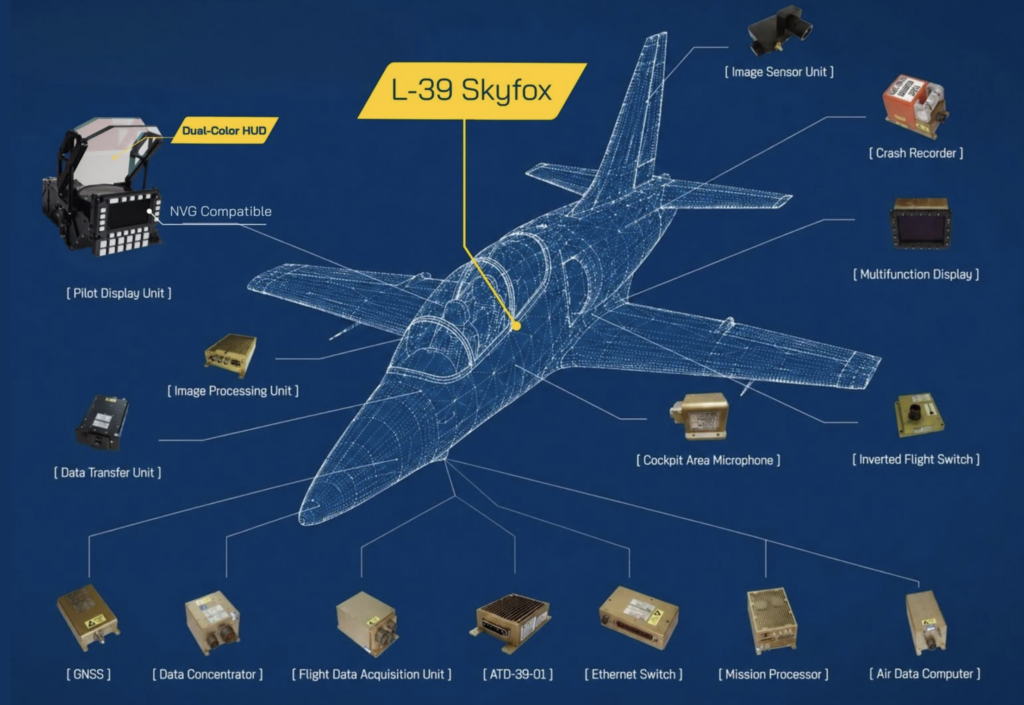
The company’s presence is one example of a broader point: many of the capabilities that determine whether an aircraft can be operated, evaluated, maintained and modernised are delivered by specialist suppliers rather than the aircraft manufacturer itself.
These companies may provide only a small physical component of the final platform, but their technology can influence flight safety, mission effectiveness, pilot awareness, post-flight analysis and the ability to keep older fleets operational.
Farnborough visitors should therefore look beyond the visible aircraft and ask how their systems work together.
Can information be collected and converted reliably? Is recorded data protected and easily evaluated? Can new equipment be integrated without creating excessive modification and certification risk? Is the architecture open enough to accommodate future upgrades?
This is especially important for operators that cannot replace complete fleets immediately.
For many armed forces, the most realistic path to increased capability will combine the acquisition of new platforms with carefully selected upgrades of aircraft already in service. Successful modernisation is not about adding as much new equipment as possible. It is about integrating the right systems while preserving reliability, safety and supportability.
4. Can smaller companies move from innovation to production?
The aerospace and defence sectors rarely suffer from a shortage of innovative ideas.
The harder problem is moving those ideas from demonstrations and pilot projects into certified, repeatable and commercially sustainable production.
Farnborough 2026 is placing greater emphasis on this challenge. Its new Defence SME Zone is intended for businesses with annual turnover below £10 million, providing access to prime contractors, investors, government delegations and the wider defence supply chain. The accompanying Enterprise Gateway will offer workshops covering procurement, regulation, exports and funding, as well as opportunities for SMEs to pitch directly to investors and larger companies.
Creating visibility is useful, but visibility alone does not solve the scaling problem.
Small companies must often navigate lengthy qualification processes, demanding cyber-security requirements, export controls, certification costs and procurement systems designed around much larger suppliers.
Prime contractors, meanwhile, need innovative suppliers but cannot accept uncontrolled technical, financial or delivery risk.
The key signal from Farnborough will therefore be whether the industry is developing practical mechanisms to bridge this gap.
Are prime contractors opening meaningful routes into their programmes? Are governments shortening procurement cycles without weakening standards? Can smaller companies access test facilities, certification expertise and growth finance? Are successful demonstrations leading to contracts?
The aerospace supply chain needs innovation, but it also needs suppliers capable of delivering the same approved product repeatedly, on schedule and in the required volume.
The companies that achieve both will have a disproportionate influence on the next generation of aviation and defence programmes.
5. Who will build, operate and maintain everything being announced?
Technology receives more attention than people, but workforce capacity may determine how much of the industry’s ambition can actually be realised.
Increasing aircraft production requires engineers, technicians, machinists, software specialists, quality personnel and supply-chain managers.
Introducing more complex operational systems also creates demand for trained pilots, mission crews, instructors, maintenance personnel, data analysts and certification specialists.
Farnborough has made the future workforce one of its principal themes. The official programme describes talent development as essential to the future of aerospace, defence and space, with particular attention to STEM engagement, upskilling for emerging technologies and pathways into aerospace careers. A dedicated session on 22 July will examine the aerospace skills gap and warn that sector growth will be constrained unless recruitment, training and capability-building accelerate.
This should not be treated as a secondary human-resources discussion.
The availability of skilled people directly affects production rates, maintenance capacity, certification timelines and operational readiness.
Artificial intelligence and automation may increase productivity, but they will not remove the need for experienced engineers and technicians. In many areas, they will create demand for new combinations of aerospace, software, data and operational expertise.
Companies at Farnborough will speak frequently about expanding production and introducing new technology. The important question is whether their workforce plans are as credible as their product plans.
Who will manufacture the aircraft? Who will certify its systems? Who will maintain it in ten or twenty years? Who will train the people responsible for operating it?
Without convincing answers, ambitious order books may simply become longer waiting lists.
Reading Farnborough differently
Farnborough will continue to be measured through contract values, aircraft orders and the visibility of major product launches. Those indicators remain important.
But they should be read alongside a second set of measures.
Which manufacturers demonstrate that they can convert backlogs into deliveries? Which industrial partnerships create lasting national capability? Which specialist suppliers are becoming essential to platform performance? Which smaller companies are finding credible routes into production programmes? And which organisations are investing seriously in the people required to sustain growth?
The most important announcement from Farnborough 2026 may not be the largest aircraft order.
It may be an agreement that makes a fleet more available, establishes a new maintenance capability, integrates a critical system, brings a specialised supplier into a global programme or creates the workforce needed to deliver what has already been sold.
Aircraft will remain at the centre of Farnborough.
But the real direction of aerospace and defence will be revealed by everything required to keep those aircraft operational.
About the Author