Embraer and Saab Sign Agreement for production of additional 20 Gripen in Brazil
A framework to expand Gripen production in Brazil became the headline announcement of Embraer’s appearance at the Farnborough International Airshow 2026. But the wider picture was even more significant: new commercial aircraft commitments, an expanded role for the C-390 Millennium, international industrial partnerships, major support agreements and further progress by Eve Air Mobility.
Embraer arrived at Farnborough International Airshow 2026 promising to demonstrate strong growth momentum. By the middle of the show, the Brazilian aerospace group had delivered a series of announcements spanning defence, commercial aviation, services, advanced manufacturing and electric air mobility.
The most strategically important development was an agreement with Saab establishing a framework for the potential production of 20 additional Gripen fighters in Brazil. However, the strength of Embraer’s Farnborough performance came from the breadth of its portfolio. The company was not relying on a single aircraft programme or market segment. Instead, it demonstrated an increasingly integrated global aerospace business capable of producing military and commercial aircraft, supporting fleets throughout their operational lives, building international industrial partnerships and investing in future forms of aviation.
Taken together, the announcements made at Farnborough presented Embraer not simply as a successful aircraft manufacturer, but as an aerospace group seeking a larger role in global production, defence integration, services and advanced mobility.
Gripen agreement strengthens Brazil’s role in global fighter production
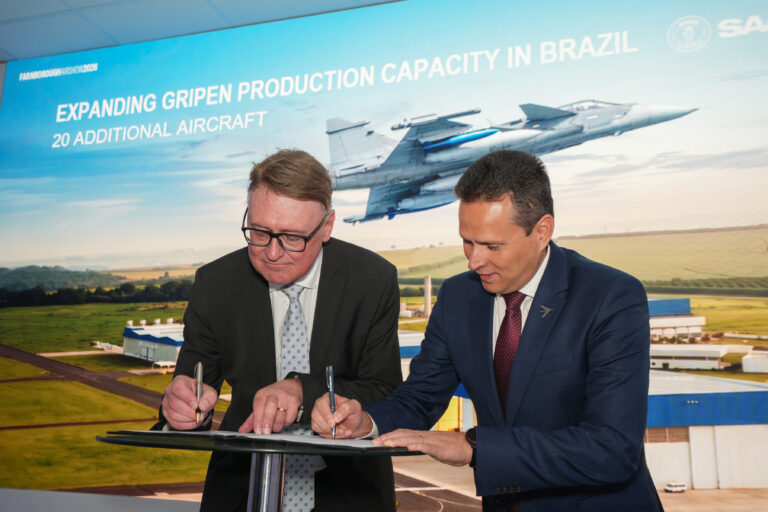
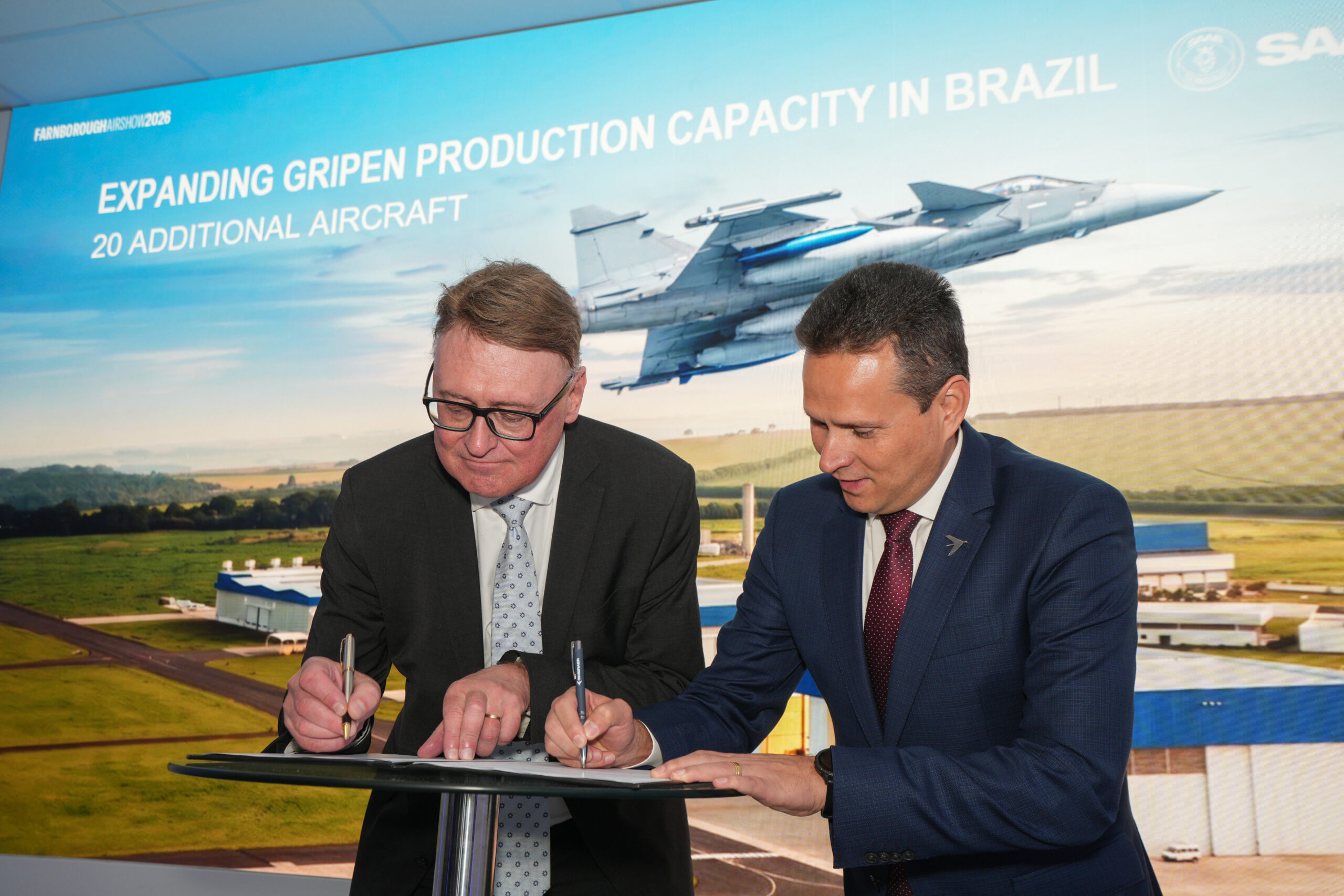
The headline development came on 21 July, when Embraer and Saab signed a Heads of Agreement providing a framework for the potential production of 20 additional Gripen aircraft at Embraer’s Gavião Peixoto industrial complex in São Paulo State.
The announcement does not yet represent a firm order for 20 fighters. Rather, it establishes the industrial and commercial framework under which the additional aircraft could be assembled in Brazil. Embraer and Saab intend to conclude the corresponding agreement during 2026.
Under the proposed arrangement, Embraer would assume responsibility for assembling the aircraft in Brazil. The Gavião Peixoto facility would complement Saab’s production line in Linköping, Sweden, creating additional capacity to respond to future global demand for the Gripen.
The Brazilian plant is already home to the only Gripen final assembly line outside Sweden. Expanding its production role would therefore strengthen Brazil’s position inside one of the world’s most important current fighter programmes while providing Saab with greater industrial flexibility.
For Embraer, the agreement is also evidence of how far its relationship with Saab has developed. What began as cooperation connected to Brazil’s acquisition of the Gripen has evolved into a decade-long industrial partnership involving manufacturing, engineering, testing and technology transfer. Embraer now has the potential to become an increasingly important part of the fighter’s international production system.
The timing is significant. In March 2026, Embraer, Saab and the Brazilian Air Force unveiled the first Gripen E produced in Brazil. The Farnborough agreement moves the programme’s industrial narrative forward: from establishing local production capacity to potentially using that capacity to help meet wider international demand.
The importance of the announcement therefore extends beyond the proposed 20 aircraft. It demonstrates that Embraer’s industrial infrastructure can be integrated into a global combat-aircraft production model, adding fighter manufacturing to a portfolio already covering military transport, light attack, commercial aviation and executive jets.
C-390 moves beyond tactical transport
The C-390 Millennium was another central element of Embraer’s Farnborough presence. Displayed at the show alongside the E195-E2, the aircraft was supported by announcements that expanded both its operational potential and the ecosystem surrounding it.
The most forward-looking development was a memorandum of understanding between Embraer and US defence technology company Anduril to explore the integration of the pallet-launched Barracuda-500M stand-off cruise missile with the C-390.
The proposed roll-on/roll-off system would allow the aircraft to launch multiple palletised munitions using conventional aerial-delivery procedures. Such a capability could allow the C-390 to generate stand-off kinetic or non-kinetic effects while retaining its core airlift functions.
This would represent a significant evolution of the platform. The C-390 is already designed for cargo and troop transport, aerial refuelling, humanitarian support, medical evacuation, firefighting and other military missions. The Anduril cooperation could extend the aircraft’s role into distributed strike and mass-effects operations without requiring permanent structural modification of the basic transport platform.
Embraer presented the initiative as part of the aircraft’s continued development into a multi-mission force multiplier, particularly for agile and dispersed operations involving US and allied forces.
While the memorandum does not yet amount to a completed integration programme, it shows Embraer seeking to position the C-390 within a broader transformation of military air power. Modern air forces increasingly require aircraft that can perform more than one narrowly defined task. By combining air mobility with modular mission systems, Embraer is attempting to increase the operational and strategic value of every C-390 platform.
Training infrastructure for Sweden and Austria
Embraer also announced an agreement to provide C-390 training devices to the Swedish and Austrian air forces.
Sweden will receive a comprehensive package consisting of a Full Flight Simulator, a Cargo Handling Station Trainer developed with Rheinmetall and a computer-based training solution developed with ETI. Austria will receive a computer-based training system supporting theoretical instruction and crew qualification.
The Full Flight Simulator is intended to achieve Level D qualification and will support training for normal, abnormal and emergency operations. According to Embraer, the system will incorporate more than 350 simulated malfunctions and will also support military mission training.
The Cargo Handling Station Trainer will provide realistic instruction for loadmasters and personnel involved in cargo operations, while the computer-based training package will cover pilots, loadmasters, other crew members and maintenance personnel through a SCORM-compatible learning-management environment.
The agreement demonstrates that the C-390 programme is entering a more mature phase in Europe. Selling an aircraft is only the beginning of a military programme. Long-term success depends on training, maintenance, logistics, interoperability and the ability to prepare crews without consuming excessive aircraft availability.
By building a common training ecosystem for European customers, Embraer can strengthen operational commonality between C-390 users while also expanding the recurring services and support component of the programme.
Czech C-390 takes centre stage
Farnborough also provided the setting for a highly symbolic milestone for the Czech Air Force.
On 20 July, the Czech Republic officially named its first C-390 Millennium Karel Toman-Mareš, honouring a distinguished Czechoslovak resistance leader and pioneer of the Czechoslovak Air Force in exile during the Second World War.
Karel Toman-Mareš was the first commanding officer of No. 311 Czechoslovak Bomber Squadron of the Royal Air Force, the first Czechoslovak bomber unit formed in the United Kingdom during the war.
The naming ceremony followed the delivery of the Czech Republic’s first C-390 on 16 July, only 20 months after the acquisition contract was signed. The aircraft’s appearance at Farnborough therefore connected Embraer’s international commercial campaign with a visible example of the programme’s progress in Central Europe.
For Embraer, the Czech aircraft represents more than another delivery. The Czech Republic is part of a growing European C-390 community that includes Portugal, Hungary, the Netherlands, Austria, Sweden and Lithuania. The expansion of this group is creating the foundation for greater interoperability, shared training and potentially deeper cooperation in maintenance and support.
A major day for commercial aviation
Although Gripen and the C-390 dominated the defence narrative, Embraer’s commercial aviation business generated the greatest volume of customer commitments.
Announcements made during Farnborough covered 30 firm passenger aircraft, consisting of E175, E190-E2 and E195-E2 models. In addition, Azorra committed to 20 firm passenger-to-freighter conversions. Across the passenger and freighter announcements, customers also secured a combined 40 options or purchase rights.
The largest individual commercial agreement came from Abra Group, the parent company of Avianca, GOL and Wamos Air. Abra agreed to acquire 20 E195-E2 aircraft, together with ten purchase options and 15 purchase rights. Subject to the relevant conditions, the agreement could therefore cover as many as 45 aircraft.
Abra plans to use the E195-E2 to improve the relationship between capacity and demand across its network, add frequencies and open markets where a larger narrowbody might offer more capacity than required. The agreement also gives the E195-E2 a potentially important role within one of Latin America’s most significant airline groups.
Binter placed an additional firm order for five E195-E2s and secured four purchase rights. This was the airline’s fourth E2 order and reflects the aircraft’s established role connecting the Canary Islands with destinations in mainland Spain, Europe and Africa. Binter operates its E195-E2s with 132 seats in a single-class configuration.
Luxair converted purchase rights for three E190-E2s into firm orders and added another purchase right. The Luxembourg carrier had previously ordered six E195-E2s, four of which were already in operation. The additional E190-E2s will give the airline two aircraft sizes while retaining a common pilot type rating, maintenance infrastructure and operating procedures. Luxair’s firm E2 order book consequently increased to nine aircraft.
In Japan, Fuji Dream Airlines placed a firm order for two E175s, with deliveries scheduled for 2027 and 2028. The aircraft will be configured with 84 seats. Fuji Dream Airlines already operates an all-Embraer fleet consisting of two E170s and 13 E175s, making the new order a further endorsement of the original-generation E-Jet family in the Japanese regional market.
The range of customers was as important as the total number of aircraft. The orders came from Latin America, Europe and Asia and covered both the original E175 and the new-generation E2 family. They also represented different airline strategies: regional connectivity in Japan, island and medium-haul services from the Canary Islands, fleet flexibility in Luxembourg and a broader network strategy across Latin America.
E-Freighter secures major conversion commitment
Azorra provided another significant commercial announcement by signing an agreement for 20 firm E-Jet passenger-to-freighter conversions and ten additional purchase rights.
The agreement followed the entry into service of the E190F in March 2026 and represents an important endorsement of Embraer’s strategy for the converted-freighter market.
The E190F was developed to occupy the space between large cargo turboprops and converted narrowbody jets. Embraer states that the aircraft provides more than 100 cubic metres of combined cargo volume and a payload of up to 13.5 tonnes.
According to the manufacturer, the E-Freighter can offer 30% lower operating costs than older conventional narrowbody freighters with comparable cargo volume and range. It also provides greater volume and substantially more range than large cargo turboprops.
The Azorra agreement is strategically valuable because it supports a second life for existing E-Jets. Rather than relying solely on the production of new passenger aircraft, Embraer can generate additional value through conversion engineering, programme support, maintenance and continued parts demand.
This creates a longer commercial lifecycle for the E-Jet platform while giving cargo operators access to an aircraft suited to decentralised express-freight networks and lower-volume routes.
Services become a larger part of the Embraer story
Embraer’s Farnborough announcements also showed the importance of services and support as a pillar of the company’s growth.
SkyWest Airlines extended its long-term heavy-maintenance agreement with Embraer for a fleet of 271 E175 aircraft in the United States. Work will be performed at Embraer facilities in Nashville, Tennessee; Macon, Georgia; and Fort Worth, Texas.
SkyWest is the world’s largest owner and operator of the E175, making the scale of the agreement particularly significant. The extension expands the existing programme and increases available maintenance capacity to support the airline’s long-term fleet requirements.
Aircraft maintenance agreements may attract less public attention than new orders, but they provide recurring business, strengthen customer relationships and help manufacturers retain a role throughout an aircraft’s operational life.
When considered together with the C-390 training announcement and the E-Freighter conversion programme, the SkyWest agreement illustrates Embraer’s effort to expand beyond aircraft deliveries into training, maintenance, modifications and long-term fleet availability.
Building industrial partnerships in the UAE
Industrial cooperation was another major theme.
Embraer and Mubadala Investment Company signed a Strategic Framework Agreement creating a pathway towards long-term cooperation in supply, maintenance, repair and overhaul, workforce development, and research and development.
The companies plan to examine training programmes, practical placements and knowledge transfer for Emirati aerospace professionals. They will also explore research into advanced aerostructures, composites, additive manufacturing and high-temperature alloys, potentially supported by a jointly located innovation hub.
The agreement also creates a pathway for companies within the UAE’s aerospace ecosystem to secure a larger role in Embraer programmes.
A related agreement between Embraer and Strata Manufacturing established a framework for assessing the supply of advanced composite aerostructures for Embraer commercial aircraft.
The initial work will evaluate potential packages for the E2 family through a structured series of technical, commercial and contractual stages. The two companies also intend to explore possible cooperation on other Embraer aircraft platforms.
These agreements align Embraer with the UAE’s ambition to expand its advanced manufacturing and aerospace capabilities. For Embraer, they could help diversify the supply chain, create additional production capacity and strengthen the company’s position in the Middle East.
Deeper cooperation with the United Kingdom
On 22 July, Embraer and the United Kingdom’s Department for Business and Trade signed a memorandum of understanding covering research and development, innovation, aviation capabilities and supply-chain development.
Embraer has operated in the UK market for more than 45 years and works with British suppliers whose technologies are incorporated into its products. The new framework is intended to create regular engagement between Embraer and UK stakeholders and identify additional opportunities in engineering, innovation and industrial cooperation.
The agreement builds on cooperation with UK Export Finance, which Embraer says helped increase the number of British companies in its supply chain and almost doubled the volume of business conducted with UK suppliers.
Signing the memorandum at Farnborough was particularly appropriate. It demonstrated how Embraer is using major international airshows not only to sell aircraft, but also to negotiate its position within national aerospace ecosystems and global supply chains.
Eve advances certification and market development
Eve Air Mobility added another dimension to Embraer’s Farnborough campaign. The company displayed a full-scale eVTOL mock-up and offered a simulated flight experience, but its most important announcements concerned certification, customer commitments and preparation for future operations.
Brazil’s National Civil Aviation Agency, ANAC, published proposed noise-certification criteria for the Eve 100. The consultation, open until 8 August 2026, is intended to help establish the environmental certification framework applicable to the aircraft.
ANAC also opened consultation on updated airworthiness criteria, while Eve applied to the European Union Aviation Safety Agency to begin the European validation process for the Eve 100 type certificate.
Together, these developments represent progress towards an internationally recognised certification basis involving authorities in Brazil, Europe and the United States.
Commercially, Eve signed a letter of intent with Shearwater Global Capital for up to 16 aircraft. The agreement is notable because it involves an aviation-finance and leasing business rather than only a prospective operator. Access to leasing and asset-finance structures will be important if eVTOL fleets are to move from demonstration projects into broader commercial service.
Eve also signed a letter of intent with Moov covering up to 30 eVTOLs for potential operations in Cabo Verde and Europe. The companies will evaluate tourism flights, airport, port and resort connections, inter-island mobility, medical transport and infrastructure inspection.
On 22 July, Eve announced a partnership with the Florida Department of Transportation involving the SunTrax Air testing environment. The initiative will examine infrastructure, operational procedures and airspace-navigation requirements needed for the safe integration of advanced air mobility into Florida’s transport network.
The combination of certification work, orders, leasing structures and infrastructure planning shows that Eve is attempting to develop an entire operational ecosystem rather than focusing exclusively on the aircraft.
Market outlook supports the E-Jet strategy
Immediately before Farnborough, Embraer published its 2026 Commercial Market Outlook, forecasting global demand for 8,500 new commercial jets with up to 150 seats through 2045. The projected aircraft have a combined value of approximately USD 650 billion.
North America is expected to represent the largest share, with 2,670 deliveries, followed by Europe and the Commonwealth of Independent States with 1,870 aircraft and China with 1,470.
Embraer expects passenger traffic to grow by an average of 3.7% annually during the period, with China, the Middle East, Africa and Latin America recording the highest regional growth rates.
The forecast provides the strategic context for the E-Jet announcements made during the show. Embraer’s argument is that airlines will increasingly need aircraft that can connect smaller markets, add frequencies and match capacity more precisely to demand.
The orders from Abra, Binter, Luxair and Fuji Dream Airlines each reflect this logic in different regions and operating environments.
More than an order campaign
Embraer’s performance at Farnborough 2026 cannot be measured only by counting aircraft orders.
The company secured 30 firm passenger-aircraft orders and 20 firm freighter-conversion positions, together with 40 additional options or purchase rights. It also announced a potentially important expansion of Gripen production, a new concept for deploying stand-off weapons from the C-390, training infrastructure for European air forces, long-term maintenance for 271 US-operated E-Jets and new industrial frameworks involving Brazil, Sweden, the United States, the UAE and the United Kingdom.
At the same time, Eve demonstrated progress in certification, financing, infrastructure and market development.
The common theme was scale. Embraer is expanding not only the number of aircraft it delivers, but also the number of roles it can perform within the global aerospace industry.
In the first half of 2026, the company delivered 109 aircraft, approximately 20% more than during the same period in 2025. It arrived at Farnborough supported by a record backlog and used the show to demonstrate how that momentum could extend across commercial aviation, defence, support services and future mobility.
The Gripen agreement provided the headline. The broader achievement was Embraer’s ability to present a coherent portfolio stretching from electric urban aircraft to regional airliners, tactical transports and advanced fighter production.
About the Author