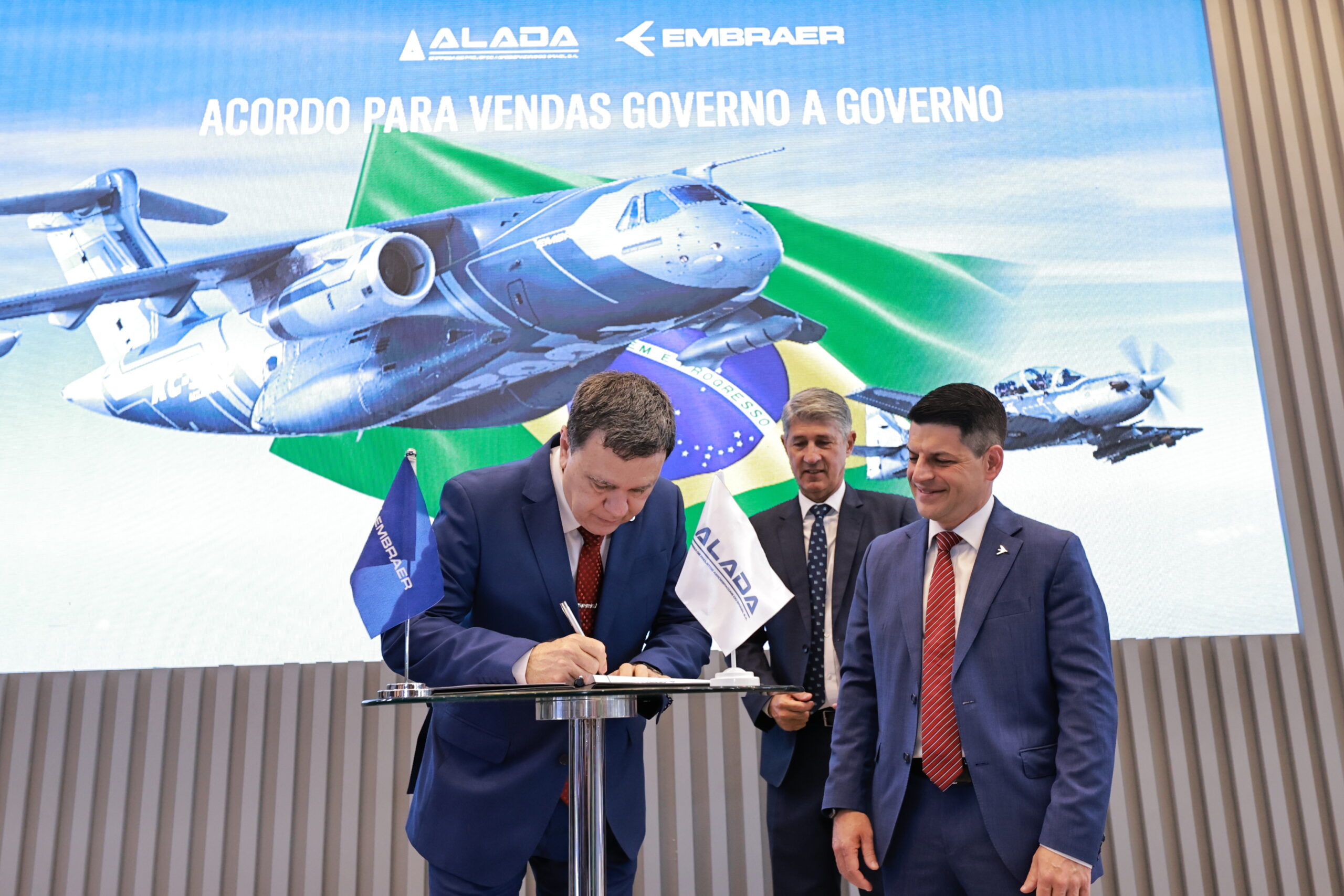
Embraer and ALADA Sign Agreement for Government-to-Government Sales of the KC-390 Millennium and A-29 Super Tucano.
A new government-to-government sales framework for the KC-390 Millennium and A-29 Super Tucano marks an important step in Brazil’s efforts to strengthen its position in the international defence market. Its significance lies less in the aircraft themselves than in the institutional architecture supporting their export.
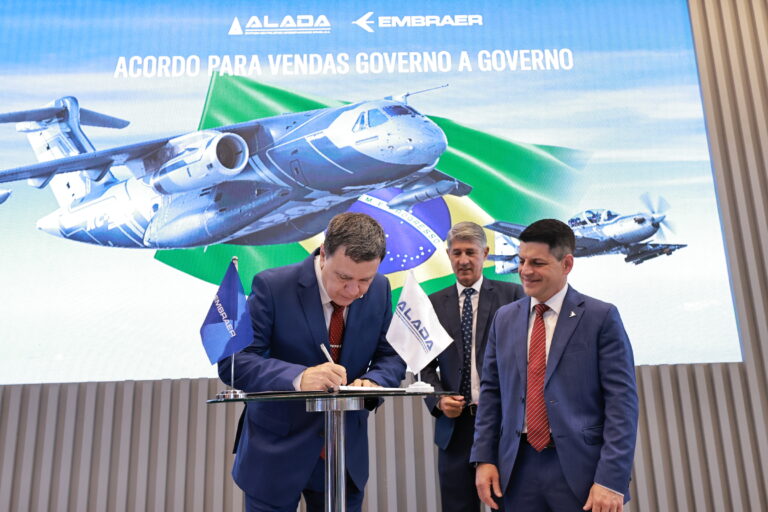
Embraer and Brazil’s federally owned aerospace company ALADA signed a framework agreement at Mostra BID in Brasília on 25 November, establishing a mechanism for developing future government-to-government (G2G) sales opportunities involving the KC-390 Millennium and A-29 Super Tucano, with an initial focus on Latin America and Africa.
The agreement follows a Memorandum of Understanding signed at FIDAE in Santiago, Chile, in April 2026. While it does not constitute an aircraft order or identify new customers, it represents a further step towards providing Embraer with an additional route to international markets where intergovernmental procurement is preferred or required.
For Brazil, the development has implications that extend beyond the commercial interests of its largest aerospace manufacturer. It reflects a broader effort to strengthen the institutional framework through which the country can compete internationally as a supplier of military capabilities.
Defence procurement is about more than the platform
Military aircraft acquisitions are rarely determined by technical performance alone. Operational requirements, acquisition costs and lifecycle expenditure remain central considerations, but the procurement mechanism itself can have a decisive influence on whether a transaction is politically, financially and legally feasible.
For many governments, particularly those acquiring complex military capabilities with service lives extending over several decades, the relationship with the supplying nation can be as important as the relationship with the original equipment manufacturer.
Government-to-government arrangements can provide a framework for coordinating procurement, training, technical assistance, logistics and long-term operational cooperation. Depending on their structure, they may also reduce certain contractual and administrative uncertainties associated with complex international acquisitions.
The United States has long institutionalised this approach through its Foreign Military Sales (FMS) system. Other major defence-exporting countries employ their own intergovernmental mechanisms, reflecting different legal, industrial and political environments.
Brazil’s emerging model should not be regarded as a direct equivalent of the US FMS system. Nevertheless, the agreement between Embraer and ALADA addresses a similar commercial challenge: ensuring that an aircraft manufacturer can participate effectively in procurement processes where a direct commercial contract may not be the preferred acquisition route.
ALADA and the institutional evolution of Brazilian defence exports
Established on 28 July 2025 following legislative authorisation earlier that year, ALADA — Empresa de Projetos Aeroespaciais do Brasil S.A. — is a wholly owned subsidiary of NAV Brasil, operating within the institutional structure of the Brazilian Ministry of Defence through the Air Force Command.
Although its original mandate encompasses aerospace infrastructure, space-related activities and the development and commercialisation of aerospace technologies, its involvement in defence exports has become increasingly explicit.
In 2026, the Brazilian Ministry of Defence formally included ALADA’s services related to the commercialisation, certification and management of defence systems exports within its classification of strategic defence products.
The partnership with Embraer therefore provides a practical aerospace industry application for this developing institutional capability.
Rather than replacing Embraer’s established commercial sales organisation, the framework potentially complements it by creating an additional interface between the manufacturer, Brazilian authorities and prospective government customers.
The distinction is important. ALADA does not manufacture the aircraft, and the agreement does not itself establish export financing, sovereign guarantees or specific contractual commitments. Its immediate purpose is to facilitate the development of opportunities that can subsequently be structured through intergovernmental arrangements.
Europe has already demonstrated the value of government-to-government procurement
For Embraer, the commercial relevance of such arrangements is not theoretical.
On 2 November 2026, Greece signed an intergovernmental agreement with Portugal for the acquisition of three KC-390 Millennium aircraft, with options for three additional units.
Portugal’s role is particularly significant. As an early participant in the aircraft’s development and production programme, an operator of the platform and an industrial partner, Portugal has acquired a position that extends beyond that of a conventional export customer.
The Portuguese government has also identified economic benefits and long-term operational cooperation associated with the Greek acquisition.
A different but complementary approach has emerged in northern and central Europe. In July 2024, the Netherlands signed a joint acquisition contract with Embraer covering nine C-390 aircraft for the Netherlands and Austria. Sweden subsequently joined the cooperation framework and placed an order for four aircraft in October 2025.
These arrangements illustrate how procurement cooperation can create opportunities for common training solutions, greater interoperability, coordinated support and potential economies of scale.
They also demonstrate that the expansion of an aircraft programme does not necessarily depend on the manufacturer negotiating entirely separate acquisition structures with every prospective operator.
Embraer’s European experience provides a relevant commercial precedent for the broader use of intergovernmental procurement. The ALADA agreement, however, represents a distinct Brazilian mechanism rather than a replication of the European arrangements.
Two aircraft, different operational requirements
The inclusion of both the KC-390 Millennium and the A-29 Super Tucano is commercially significant because the two platforms address substantially different capability requirements.
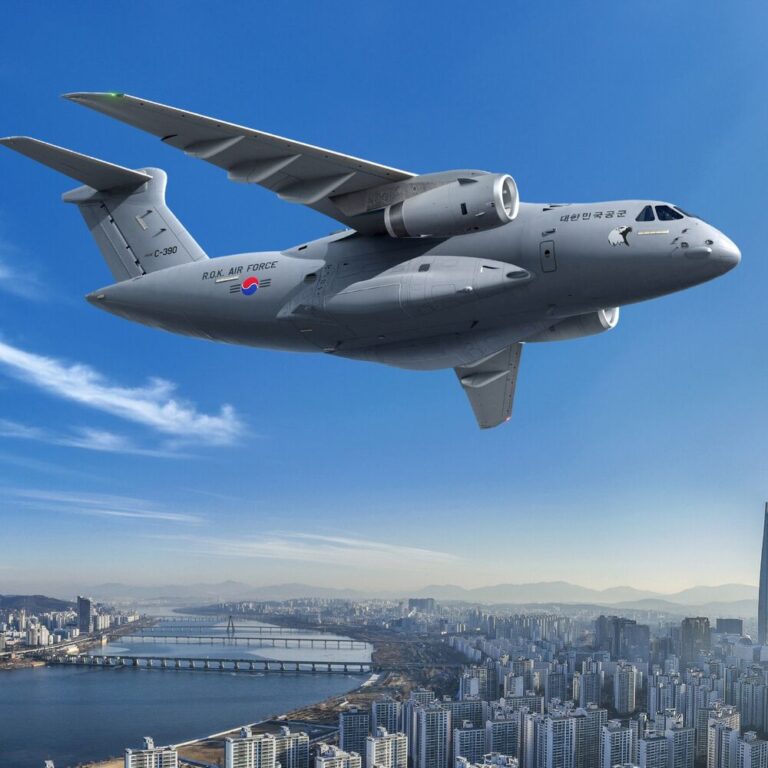
The KC-390 is positioned within the medium military airlift market, offering transport, aerial refuelling and a range of additional military and humanitarian mission capabilities. Its growing international operator community strengthens the potential for cooperation in training, logistics and fleet support.
The A-29 addresses a different segment, encompassing military pilot training, surveillance, armed reconnaissance and light attack missions. Its turboprop configuration and ability to operate in demanding environments make it relevant to air forces seeking to balance operational requirements with available infrastructure and long-term operating budgets.
Across Africa and Latin America, the two aircraft may consequently appeal to different categories of customers, depending on national priorities, existing fleets and financial resources.
Their inclusion under a common export framework allows Brazil to pursue opportunities across a wider range of military aviation requirements without implying that prospective customers would necessarily acquire both platforms.
The challenge will be converting market access into contracts
The strategic value of the ALADA agreement will ultimately depend on implementation.
A government-to-government framework can help address institutional and procurement barriers, but it cannot eliminate the underlying constraints facing military aircraft acquisitions. Budget availability, financing conditions, delivery schedules, export approvals, industrial participation requirements and the ability to sustain an aircraft throughout its operational life remain decisive factors.
This is particularly relevant in markets where the initial acquisition price represents only one component of the long-term financial commitment.
Embraer’s ability to offer credible training, maintenance, spare-parts provision and technical support will remain central to its competitiveness. Equally, the effectiveness of ALADA will depend on its ability to translate intergovernmental discussions into commercially and legally executable procurement arrangements.
The announcement does not disclose contract values, aircraft quantities, financing instruments or binding commitments from prospective customers. It would therefore be premature to interpret the framework as an increase in Embraer’s order backlog.
Its importance lies in expanding the range of circumstances under which future orders could materialise.
From aircraft manufacturer to global defence partner
Embraer’s international defence expansion increasingly illustrates a wider transformation in military aerospace competition.
Aircraft manufacturers are competing not only through platform performance, acquisition economics and industrial capabilities, but also through the strength of the international partnerships surrounding their products.
For Brazil, the emergence of ALADA as a participant in defence export transactions provides an opportunity to connect the country’s aerospace industrial capabilities more directly with its international defence relationships.
For Embraer, it adds another dimension to an export strategy that already benefits from industrial partnerships, multinational procurement arrangements and an expanding international user community.
The agreement signed in Brasília is not a sales breakthrough in the conventional sense. No additional aircraft have been ordered as a direct result of the announcement.
It is, however, a potentially important development in the institutional infrastructure behind future Brazilian defence exports.
In an increasingly competitive international aerospace market, the ability to deliver an aircraft is only part of the equation. The ability to establish a durable government, industrial and operational relationship around that aircraft may prove equally consequential.
About the Author