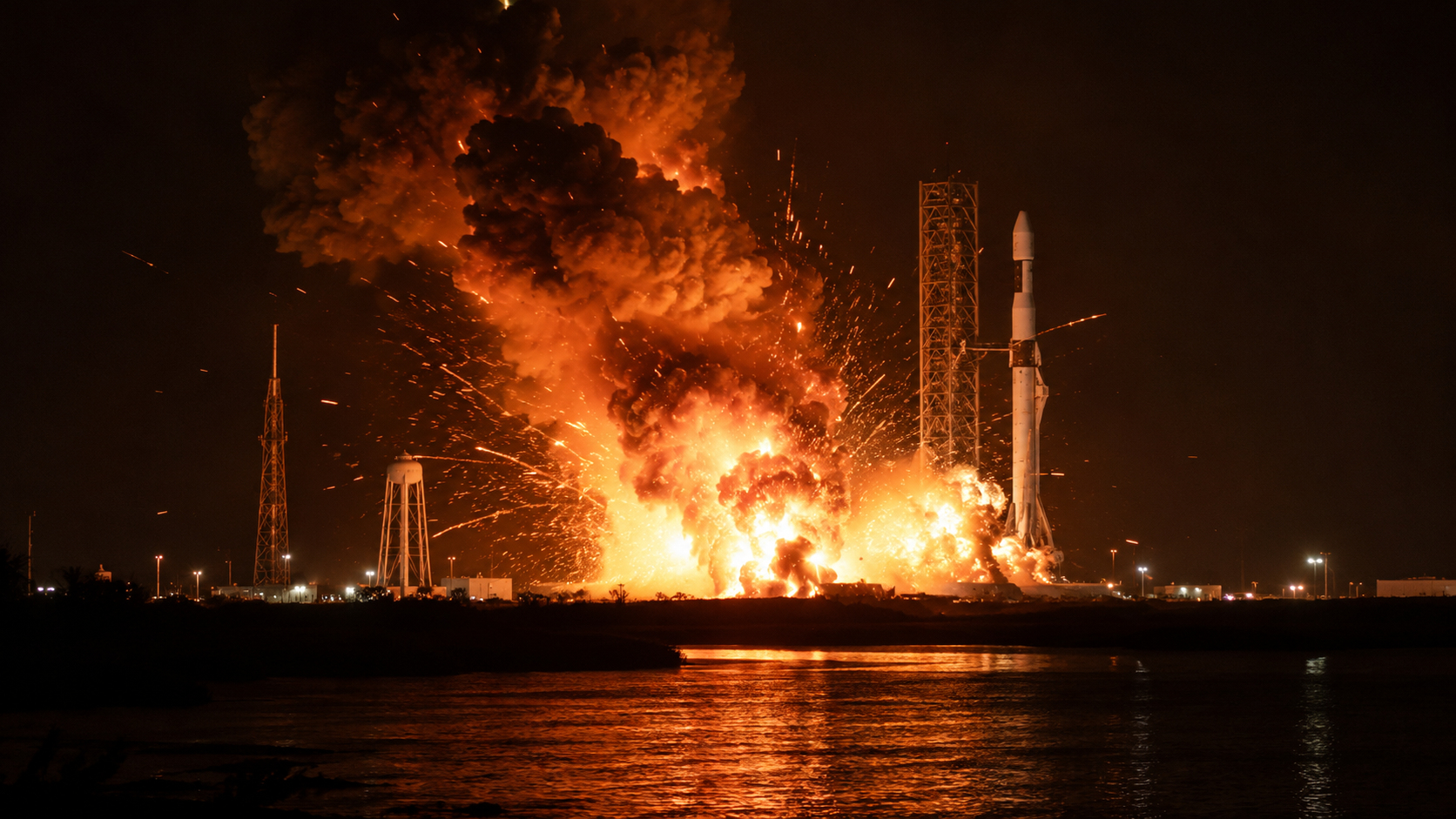
Blue Origin says it plans to return its New Glenn heavy-lift rocket to flight before the end of 2026, following a major explosion during a hot-fire test at Cape Canaveral that damaged the company’s only operational New Glenn launch pad.
The incident occurred during pre-launch testing of an uncrewed New Glenn rocket at Launch Complex 36 in Florida. The vehicle was being prepared for a mission to carry Amazon’s low-Earth-orbit broadband satellites, one of the most strategically important commercial payload lines in the current launch market.
No personnel were injured, and the satellites were not on board the rocket at the time of the explosion. However, the event represents a serious setback for Blue Origin at a critical moment in the development of New Glenn — a vehicle designed to compete in the heavy-lift launch segment, serve commercial satellite customers, support national security launch requirements and play a role in NASA’s lunar architecture.
According to Blue Origin CEO Dave Limp, the company still expects New Glenn to fly again before the end of the year. Limp said that key infrastructure, including the main fuel tanks and nearby boosters, remained intact. The main damage reportedly affected the launch pad’s support tower and related ground systems, which will now require repair before New Glenn operations can resume.
The significance of the accident goes well beyond one vehicle. New Glenn is central to Blue Origin’s attempt to move from suborbital operations into the core orbital launch market, where cadence, reliability and pad availability determine commercial credibility. Unlike SpaceX, which operates a high-frequency launch system with multiple pads and mature recovery infrastructure, Blue Origin is still building its operational rhythm.
That makes Launch Complex 36 a strategic bottleneck. If the pad is unavailable, New Glenn cannot fly from its current East Coast launch site. For customers waiting for capacity — including Amazon’s satellite internet programme — the schedule risk is immediate. For NASA and future national security customers, the event adds another layer of scrutiny to New Glenn’s path toward operational maturity.
The explosion also comes at a sensitive time for the wider launch market. Demand for heavy-lift and large-fairing capacity is rising rapidly, driven by megaconstellations, national security payloads, lunar missions and deep-space programmes. SpaceX remains the dominant force, while United Launch Alliance’s Vulcan, Blue Origin’s New Glenn and other systems are expected to provide additional capacity and competition.
For Amazon, the stakes are particularly high. Its broadband satellite constellation requires large-scale deployment, and launch access is a decisive factor in whether it can compete effectively with SpaceX’s Starlink. Amazon has contracted launches across multiple providers, but New Glenn is an important part of that architecture because of its size and potential payload capacity.
For NASA, the issue is broader. Blue Origin’s launch infrastructure is linked to future lunar logistics and the Blue Moon programme. Any sustained delay to New Glenn could create pressure across schedules connected to Artemis-related activities, even if the full impact is not yet known.
The coming months will therefore be decisive. Blue Origin must complete the technical investigation, repair damaged ground systems, satisfy regulatory and customer requirements, and demonstrate that New Glenn can return safely to launch operations. A return to flight by year-end would preserve momentum. A longer delay would strengthen concerns about launch cadence, infrastructure resilience and Blue Origin’s ability to scale quickly enough for the demands of the market.
Source: Blue Origin/image AI
About the Author