Author: Military History Institute Prague
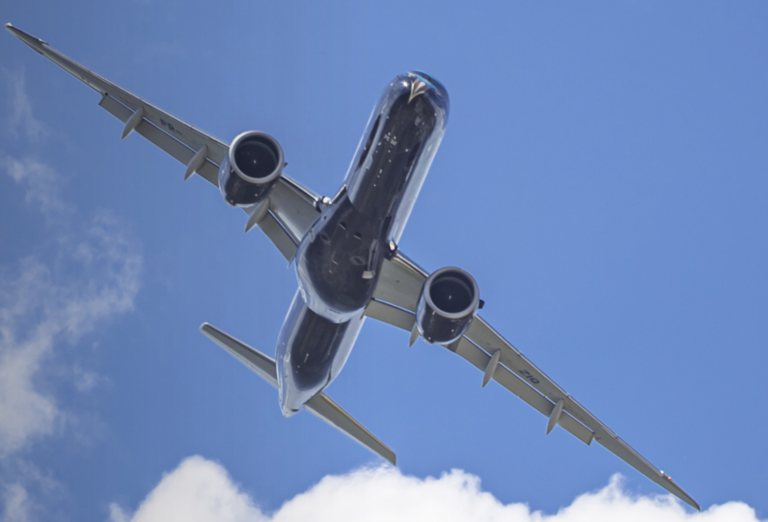
The first of two Embraer C-390 Millennium transport aircraft ordered by the Czech Armed Forces is expected to arrive in the Czech Republic soon. At first sight, it will stand out thanks to its unusual camouflage. This is not a matter of aesthetics, but of function: the aim is to break up the aircraft’s silhouette and make it more difficult for an observer to read.
The design was created by academic painter Pavel Holý from the Military History Institute Prague, who personally supervised its final application in Brazil at the manufacturer’s site.
The Military History Institute Prague has been involved in several camouflage projects for the Czech Armed Forces.
“The Military History Institute Prague has been working with the Czech Armed Forces on aircraft camouflage for many years. Pavel Holý has contributed, for example, to the appearance of the AH-1Z Viper and UH-1Y Venom helicopters, the government Airbus A319CJ, and the L-159 Alca in the Spitfire camouflage of General Peřina,” said Brigadier General Aleš Knížek, Director of the Military History Institute Prague.
For the new transport aircraft, Pavel Holý started from a simple question: how to make it harder for an observer to estimate the aircraft’s distance, size or direction of flight.
“Of course, the aircraft does not disappear. But camouflage can complicate the observer’s ability to judge how far away it is and where exactly it is heading,” he explains.
For that reason, Holý did not seek to decorate the aircraft, but to disrupt its silhouette. Dark and light surfaces do not connect in the way the eye would expect. Some parts visually recede, while others blend into the background.
In designing the camouflage, Holý applied the opposite principle to the one he uses in his hyperrealist paintings. On canvas, he tries to convince the viewer that they are seeing something that is not actually there. With camouflage, the goal is the reverse: to persuade the observer that there may be nothing in the sky, even though an aircraft is there.
The design process began in autumn 2023. It was not simply a matter of choosing colours. The camouflage had to work on a real three-dimensional aircraft, from different viewing angles and under varying light conditions. Each graphic element therefore went through a series of modifications and consultations.
For the final checks, Pavel Holý travelled to Brazil, to the location where the aircraft was being painted. He was accompanied by Major Aleš Štancl from the 24th Transport Air Base in Prague-Kbely. Together, they supervised the transfer of the design into production documentation and resolved minor adjustments that emerged when the graphics were applied to the aircraft’s three-dimensional model.
“At every stage of the transfer process, small errors can occur. On a monitor, you may not notice them, but on the actual aircraft you certainly will,” Holý says.
The inspection also included details of the aircraft’s markings. The fuselage will carry the name of Tábor native Brigadier General Karel Toman-Mareš, the first commander of No. 311 Czechoslovak Bomber Squadron RAF, after whom the first Czech C-390 Millennium will be named.
In the end, the greatest challenge was not the design itself, but its implementation.
“After applying the base colour, you have only a few hours to apply the top coat. If you fail to do so within that time, the base coat has to be washed off and the process starts again. The aircraft is therefore painted in sections, each sized according to what can realistically be completed within the prescribed time limit,” Holý explains.
Although most modern military transport aircraft fly in single-colour schemes, Holý is convinced that camouflage still has a place today. He points out that a number of armed forces expecting deployment in high-risk areas have never fully abandoned multi-colour paint schemes.
The first Czech Embraer C-390 Millennium will primarily be used for passenger and cargo transport, medical evacuation, airborne operations and firefighting. The Czech Armed Forces are expected to receive the second aircraft in 2027. Both aircraft will carry the same camouflage and will differ only in their identification numbers and names.
Source: MO ČR
About the Author