A new long-term agreement with SDTS, Babcock France and Top Aces France will bring A-4N Skyhawks, Alpha Jets and L-39s into adversary air training for the French Armed Forces, while allowing frontline combat aircraft to focus on the missions that matter most.
France is taking a major step towards outsourced adversary air training, awarding a framework agreement worth an estimated €450 million for a new Red Air capability supporting the French Air and Space Force, Navy and Army.
The contract was awarded by the French Ministry of the Armed Forces and Veterans through the Armed Forces Commissariat to a consortium led by SDTS, together with Babcock France and Top Aces France. It will run for an initial six years, with an option for a further two.
On paper, the deal is about providing aircraft that can play the adversary during military exercises. In reality, it represents something broader: a shift in how France intends to generate combat readiness while protecting increasingly valuable frontline fighter capacity.
Preserving frontline fighter hours
The rationale behind the programme is unusually clear.
The French Ministry of the Armed Forces says the requirement emerged against the background of a reduced fighter force and the ageing of parts of the aviation fleet. The objective is to concentrate the use of frontline combat aircraft on priority missions and operational training rather than consume their available flying hours by having them simulate enemy forces.
France already used contracted aircraft for certain support and target-type missions, but the ministry says previous arrangements were not sufficient for high-end combat air training against fighter aircraft.
The new programme is therefore described by the French authorities as an unprecedented strategic procurement — and a significant step towards a genuinely externalised Red Air capability.
That distinction matters. Contracted adversary air is no longer simply about putting another aircraft in the training area. Modern Red Air providers are expected to reproduce sensors, tactics, electronic effects and threat behaviour closely enough to challenge crews flying some of Europe’s most capable combat aircraft.
Skyhawks, Alpha Jets and L-39s
The consortium will use a deliberately mixed fleet.
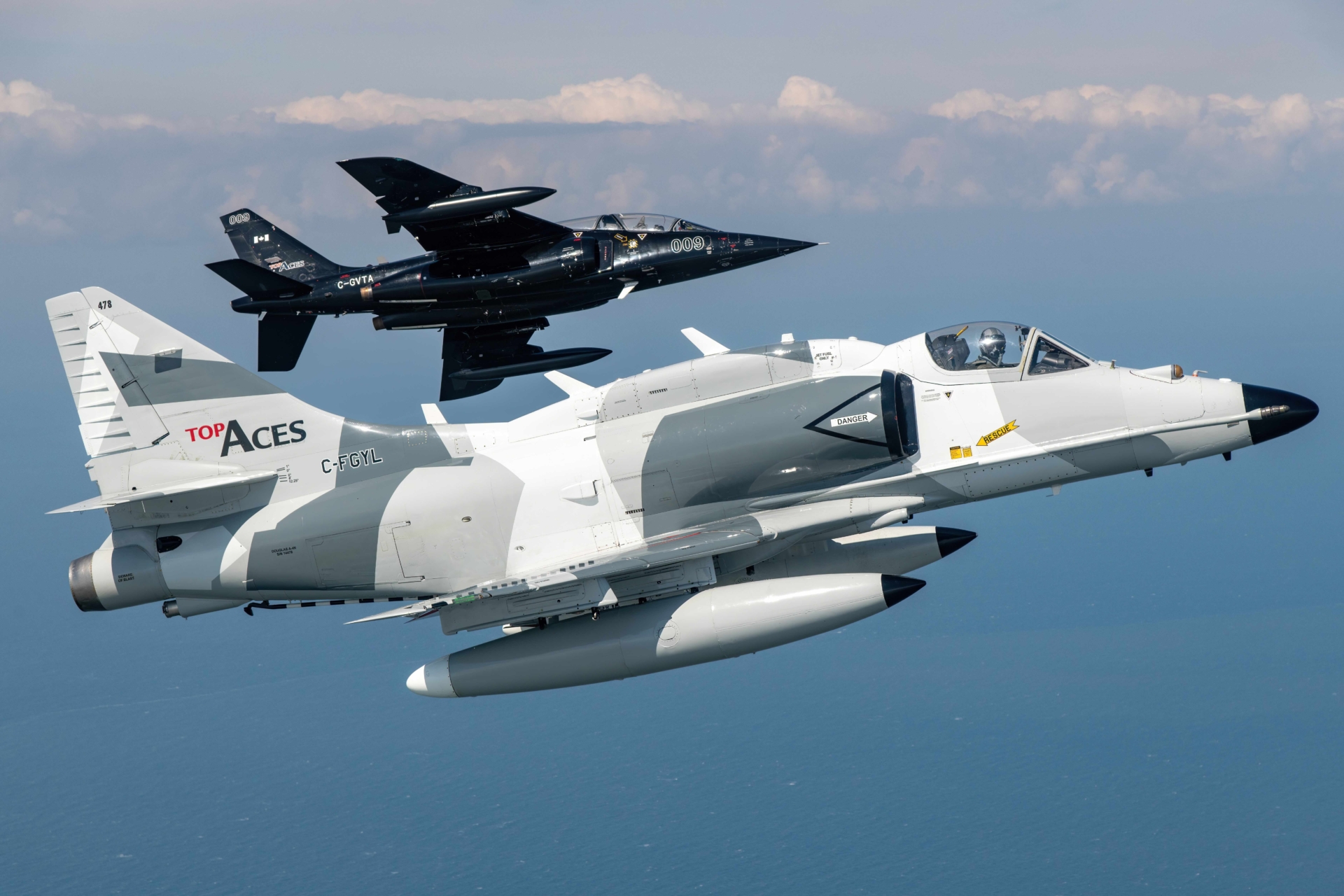
For the more demanding end of the threat spectrum, Top Aces France will provide upgraded A-4N Skyhawk Advanced Aggressor Fighters together with Alpha Jets.
The A-4Ns will be equipped with mission systems capable of replicating modern airborne threats. Top Aces’ wider A-4N capability is built around its Advanced Aggressor Mission System, an open-architecture solution designed to integrate technologies including AESA radar, IRST, electronic attack and beyond-visual-range threat simulation.
The A-4Ns and Alpha Jets are expected to operate primarily from Clermont-Ferrand Auvergne Airport, allowing them to deploy to training areas and military units across France.
Babcock France, meanwhile, will operate its upgraded L-39 Albatros fleet from Dijon-Bourgogne. These aircraft will cover lower-end threat profiles and missions including Joint Terminal Attack Controller and Forward Air Controller training.
According to Babcock France, the programme is expected to generate up to 400 training sorties and more than 1,000 flying hours annually, with the contracted aircraft operating alongside French Rafale and Mirage 2000 fighters.
This mix allows the customer to use different aircraft — and different cost and capability levels — depending on what a particular training scenario actually requires.
More than flying hours
The contract also goes considerably further than providing aircraft and pilots.
The consortium will support the complete training cycle, from mission preparation and briefing through mission execution to tactical data exploitation and post-mission debriefing.
Flight operations and maintenance will be conducted by French personnel from SDTS, Babcock France and Top Aces France. The French authorities have specifically highlighted sovereignty and the protection of sensitive information as key considerations in establishing the programme, with the provision structured around French contractors and subcontractors.
That combination — commercial capability operating within a nationally controlled framework — may prove particularly important as European armed forces increasingly look outside their own fleets for additional training capacity.
A growing European market
For Top Aces, France is also another major step in its European expansion.
Earlier in 2026, the company secured a renewed 10-year contract worth up to €420 million with the German Armed Forces, extending its adversary air support to the Bundeswehr through 2035.
Germany and France together therefore represent two major long-term European commitments for contracted adversary air within a single year.
The trend is not difficult to understand.
Modern frontline fighters are expensive assets. Their pilots, maintainers and available flying hours are equally valuable. Using those resources to provide routine opposition for other crews becomes increasingly difficult to justify when specialist operators can generate dedicated adversary capacity using aircraft equipped to reproduce relevant threats.
This was also one of the central themes when ACE spoke earlier this year with Thomas Beringer, Top Aces’ Vice President Europe and Managing Director in Germany. He described adversary air as a way to focus frontline crews and aircraft life more directly on core training missions while increasingly sophisticated commercial aggressor aircraft reproduce the opposing threat.
At the time, Beringer also pointed to exceptionally strong demand for adversary air services across Europe. The French decision now provides another significant indication of where that market is heading.
Readiness is the real story
The aircraft naturally attract attention. An A-4 Skyhawk equipped to represent contemporary threats is an unusual combination of Cold War airframe and modern mission technology.
But the significance of the French contract is not really about the Skyhawk, Alpha Jet or L-39.
It is about availability.
European air forces face increasing requirements for readiness, higher-end training and more complex threat replication while operating finite fleets of increasingly sophisticated combat aircraft. Every Rafale, Eurofighter or F-35 hour used to provide Red Air is an hour unavailable for another task.
France is now putting substantial resources behind a different model: use specialised commercial operators to generate the opposition, preserve frontline capacity and make the training environment more scalable.
With a potential eight-year duration, an estimated value of €450 million and more than 1,000 contracted flying hours per year, this is not a temporary capacity fix.
It is becoming part of the force-generation model.
Sources: ACE reporting based on information released by Top Aces on 9 November 2026, complemented by the French Ministry of the Armed Forces and Veterans / Commissariat des armées, SDTS and Babcock France.
About the Author