The evolving challenge of protecting military forces, critical infrastructure and civil airspace against unmanned threats
The rapid proliferation of unmanned aerial systems has become one of the defining changes in modern warfare. What was once a capability associated primarily with technologically advanced armed forces is now widely available to state and non-state actors alike. Commercial quadcopters, FPV drones, loitering munitions and increasingly autonomous systems have entered the battlefield at scale, reshaping the way military operations are planned, conducted and defended against.
The conflicts in Ukraine, the Middle East and Nagorno-Karabakh have demonstrated that unmanned systems are no longer used only for reconnaissance. They now support artillery targeting, electronic warfare, logistics and direct strike missions. Small commercial drones and FPV systems, in particular, have shown that low-cost assets can destroy armoured vehicles, disrupt infrastructure and impose significant operational pressure on much more expensive military systems.
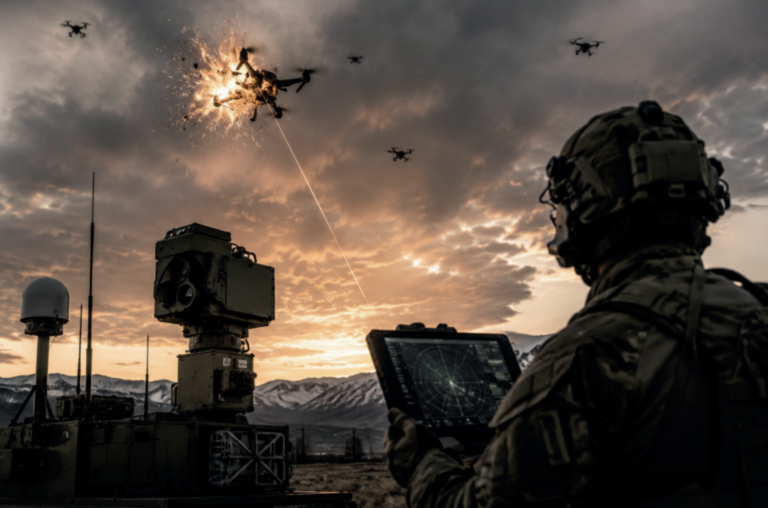
This development has led to the urgent need for effective Counter-UAV, or C-UAV, capabilities. These include the ability to detect, identify, track, classify and neutralise unmanned systems. C-UAV is becoming a core element in the protection of military bases, deployed forces, critical infrastructure and, increasingly, civilian airspace.
For the Czech Republic, this is no longer an abstract debate. The Ministry of Defence and the Czech Armed Forces are expected to present a concept for protection against UAV threats. Building a comprehensive and layered national capability, however, will be a major challenge – not only for military planners, but for the state as a whole.
Counter-UAV as a New Layer of Air Defence
Although Counter-UAV is often presented as a completely new area of warfare, its basic logic is not new. In essence, it represents the next evolutionary stage of air defence.
The fundamental principles remain the same. Any air defence system must be able to detect a threat, identify it, track it, decide on the appropriate response, engage the target and assess the effect. This decision cycle – often described as the kill chain – has been present in air defence from the Second World War through the Cold War to modern integrated air and missile defence.
What has changed is not the principle, but the scale and speed of the threat.
Traditional air defence systems were designed to deal with a limited number of high-value targets such as aircraft, helicopters, cruise missiles or ballistic missiles. Modern forces may now face dozens or even hundreds of low-cost UAVs of different types at the same time. These systems may fly at very low altitude, use terrain masking, operate in urban areas and appear in environments where legitimate civilian drone activity is also present.
This makes C-UAV not a separate niche, but a necessary part of Integrated Air and Missile Defence, or IAMD.
Modern air defence must now address a continuous spectrum of aerial threats: manned aircraft, helicopters, cruise missiles, ballistic missiles, loitering munitions, FPV drones and reconnaissance UAVs. From the defender’s perspective, these are different types of aerial threats requiring different sensors and effectors, but not a fundamentally different defensive logic.
The Sensor Problem
The greatest technical challenge in C-UAV is often not the final engagement of the target, but the first stage of the process: detection, identification and tracking.
Traditional radar systems were optimised for aircraft and helicopters with relatively large radar cross-sections. Small drones present a very different problem. They are small, slow, often fly low, and may be difficult to distinguish from clutter, birds or civilian activity.
Modern C-UAV systems therefore increasingly rely on a multisensor approach. This may include short-range radars, passive radio-frequency detection, electro-optical systems, infrared sensors, acoustic detectors and systems able to detect control or communication links.
The key trend is sensor fusion. Instead of relying on one sensor, data from multiple sources are combined into a single operational picture. This increases the probability of detection and, just as importantly, reduces false alarms – one of the major weaknesses of current C-UAV architectures.
For Europe, and especially for countries with dense civilian drone activity, the challenge is even more complex. Lessons from Ukraine are essential, but not fully transferable. In a high-intensity war, drones are often divided into friendly and hostile. In peacetime or crisis conditions in Central Europe, the system must distinguish between hobby users, commercial operators, public-service drones and genuine threats.
AI and the Acceleration of the Kill Chain
The most important contribution of artificial intelligence in C-UAV will not be the replacement of human operators. Its main value lies in accelerating the decision-making process.
In the past, an operator had to evaluate radar contacts, compare inputs from several sensors, classify the target, assess its level of threat and select the most suitable response. With the current volume and speed of UAV threats, this approach is becoming increasingly unsustainable.
AI-enabled systems can assist by identifying the type of UAV, predicting its trajectory, assessing the threat level, recommending the most appropriate effector and prioritising targets during mass or swarm attacks.
In practical terms, AI can compress the decision cycle from minutes to seconds, and in some cases to fractions of a second. Speed of decision-making is likely to become one of the decisive factors in future C-UAV effectiveness.
Soft-Kill and Hard-Kill Solutions
Current C-UAV systems are based on a layered combination of sensors, command-and-control systems and effectors.
Soft-kill systems are currently among the most widespread C-UAV tools. Their purpose is to disrupt the drone’s navigation, command link or communication. This can include GNSS jamming, jamming of control frequencies, spoofing, cyber takeover or other electronic warfare measures.
Their advantage is relatively low cost and repeatability. Their weakness is reduced effectiveness against autonomous drones, optically guided FPV systems or platforms resistant to jamming.
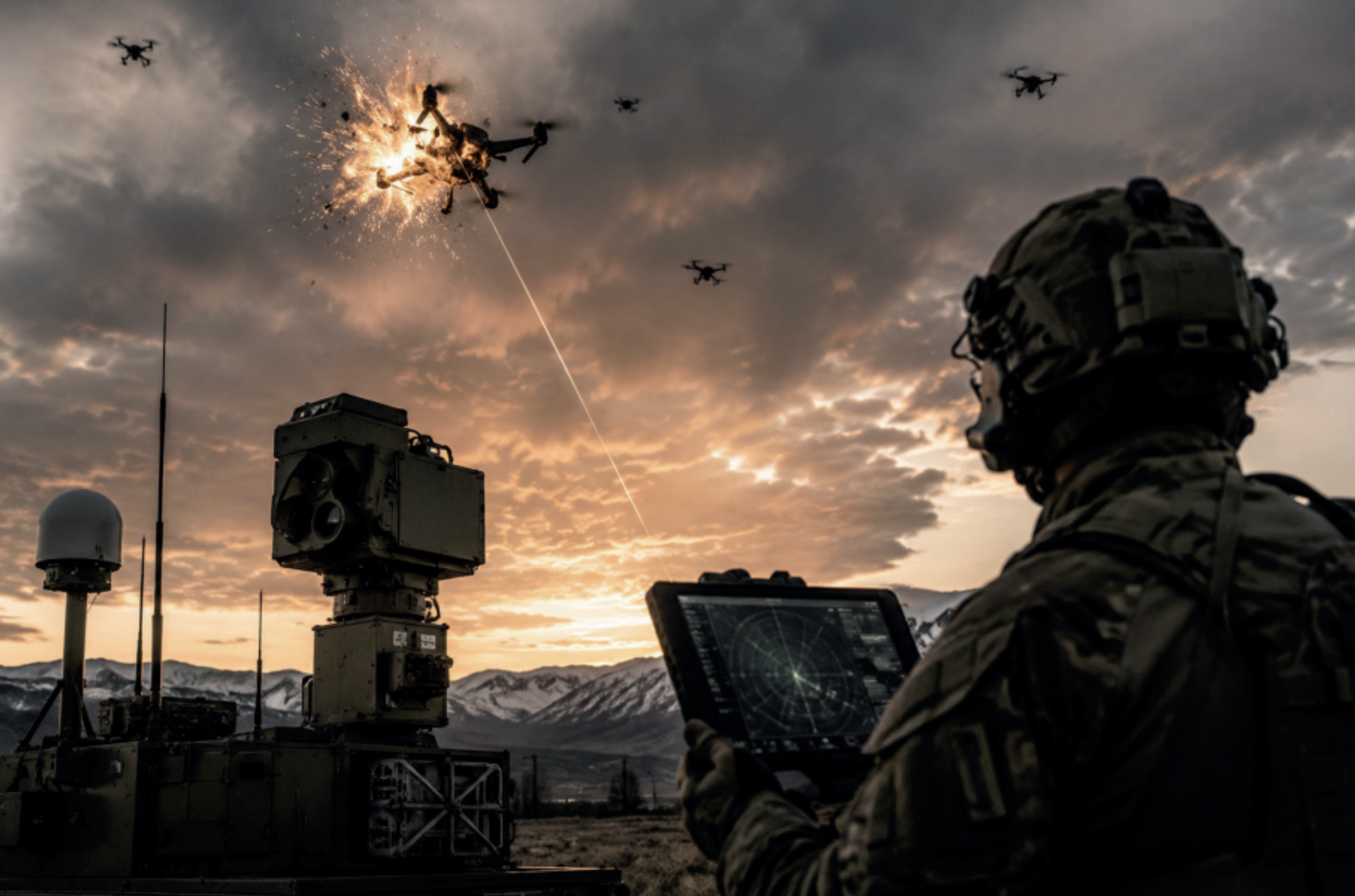
Hard-kill systems physically destroy or disable the UAV. They include anti-aircraft guns, programmable airburst ammunition such as AHEAD, short-range missiles, machine-gun systems, lasers, microwave systems and interceptor drones.
Directed-energy weapons are gaining particular attention because they promise low-cost engagements with limited logistical burden. However, no single category of C-UAV system is sufficient on its own. The highest effectiveness is achieved by combining soft-kill and hard-kill tools within a layered architecture.
A credible modern concept should therefore include early detection, electronic attack where appropriate, physical destruction when necessary, and decentralised data-sharing between units and command levels.
The problem is obvious: such a system is expensive.
Organisational Transformation
The rise of UAV threats is not only a technological problem. It also forces armed forces and states to rethink organisation, command and responsibility.
Historically, air defence was often divided into two relatively separate areas. The first was national air defence, protecting national airspace, strategic assets and critical infrastructure. This was usually part of the air force and focused on aircraft, cruise missiles and later ballistic missiles.
The second was ground-based air defence, or GBAD, protecting manoeuvre forces in the operational area. These assets were typically integrated into land-force structures and designed to defend brigades, divisions or deployed units against tactical aerial threats.
This division worked in an environment where aerial threats were relatively clearly separated by altitude, speed and operational role. UAVs have blurred that boundary.
The same category of threat can now endanger strategic infrastructure deep in the rear area and individual vehicles on the front line. This creates a new operational space between traditional national air defence and tactical GBAD. It is in this space that the most important organisational transformation is taking place.
Who Owns the C-UAV Mission?
One of the central questions today is who should be responsible for C-UAV.
There are three basic models.
The centralised model places C-UAV capabilities under air defence or air force command. The advantage is unified command, standardisation and effective use of sensor networks. The disadvantage is potentially slower response to the immediate needs of front-line units.
The decentralised model makes C-UAV organic to land units. Brigades, battalions or even companies have their own sensors, electronic warfare tools and effectors. This provides flexibility and rapid response, but also creates risks of fragmentation, duplication and poor coordination.
The hybrid model is increasingly likely. Strategic sensors and the common air picture remain centralised, while immediate protective means are distributed to deployed units and key facilities. This model best reflects the character of the current battlefield.
C-UAV is therefore moving from a support function to a combat function. Without the ability to counter reconnaissance and strike drones, it becomes increasingly difficult to move troops, concentrate forces, conduct logistics or launch offensive operations. Unit survivability is now directly linked to protection against UAVs.
The Human Factor
Discussions about C-UAV often focus on sensors, effectors, artificial intelligence and new technologies. But the limiting factor may not be technology. It may be personnel.
Every sensor, electronic warfare system and air defence effector requires operators, maintainers, planners, data analysts and commanders able to make decisions under pressure. As systems become more complex, training requirements will grow.
C-UAV creates a new category of specialist combining knowledge of air defence, radar systems, electronic warfare, cyber operations, unmanned systems, data analysis and artificial intelligence.
The future C-UAV operator will not simply operate a single system. He or she will need to understand the entire aerial threat environment and work within a networked command-and-control architecture.
This raises another question: should these capabilities remain exclusively within the armed forces, or should a wider national ecosystem of specialists be created?
Beyond the Military Sector
Small UAVs are not only a military problem. They are a threat to airports, energy infrastructure, major public events, critical state facilities, transport nodes and emergency response operations.
Many UAV incidents occur outside wartime and outside military areas. That means the future C-UAV system cannot be built only around the Czech Armed Forces.
A broader model will likely be needed, involving the Police of the Czech Republic, the Fire Rescue Service, airport authorities, critical infrastructure operators, crisis management bodies and potentially specialised state agencies.
In this respect, C-UAV may follow a development similar to cyber security. What began as a specialist military or technical domain gradually became a responsibility of the wider public administration and national resilience system.
The most difficult question will not be who destroys the drone. It will be who organises, commands, coordinates and finances the entire system.
The Czech Challenge
For the Czech Republic, geography and infrastructure create specific difficulties.
The country’s terrain includes mountains, forests, valleys and dense urban areas. These create radar shadows and complicate the detection of low-flying targets. Even during the Cold War, when Czechoslovakia had a much denser radar network than today, complete low-altitude coverage was not achievable.
The Czech Armed Forces are modernising their radar capabilities, including the introduction of eight 3D MADR radars, integrated into NATO air and missile defence structures. These systems will significantly improve the national air picture, but their primary task is not the detection of small drones flying at extremely low altitude.
A specialised sensor layer will therefore be necessary.
In the C-UAV field, the largest investment may not be in effectors, but in sensors and data infrastructure. Protection of military bases, airports, ammunition depots, power plants, communication nodes, logistics centres and troop assembly areas will require a network of short-range radars, passive sensors, electro-optical systems, acoustic detectors, RF detection and data-fusion tools.
At the same time, the system must be able to distinguish between real threats and legitimate civilian drone activity, which is expected to grow in logistics, industry, emergency response and public administration.
Integration, Not Isolation
The success of Czech C-UAV capability will not depend only on buying new sensors or effectors. The decisive issue will be integration.
C-UAV must not become a separate and isolated subsystem. It must be built into the broader IAMD architecture, linking sensors, command-and-control systems, electronic warfare and effectors across different levels of command.
Only such integration can prevent duplication, avoid conflicting operational pictures and make efficient use of limited resources.
The financial implications will be significant. C-UAV is not a one-off acquisition. It will require long-term funding for sensor networks, data systems, software upgrades, personnel training, AI integration and continuous technological renewal.
Unlike some traditional air defence systems, C-UAV will not be a capability purchased once and used unchanged for decades. It will require permanent adaptation.
From “See and Destroy” to “See, Understand and Decide”
Building C-UAV capability cannot be reduced to the procurement of new technology. It also requires trained personnel, clearly defined institutional responsibilities, effective command-and-control arrangements and a sustainable funding model.
The key challenge will not only be detecting a drone. It will be understanding what the drone is, who controls it, what its purpose is and whether it represents a real threat.
The future of C-UAV will therefore not be based simply on the principle of “see and destroy”. It will increasingly depend on the ability to “see, understand and decide”.
In an environment where thousands of legitimate users may share low-level airspace with hostile systems, this ability to distinguish, prioritise and act correctly may become one of the decisive factors in protecting the state.
Counter-UAV is no longer only a military issue. It is becoming part of a broader system of national security and resilience. If the Czech Republic’s emerging concept can clearly define required capabilities, institutional responsibilities and funding mechanisms, it may become one of the key documents shaping national security for the coming decades.
Author: COL (Ret.) Petr Tichy
About the Author