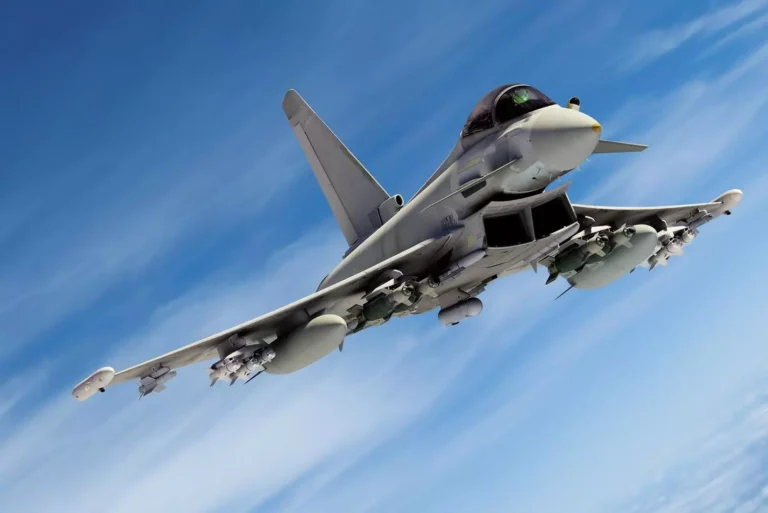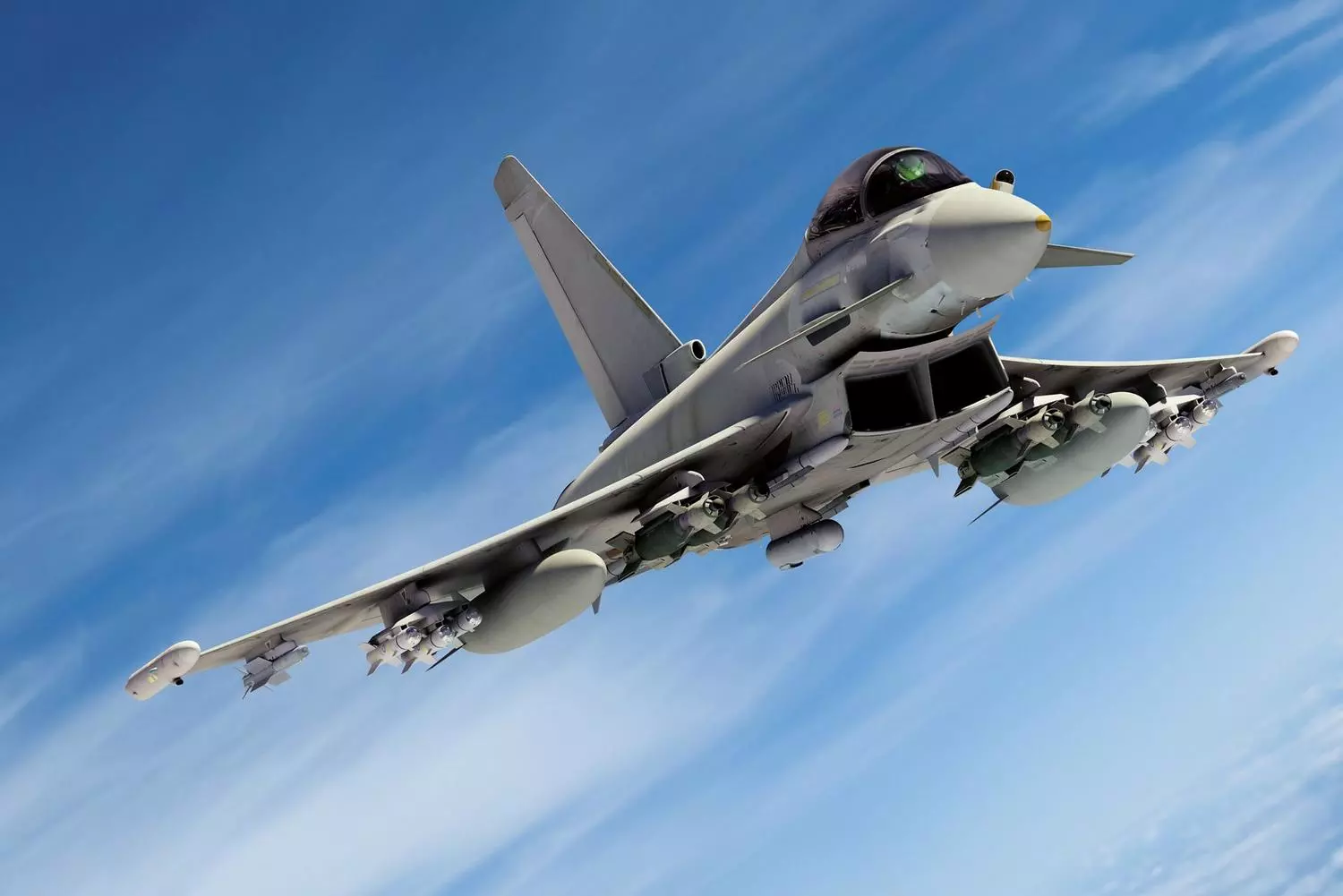
Eurofighter Typhoon Copy: Airbus
Airbus employees in Manching are calling on Berlin to launch the development of a new German combat aircraft rather than join the British-Italian-Japanese Global Combat Air Programme. Behind their demand lies a much broader strategic question: how much control over the design, development and evolution of future combat aircraft is Germany prepared to relinquish in exchange for international cooperation?
On 23 November 2026, the works council at Airbus Defence and Space in Manching called on the German government to authorise the development of a next-generation German combat aircraft without further delay. The employee representatives also rejected the prospect of Germany joining the Global Combat Air Programme (GCAP), currently being developed by the United Kingdom, Italy and Japan.
The demand, reported by German defence publication Hartpunkt and Aviation Week, comes as Berlin continues to examine its options following the abandonment of the common fighter aircraft at the centre of the original Franco-German-Spanish Future Combat Air System (FCAS).
Although the position of the works council does not constitute an official policy decision by either Airbus management or the German government, it reflects a fundamental concern within Germany’s aerospace industry: whether the country will retain sufficient technological and industrial influence over the next generation of combat aviation.
FCAS is not entirely dead
The distinction between FCAS as an overarching combat architecture and its original New Generation Fighter (NGF) is essential to understanding Germany’s current position.
Speaking at the opening of the ILA Berlin Air Show on 10 June 2026, German Chancellor Friedrich Merz confirmed that Germany and France would continue their cooperation on the broader system-of-systems architecture despite the failure to agree on the development of a common fighter aircraft.
The original FCAS vision extended far beyond a single platform. It envisaged a network of crewed and uncrewed aircraft, sensors, communications infrastructure and command-and-control capabilities operating within a common digital environment.
The political decision to abandon the jointly developed fighter therefore does not necessarily invalidate the technological rationale behind FCAS. Instead, it opens the possibility that different national or multinational combat aircraft could eventually operate within a shared European architecture.
Whether that ambition can be translated into a genuinely interoperable operational capability remains to be demonstrated. Nevertheless, it suggests that European cooperation in combat aviation need not depend exclusively on the development of an identical airframe.
The limits of industrial sovereignty
Germany possesses substantial expertise in military aircraft engineering, propulsion, sensors, avionics, electronic warfare, flight testing and systems integration. Through the Tornado and Eurofighter programmes, German industry has accumulated decades of experience in the development and sustainment of complex multinational combat aircraft.
Airbus has also confirmed the formation of Team Gen 6, bringing together Airbus Defence and Space, AUTOFLUG, Diehl Defence, HENSOLDT, Liebherr, MBDA Germany, MTU Aero Engines and Rohde & Schwarz.
The initiative illustrates the breadth of Germany’s defence aerospace ecosystem. However, the existence of these industrial capabilities should not be confused with the establishment of a fully funded national fighter development programme.
Developing a next-generation combat aircraft requires sustained investment across multiple technological disciplines, extensive testing infrastructure, long-term procurement commitments and a supply chain capable of supporting the platform for decades.
The economic challenge is equally significant. A programme financed primarily by Germany would have to distribute its non-recurring development costs across a potentially smaller production fleet than a comparable multinational programme. Export orders could improve the business case, but they cannot be guaranteed at the outset.
The strongest argument for retaining significant national involvement is therefore not necessarily the creation of an exclusively German aircraft. It is the preservation of the engineering authority and intellectual property required to influence future upgrades, integrate new technologies and respond to evolving operational requirements.
There is an important difference between manufacturing an aircraft and possessing the knowledge, rights and infrastructure required to develop its successor.
GCAP: Joining a programme already in motion
Germany’s potential participation in GCAP presents an alternative industrial and strategic proposition.
On 28 October 2026, during a visit to Japan, Chancellor Merz confirmed that Germany was examining whether it could participate in the programme. On 2 November, German Defence Minister Boris Pistorius indicated that discussions with the existing partner nations would be necessary to clarify the conditions of possible German involvement.
Unlike a new development initiative, GCAP already has an established international governance structure, a dedicated industrial joint venture and a declared target of introducing its aircraft into service in 2035.
On 3 July 2026, the British Ministry of Defence announced a £4.6 billion contract, jointly funded by the three participating nations and awarded to the industrial joint venture Edgewing, to advance the aircraft’s development.
Germany could potentially benefit from joining a programme in which substantial political, organisational and financial commitments have already been made. Shared development costs and access to a larger prospective production base could offer significant advantages.
However, these same characteristics also create obstacles. The existing participants have already negotiated their industrial relationships and programme governance. Introducing another major partner could require adjustments to responsibilities, intellectual property arrangements and decision-making structures.
Germany would consequently have to assess whether the industrial and technological influence available to a new participant would justify the scale of its financial commitment.
For Britain, Italy and Japan, the corresponding question is whether German participation would strengthen the programme without introducing unacceptable complexity or delays.
The experience of FCAS demonstrates that these issues cannot safely be postponed until after a political agreement has been reached.
Could Sweden and Spain offer another route?
An alternative involving Germany, Sweden and Spain has also emerged in the public debate.
In October, POLITICO reported on internal German defence ministry assessments that favoured exploring such a partnership rather than joining GCAP. The reporting concerned an internal assessment, not an approved multinational development programme.
Sweden nevertheless represents a particularly interesting potential partner. Its aerospace industry has maintained extensive combat aircraft design and integration capabilities through successive generations of Saab fighters.
In September 2026, Saab announced a further contract from the Swedish Defence Materiel Administration for continued conceptual work on future fighter systems. Spain, meanwhile, already possesses significant industrial experience through Eurofighter and its participation in FCAS.
A new partnership could theoretically provide Germany with greater influence over the initial definition of the aircraft and its industrial structure. The trade-off would be the need to establish a new governance framework, reconcile national requirements and fund development from an earlier stage.
The lesson from FCAS is that a consortium’s prospects depend less on the number of participating nations than on their ability to agree on technical leadership, contractual responsibilities, intellectual property and operational objectives.
The changing economics of combat aviation
Perhaps the most important question is whether Germany should continue to approach future air power primarily through the development of a single flagship fighter aircraft.
The Luftwaffe is already undergoing a substantial transformation. Germany ordered an additional 20 Eurofighters in October 2025, while its acquisition of 35 F-35As is intended to replace important capabilities currently provided by the Tornado fleet.
These investments provide the basis for a phased transition towards future combat aviation capabilities. They do not eliminate the need to make decisions about the next generation of aircraft, but they allow Germany to consider that future within a broader force structure.
The emergence of uncrewed combat aircraft, increasingly sophisticated mission systems and collaborative combat technologies also changes the industrial equation.
In future, a country’s influence over combat aviation may depend as much on its ability to develop and integrate software, sensors and autonomous systems as on its ability to manufacture a crewed fighter.
This does not mean that crewed aircraft are becoming redundant. Nor does it mean that uncrewed platforms can automatically replace their full range of operational capabilities. Rather, it suggests that investment decisions should be evaluated across the entire combat aviation architecture.
Germany could retain considerable technological influence through critical subsystems and collaborative combat technologies, even within a multinational aircraft programme. Conversely, nationally controlled aircraft development would not guarantee complete sovereignty if essential technologies remained dependent on external suppliers.
A decision that will shape the next several decades
Germany’s choice is ultimately about more than selecting a successor to the Eurofighter.
A nationally led programme could maximise German influence over development priorities, but would expose the country to considerable financial and technological risk. Joining GCAP could offer access to an established programme and a broader production base, although potentially with less influence over its original architecture. A new European partnership could provide another balance between industrial participation and shared investment, but would introduce its own development and governance challenges.
None of these options offers complete strategic autonomy, minimal development costs and rapid operational availability simultaneously.
The immediate priority for Berlin should therefore be to define which capabilities Germany considers essential to retain under national control, which can be shared with trusted international partners and which investments would deliver the greatest long-term operational value for the Luftwaffe.
The political ambition of European defence cooperation will only be sustainable if it is supported by realistic industrial arrangements and credible military requirements.
Germany does not necessarily need to build its next fighter alone. But it does need to decide what role it intends to play in shaping the future of combat aviation — and what capabilities it cannot afford to lose.
About the Author