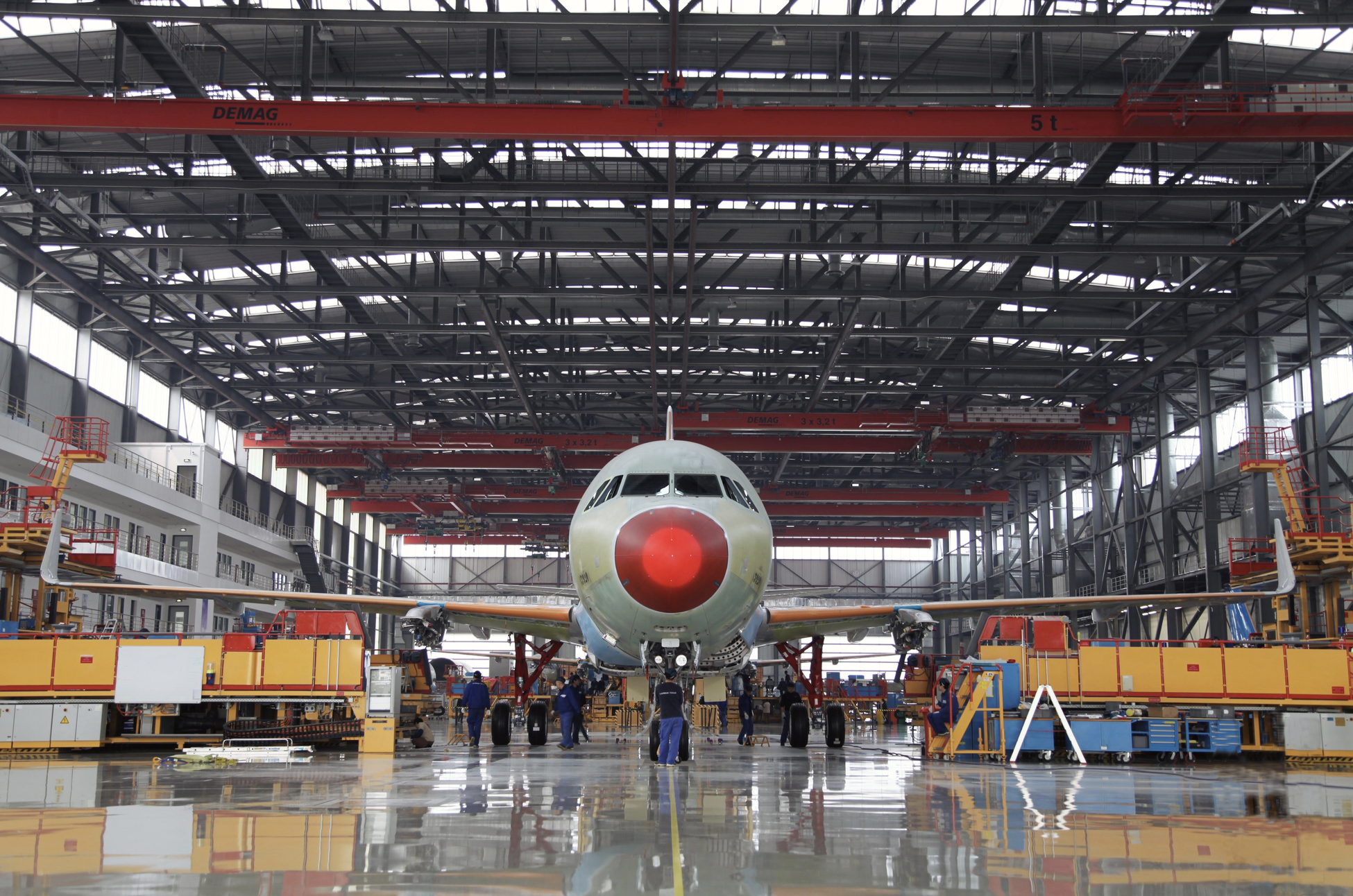
Airbus A320 Family final assembly line in Tianjin, China. The European manufacturer's industrial presence in China is facing renewed scrutiny following a US congressional investigation into Western aerospace technology transfers. Photo: Airbus.
An investigation by a US congressional committee calls for tighter controls on Western aerospace cooperation with China. Airbus is among the companies facing scrutiny, but the findings also raise a more fundamental question: how should governments address security risks arising from industrial relationships developed under their own regulatory frameworks?
A new investigation released by the US House Select Committee on China on 19 November 2026 has intensified scrutiny of Western aerospace companies operating in China. The committee argues that commercial cooperation, technology transfers and industrial partnerships have contributed to the development of capabilities that could support China’s military aviation sector.
The recommendations go beyond traditional export controls. They include restrictions on investment in China’s aerospace industry, greater scrutiny of French acquisitions of American aerospace companies, potential consequences for government contractors and a proposal that the Federal Aviation Administration should not certify aircraft manufactured in China.
Airbus features in the broader investigation, according to exclusive reporting by Reuters. However, the committee’s public statement does not identify the European manufacturer among the three companies specifically named in its findings on licensed technology transfers: Honeywell Aerospace, GE Aerospace and Collins Aerospace.
That distinction is important. The investigation examines a broad industrial and regulatory problem, while questions concerning Airbus also arise from earlier congressional correspondence and specific business relationships in China.
Airbus and the Chinese aerospace supply chain
Airbus has operated an A320 Family final assembly line in Tianjin since 2008. In October 2025, the manufacturer opened a second line at the same location, and in September 2026 it delivered the first aircraft assembled on that additional line, an A320neo for China Eastern Airlines.
The expansion forms part of Airbus’s global manufacturing strategy. China represents a major commercial aviation market, while the Tianjin facilities contribute to the manufacturer’s international production network.
Washington’s concerns, however, extend beyond final assembly.
In a letter dated 19 December 2025, committee chairman John Moolenaar raised questions about Airbus’s relationship with Xi’an Aircraft Industry Group (XAC), a Chinese aerospace manufacturer associated with both civil and military aviation.
According to the letter, XAC manufactures wings for A320 aircraft assembled in Tianjin. The committee also identified XAC’s involvement in Chinese military aircraft programmes, citing the JH-7 and alleging participation in the development of the H-20 strategic bomber.
The significance of the relationship lies in the potential overlap between civilian aerospace manufacturing and military industrial capabilities. Aircraft production requires advanced materials processing, structural manufacturing, quality assurance, engineering management and precise production techniques. Experience acquired through civilian programmes may also be useful in military aerospace manufacturing.
But the existence of an industrial relationship does not establish that restricted military technology has been transferred.
The relevant questions concern which manufacturing processes and technical information were shared, whether any of that information was subject to export restrictions, what safeguards applied and whether the cooperation demonstrably contributed to identifiable military capabilities.
The publicly available congressional correspondence does not establish those elements for a specific unauthorised Airbus transfer.
The same December 2025 letter also alleged that the French government had prevented Airbus from directly answering certain questions about its Chinese operations, including commercial arrangements, technical assistance and research partnerships. That is the committee’s account of the disclosure dispute, not an independently established finding that Airbus concealed unlawful activity.
Airbus declined to comment on the latest investigation when contacted by Reuters.
A problem created within the export-control system
One of the investigation’s most consequential findings concerns American companies rather than Airbus.
The committee states that Honeywell Aerospace, GE Aerospace and Collins Aerospace repeatedly applied for and obtained US government licences covering controlled technology transfers involving Chinese military end users or military-linked entities in connection with commercial aerospace programmes.
The existence of those licences changes how the findings should be interpreted.
Export controls distinguish between prohibited transactions, transactions requiring prior authorisation and activities that fall outside specific restrictions. A government-issued licence establishes that a particular activity was authorised under the applicable framework. It does not guarantee that the activity will remain strategically desirable as security assessments and government priorities change.
Honeywell told Reuters that the projects identified in the investigation had been fully licensed and approved by the US government. GE Aerospace emphasised its cooperation with American authorities, while RTX, the parent company of Collins Aerospace, maintained that it complies with the relevant legal requirements.
The committee is therefore confronting a policy problem that extends beyond corporate compliance.
If authorised transfers are now considered to have supported China’s military capabilities, responsibility for reviewing the strategic consequences cannot rest exclusively with the companies involved. The criteria used by licensing authorities, their access to information about end users and their capacity to assess long-term industrial consequences must also be examined.
A transaction can satisfy the legal requirements applicable at the time while creating dependencies or transferring industrial expertise that subsequently become a national security concern.
This is particularly relevant in aerospace, where technology, production knowledge and supplier relationships may remain commercially valuable for decades.
Why conventional investment controls may be insufficient
The investigation also identifies a structural limitation in American oversight.
The Committee on Foreign Investment in the United States (CFIUS) reviews certain foreign investments in American businesses for national security risks. It does not provide an equivalent general review mechanism for every industrial partnership or joint venture established by Western companies in China.
The committee argues that Chinese-based joint ventures can therefore enable transfers of sensitive capabilities outside the principal CFIUS review framework.
Washington has already begun addressing some outbound investment risks through a separate regulatory system.
The US Treasury Department’s Outbound Investment Security Program, which took effect in January 2025, initially focused on specified activities involving semiconductors, microelectronics, quantum technologies and artificial intelligence. In October 2026, Treasury proposed updated regulations implementing the COINS Act, including additional categories of strategically sensitive technologies.
The congressional committee now wants stronger restrictions directed specifically at China’s aerospace sector.
This distinction matters because an aerospace company’s activities cannot automatically be treated as prohibited simply because the company maintains a presence in China. The legal consequences depend on the precise technology, transaction, counterparties and applicable rules.
A broader restriction would require policymakers to determine whether controls should target ownership, investment, technology licensing, engineering services, manufacturing arrangements or particular end users.
Each approach addresses a different risk and would produce different industrial consequences.
The European dimension: cooperation and strategic dependence
The investigation acknowledges an uncomfortable limitation of unilateral American restrictions.
If US manufacturers withdraw from selected Chinese programmes while comparable European technologies remain available, the restrictions may reduce American commercial participation without fully eliminating China’s access to the relevant capabilities.
The committee consequently calls for allied coordination. At the same time, it recommends heightened scrutiny of acquisitions of American aerospace companies by French businesses with continuing links to China’s civil-military industrial ecosystem.
That creates a difficult policy question for transatlantic aerospace cooperation.
The United States and Europe share extensive defence-industrial relationships, including research, manufacturing, procurement and technology integration. Companies operating across both markets must navigate American export controls, European regulatory requirements and restrictions arising from the nationality or ownership of particular technologies.
For Airbus, whose businesses span commercial aviation, helicopters, defence and space, those relationships are particularly complex.
The debate is therefore not simply about withdrawing from the Chinese market. It concerns whether European manufacturers and governments will accept American assessments of which commercial relationships represent unacceptable security risks, and how any resulting restrictions would be reconciled with European industrial policy.
Differences in these assessments could complicate cooperation even between companies and governments pursuing broadly similar defence objectives.
Aircraft certification is a separate question
Among the committee’s recommendations is a proposal that the FAA should not certify aircraft manufactured in China.
Reuters reported that the FAA had not certified any Chinese aircraft and declined to comment on the investigation itself.
The proposal has implications for the international ambitions of Chinese aircraft manufacturers, particularly COMAC, but its regulatory scope requires clarification.
Aircraft type certification evaluates the compliance of a design with applicable airworthiness standards. Production approval and the certification of individual aircraft address related but distinct requirements. A proposal to restrict certification on national security or industrial policy grounds would therefore raise questions different from the established technical assessment of airworthiness.
The committee’s published summary does not specify how the proposed restriction would interact with existing certification and validation arrangements.
It would also be premature to conclude that the recommendation would affect Airbus aircraft assembled in Tianjin. Those aircraft belong to an established European-designed aircraft family, and the public recommendation does not explain how foreign-designed aircraft assembled in China would be treated.
No change to the applicable certification rules has been established by the congressional announcement.
What the investigation actually changes
The November report is politically significant, but its recommendations are not themselves binding restrictions.
It does not establish that Airbus has unlawfully transferred military technology to China. Nor does it mean that American defence contracts involving Airbus have been cancelled or that Chinese-assembled Airbus aircraft face an immediate certification ban.
What it does demonstrate is increasing political pressure in Washington to reassess industrial relationships that were developed during a period when commercial engagement with China was viewed more favourably.
The deeper challenge is distinguishing between legitimate commercial manufacturing, the transfer of potentially dual-use industrial capabilities and specific activities that create demonstrable military risks.
That distinction will determine whether future restrictions are effective.
Western aerospace manufacturers operate within interconnected supply chains that cannot be reorganised without substantial costs, long lead times and potential effects on existing aircraft programmes. At the same time, established commercial relationships cannot be assumed to remain strategically acceptable simply because they were authorised in the past.
For European aerospace, the central question is how to preserve legitimate international industrial cooperation while ensuring that commercial arrangements do not undermine clearly defined security objectives.
The answer will depend less on political declarations than on the quality of evidence, the precision of regulatory measures and the willingness of Western governments to apply consistent standards to their own licensing decisions.
The investigation has reopened that debate. Whether it produces an effective and coordinated policy remains to be seen.
Sources: US House Select Committee on China (19 November 2026); Reuters, David Shepardson (19 November 2026); US House Select Committee on China, Letter to Secretary of Defense (19 December 2025); Airbus Press Releases (October 2025, September 2026); US Department of the Treasury, Outbound Investment Security Program; Federal Aviation Administration (FAA), Aircraft Certification.
About the Author