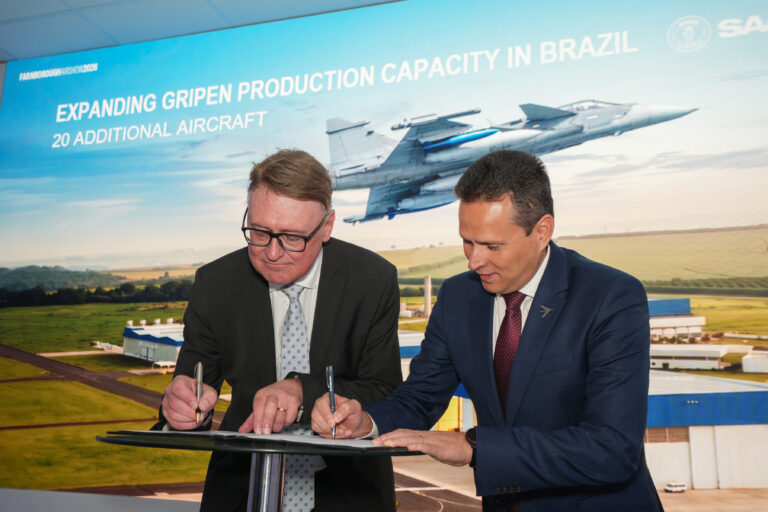
Sweden and Ukraine have entered a historic defence partnership that could see the delivery of up to 150 Saab JAS 39 Gripen E multirole fighters to Kyiv. The announcement followed high-level talks in Linköping between Swedish Prime Minister Ulf Kristersson and Ukrainian President Volodymyr Zelenskyy, during a visit to Saab’s main aerospace facility.
The agreement, signed as a letter of intent, outlines a framework for potential long-term cooperation on air defence and combat aviation. If executed, the deal would represent the largest aircraft export in Swedish history and a major boost to Ukraine’s air force modernization programme.
Strategic Shift for Ukraine’s Air Power
The planned acquisition of Gripen E aircraft marks a major step in Ukraine’s transition toward a Western-standard air fleet. The platform’s design emphasizes survivability, flexibility, and cost-efficiency, making it highly suitable for Ukraine’s operational environment.
The Gripen can operate from short or dispersed runways, requires minimal ground infrastructure, and can be rapidly rearmed and refuelled in austere conditions. These attributes make it ideal for maintaining combat readiness under high-intensity or asymmetric warfare conditions.
Ukraine, which has already begun integrating Western aircraft such as the F-16 and Mirage 2000, would gain a highly capable European fighter optimized for contested airspace and network-centric operations.
Technical Profile of the Gripen E
The Gripen E is Saab’s most advanced fighter to date. It is powered by the General Electric F414G engine, offering increased thrust and range compared with earlier variants.
The aircraft features a modern PS-05/A Mk 4 radar, infrared search and track (IRST) sensors, and a comprehensive electronic warfare suite, providing strong situational awareness and resilience against electronic threats.
With its open-architecture avionics, the Gripen E can integrate a variety of NATO-standard weapons, including long-range Meteor and AMRAAM air-to-air missiles, as well as precision-guided munitions for ground attack. This interoperability makes it compatible with allied systems already in Ukrainian service.
Production, Financing and Industrial Cooperation
While the agreement does not yet constitute a binding sales contract, it sets the stage for negotiations on production schedules, financing, and potential industrial collaboration.
Initial estimates suggest that the first deliveries could occur within three years of contract finalization. Discussions are also underway about an earlier transfer of existing Gripen C/D models to provide an interim capability before the new aircraft arrive.
Financing options under consideration include the use of frozen Russian assets, contributions from international partners, and multilateral funding through European defence frameworks.
The cooperation is expected to include pilot training, maintenance support, and technology transfer, offering Ukraine not only aircraft but also the ability to sustain and evolve its combat aviation capabilities domestically.
For Saab, a contract of this scale would significantly expand its production backlog and strengthen Sweden’s role as a central contributor to European defence industrial capacity.
Long-Term Strategic Implications
Beyond immediate combat needs, the Gripen programme represents a long-term investment in Ukraine’s post-war air defence architecture. The introduction of a modern European-built fighter fleet would position Ukraine as one of the most capable air forces in Central and Eastern Europe.
The agreement also reflects Sweden’s growing influence within NATO and its commitment to strengthening collective defence capabilities on the continent. It demonstrates Europe’s capacity to deliver advanced military solutions independently, reinforcing industrial sovereignty in the aerospace sector.
European Defence Outlook
If fully realized, the Sweden–Ukraine Gripen initiative would stand as a milestone in European security cooperation. It represents not only an arms transfer but the creation of a shared defence ecosystem, linking Sweden’s industrial expertise with Ukraine’s operational experience.
The project strengthens Europe’s aerospace resilience, advances NATO interoperability, and supports Ukraine’s long-term path toward a modern, self-sustaining air defence capability.
About the Author