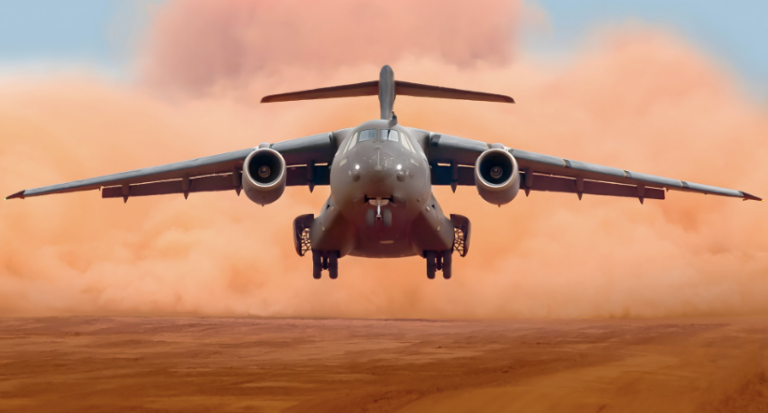
Singapore’s decision to acquire used C-130H aircraft rather than immediately transition to a next-generation platform highlights a broader dynamic in the global airlift market: many air forces face a capability gap between extending legacy turboprop fleets and investing in heavier, more expensive strategic transports. Within this space, the Embraer C-390 Millennium is emerging as a structurally well-positioned contender.
Market Context
The global medium airlift segment is entering a renewal cycle. Numerous operators of legacy C-130 variants are approaching the limits of cost-effective life extension. Structural fatigue, avionics obsolescence, and rising sustainment costs are pushing ministries of defence to reassess fleet strategies.
At the same time, the heavy transport category—represented by platforms such as the Airbus A400M Atlas—often exceeds the operational and financial requirements of small and mid-sized air forces. Procurement and lifecycle costs, infrastructure demands, and fleet size economics constrain broader adoption.
This creates a defined opportunity in the 20–30 tonne payload class.
Competitive Positioning
The C-390 differentiates itself along three primary vectors:
1. Performance and Design Philosophy
As a twin-jet transport aircraft, the C-390 offers significantly higher cruise speeds than turboprop competitors, reducing transit time in strategic lift scenarios. With a payload capacity of approximately 26 tonnes, fly-by-wire controls, and modern avionics architecture, it combines tactical runway performance with near-strategic reach.
The jet configuration also simplifies fleet commonality for air forces operating other jet aircraft and can support high-tempo operations with reduced exposure time in contested environments.
2. Multi-Mission Flexibility
The platform supports cargo transport, airdrop, aeromedical evacuation, humanitarian relief, and aerial refuelling (KC-390 variant). This modular approach aligns with current defence procurement trends favoring multi-role platforms over single-mission fleets.
3. Industrial Integration and European Momentum
Recent European orders and participation of local industry partners have strengthened political and industrial alignment within NATO and EU frameworks. Local assembly, maintenance partnerships, and supply-chain integration reduce entry barriers and enhance long-term sustainment credibility.
This European traction is strategically significant: once interoperability standards and logistics ecosystems are established within alliance structures, network effects can accelerate additional procurement decisions.
Asia-Pacific Outlook
The Asia-Pacific region presents a parallel opportunity. Several air forces operate ageing Hercules fleets while balancing modernization priorities across air combat, maritime surveillance, and missile defence. Singapore’s interim solution—acquiring used C-130Hs—may be interpreted as a bridge strategy rather than a long-term endorsement of legacy capability.
South Korea’s selection of the C-390 as its next-generation transport aircraft signals that the type is no longer viewed as an experimental alternative, but as a credible peer competitor in formal procurement processes.
Production and Scale Considerations
Sustained growth will depend on Embraer’s ability to scale production efficiently while maintaining delivery timelines. Medium transport competitions are often decided as much by industrial reliability and financing structures as by performance metrics.
If annual output increases steadily toward the end of the decade and order momentum continues, the C-390 could consolidate a durable installed base across Europe and selected Asia-Pacific operators. A fleet critical mass would further reduce lifecycle cost uncertainty and improve long-term competitiveness.
Strategic Assessment
The medium airlift segment is no longer defined solely by incremental upgrades of legacy turboprops. It is evolving toward a performance-oriented, multi-role model where speed, interoperability, and industrial partnerships carry increasing weight.
In this context, the C-390 Millennium occupies a structurally advantageous position: below the heavy strategic class, but above legacy turboprop capability in speed and systems architecture.
If current trends persist through the 2020s, the platform has a realistic pathway to becoming a reference standard in the medium transport category during the 2030s.
About the Author