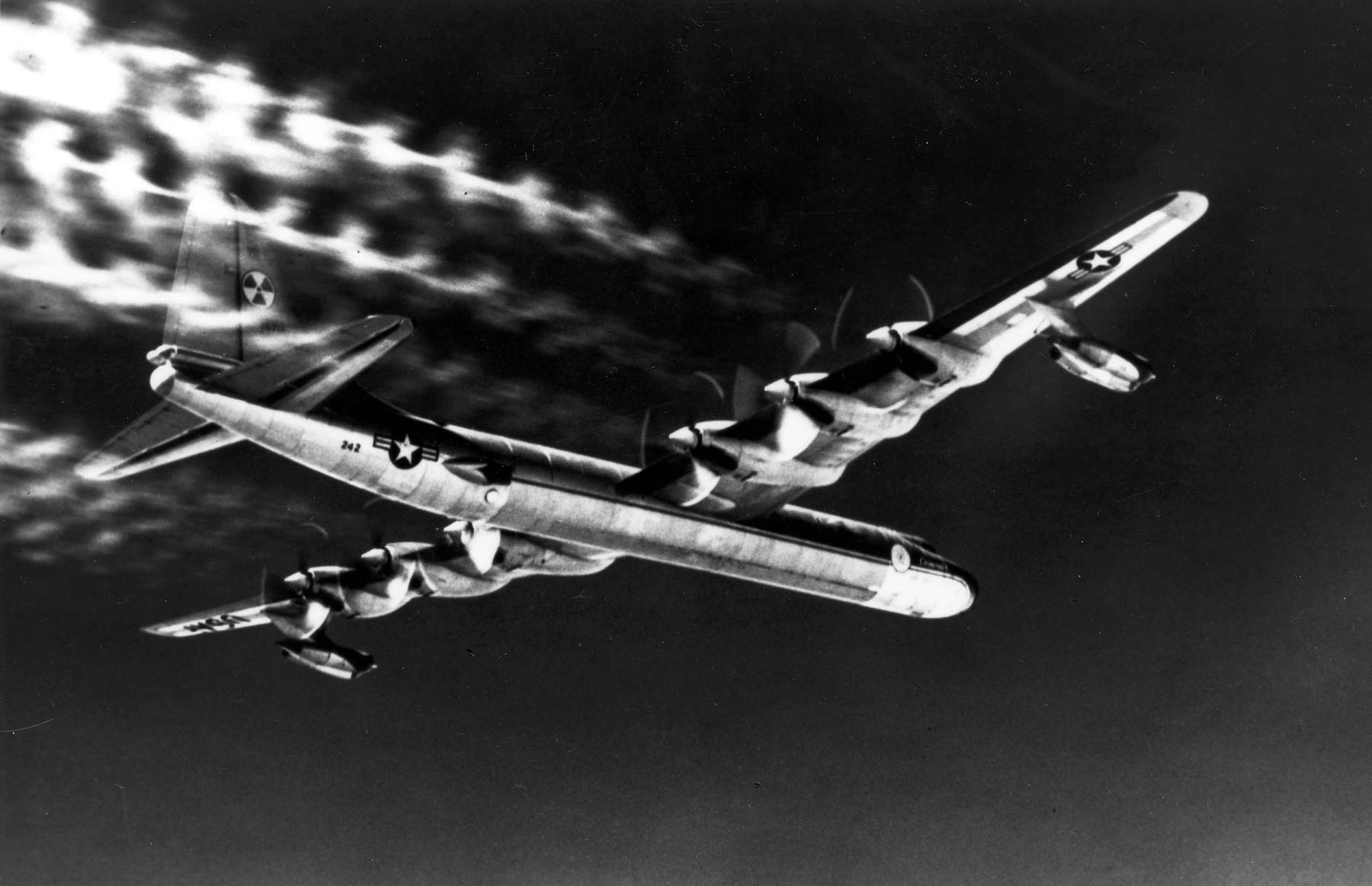
Convair NB-36H in flight. (U.S. Air Force photo)
Inside the extraordinary NB-36H experiment – and America’s attempt to build an aircraft that might stay airborne for days
Imagine standing beside a B-36 Peacemaker in the mid-1950s.
It was already an extraordinary machine: one of the largest combat aircraft ever built, powered by six piston engines and four turbojets and designed to carry nuclear weapons across intercontinental distances.
Then imagine engineers cutting into its bomb bay and installing something considerably more unusual.
A functioning nuclear reactor.
Between 1955 and 1957, the United States flew exactly such an aircraft.
The Convair NB-36H carried an operational nuclear reactor over Texas and New Mexico on dozens of test flights. Its crew sat inside a specially shielded compartment designed to protect them from radiation.
There was even a radiation warning symbol painted prominently on the aircraft’s tail.
But one persistent myth needs to be cleared up immediately.
The reactor did not power the aircraft.
The NB-36H remained powered by conventional engines throughout its flight-test programme. Its purpose was to answer a more fundamental question:
Could a nuclear reactor be operated aboard an aircraft without killing its crew, damaging its systems or making the entire concept impractical?
The answer would determine whether America could take the next, far more ambitious step – building an aircraft actually propelled by nuclear energy.
For a brief period during the Cold War, that possibility was taken remarkably seriously.
Why would anyone put a nuclear reactor in an aircraft?
The idea makes more sense when viewed from 1946 rather than from today.
The Second World War had just ended. Nuclear weapons had transformed strategic warfare. Jet propulsion was developing rapidly, but early jet engines consumed enormous quantities of fuel.
Intercontinental ballistic missiles did not yet exist as an operational strategic weapon.
A bomber’s endurance was therefore ultimately determined by one simple limitation:
fuel.
Nuclear energy appeared to offer a way around it.
The U.S. Army Air Forces began investigating nuclear aircraft propulsion as early as 1946. The programme evolved through the Nuclear Energy for the Propulsion of Aircraft project and later the joint U.S. Air Force–Atomic Energy Commission Aircraft Nuclear Propulsion programme.
The attraction was obvious.
A nuclear-powered bomber might theoretically remain airborne for extremely long periods without the conventional constraint of fuel consumption.
Range could effectively cease to be the dominant limitation.
Such an aircraft could potentially remain on continuous airborne alert, approach targets through unconventional routes or operate for extended periods without depending on forward bases.
This was before reliable intercontinental ballistic missiles changed the strategic equation.
For military planners looking at the technology available in the late 1940s and early 1950s, nuclear propulsion therefore wasn’t simply science fiction.
It was a potential solution to a genuine strategic problem.
Convair receives the challenge
On 5 September 1951, Convair received a U.S. Air Force contract connected with development of the nuclear aircraft concept.
An existing B-36H that had been damaged by a tornado at Carswell Air Force Base in Texas in September 1952 was eventually selected for conversion into the flying reactor testbed.
It was initially designated XB-36H and later NB-36H.
The aircraft was sometimes associated with the name Crusader.
Its mission was not to test nuclear propulsion itself.
Instead, it would investigate one of the most difficult problems standing between engineers and a genuine nuclear aircraft:
radiation shielding.
A reactor powerful enough to propel an aircraft would necessarily operate relatively close to its crew, avionics and structure.
Unlike a reactor installed inside a power station, engineers could not simply surround it with enormous quantities of concrete.
Every kilogram of shielding had to fly.
And every additional kilogram of shielding reduced aircraft performance.
That created a brutal engineering equation:
Protect the crew enough to survive – but not so much that the aircraft becomes too heavy to be useful.
A reactor inside the bomb bay
The NB-36H carried an air-cooled Aircraft Shield Test Reactor inside its bomb bay.
U.S. Air Force historical records describe it as a three-megawatt reactor.
It was operational in flight.
But there was no connection between the reactor and the aircraft’s propulsion system.
The B-36 continued flying using its normal six piston engines and four turbojets.
The reactor existed purely as an experimental radiation source.
Engineers could therefore measure radiation levels throughout the aircraft and determine how effectively different shielding arrangements protected the crew and equipment.
The cockpit became a radiation bunker
The crew compartment was radically modified.
The normal cockpit was replaced by a heavily shielded section incorporating lead and rubber.
Even the windows presented a problem.
According to U.S. Air Force records, the normal windshield was replaced by approximately six-inch-thick acrylic glazing.
The crew was effectively sitting inside a protective capsule within the aircraft.
The reactor itself also incorporated shielding.
The result was an aircraft whose appearance concealed an extraordinary internal architecture: conventional engines outside, a working nuclear reactor in the bomb bay and a crew protected behind massive shielding in the nose.
Photographs of the NB-36H cockpit and nuclear engineer stations preserved by the National Museum of the U.S. Air Force illustrate just how specialised the aircraft became.
47 flights with a reactor aboard
The NB-36H began its flight-test programme in 1955.
Over roughly two years, it completed:
47 test flights
215 flight hours
89 hours with the reactor operating
Flights took place over areas of Texas and New Mexico.
This was not a short publicity demonstration.
It was a sustained experimental programme intended to collect real-world data about operating a nuclear reactor aboard an aircraft.
And the aircraft demonstrated something important.
An operating reactor could, technically, be carried aboard a large aircraft while providing sufficient shielding for the crew to conduct the mission.
That did not mean the problem of nuclear-powered flight had been solved.
Far from it.
The next aircraft was supposed to actually use nuclear propulsion
The NB-36H was essentially a stepping stone.
The much more ambitious aircraft was the Convair X-6.
Two X-6 aircraft were planned.
Unlike the NB-36H, their reactors were intended to form part of an actual nuclear propulsion system.
NASA’s historical record describes the X-6 programme as an effort to investigate crew shielding, propulsion, radiobiology and radiation effects before committing to an operational military design.
Neither X-6 was ever completed.
But on the ground, engineers were getting surprisingly close to proving some of the underlying propulsion technology.
How do you make a jet engine run on nuclear energy?
This was perhaps the most radical engineering question of the entire programme.
General Electric pursued what became known as the direct-air-cycle concept.
A conventional jet engine burns fuel to heat compressed air. The hot expanding gases then drive the turbine and generate thrust.
In a nuclear turbojet, engineers proposed replacing combustion as the principal heat source with a nuclear reactor.
Air would pass through the reactor, absorb heat and then expand through the turbine.
In January 1956, General Electric demonstrated an experimental system in which a modified J47 turbojet operated using heat from a nuclear reactor.
The Heat Transfer Reactor Experiment programme subsequently progressed through HTRE-1, HTRE-2 and HTRE-3.
HTRE-3 was designed in an aircraft-like horizontal configuration and produced enough thermal power to operate two modified J47 engines.
During testing it demonstrated prolonged operation and all-nuclear starts.
So the fundamental idea was not purely theoretical.
Engineers had demonstrated on the ground that nuclear energy could be used to operate jet engines.
The alternative: keep the radioactive material away from the engine
Pratt & Whitney investigated another approach.
Instead of allowing engine airflow to interact directly with the reactor, an indirect-cycle system would transfer reactor heat through a separate working fluid.
In principle this reduced some contamination issues.
In practice it added heat exchangers, pumps, plumbing and considerable complexity.
Weight remained the enemy.
Nuclear reactors were becoming smaller, but aircraft required an extraordinary combination of high power, low weight, radiation protection and reliability.
Technology that was perfectly acceptable for a stationary reactor could become completely impractical once it had to fly.
Then came the uncomfortable question: what happens when it crashes?
Even if engineers could solve propulsion and shielding, another problem remained.
Aircraft crash.
A conventional strategic bomber crash was already a serious event.
A nuclear-powered bomber potentially meant crashing an operating reactor.
The consequences of an accident during take-off, landing or operations over populated territory introduced safety and political problems that were difficult to engineer away.
NASA’s historical assessment of the X-6 programme explicitly notes concerns about nuclear accidents following an aircraft crash as one of the reasons such systems were not pursued further.
And by the late 1950s, technology elsewhere was changing the strategic equation faster than nuclear aircraft engineers could solve these problems.
The missile changed everything
The programme’s greatest competitor wasn’t another aircraft.
It was the ballistic missile.
As intercontinental ballistic missiles matured, the strategic rationale for an extraordinarily complex nuclear-powered bomber weakened.
Missiles could provide global nuclear reach without keeping a reactor, flight crew and enormous aircraft continuously airborne.
Air-to-air refuelling was also making conventional strategic bombers far less constrained by fuel than they had been when nuclear propulsion studies began.
Meanwhile, nuclear submarines demonstrated that reactors offered enormous endurance advantages in an environment much better suited to their weight and shielding requirements.
A submarine could carry hundreds or thousands of tonnes of machinery and shielding.
An aircraft could not.
The physics that made nuclear propulsion revolutionary underwater made it extraordinarily difficult in the air.
America nevertheless kept trying
The nuclear aircraft concept did not disappear immediately.
The Air Force explored several increasingly ambitious requirements.
The WS-125A concept envisioned a nuclear-powered strategic bomber capable of subsonic cruise combined with a supersonic dash.
Later came concepts associated with continuous airborne alert and finally the proposed Convair NX-2 experimental aircraft.
In 1960, plans still existed to construct two NX-2 nuclear-powered experimental aircraft, with a first flight tentatively envisaged for 1965.
General Electric engineers believed their propulsion technology was approaching the point where it could be installed in an aircraft.
But strategic priorities had moved on.
In 1961, President John F. Kennedy terminated the U.S. nuclear aircraft programme.
What happened to the NB-36H?
There would be no museum exhibit.
After its test programme ended, the reactor was removed.
The NB-36H was scrapped at Fort Worth in 1958.
The aircraft that had carried an operating nuclear reactor through the skies over the American Southwest simply disappeared.
What remains are photographs, technical reports and the results of one of the most extraordinary experimental aviation programmes of the Cold War.
Crazy – or rational?
Seen from 2026, putting a nuclear reactor aboard a bomber can appear almost absurd.
Seen from 1946, the calculation looked different.
Engineers had just witnessed nuclear energy release quantities of energy previously unimaginable.
Strategic bombers needed enormous range.
Jet engines consumed huge quantities of fuel.
ICBMs had not yet made the bomber’s endurance problem less strategically important.
The obvious question was therefore worth asking:
Could nuclear energy eliminate the aircraft’s dependence on fuel?
The United States spent fifteen years trying to find out.
The answer turned out not to be a simple no.
Reactors could be made compact enough to contemplate airborne use.
A reactor could operate aboard an aircraft.
A crew could be shielded from it.
And nuclear heat could even operate turbojet engines on the ground.
The technology was progressing.
What ultimately defeated the nuclear aircraft was the combination of weight, complexity, radiation, accident risk, cost – and the arrival of better ways to solve the strategic problem it had been designed to address.
That is what makes the NB-36H particularly interesting.
It wasn’t simply an eccentric Cold War experiment that failed.
It was an engineering solution overtaken by a changing strategic world before engineers could make it practical.
Sources
U.S. Air Force / Kirtland Air Force Base – Aircraft Nuclear Propulsion programme and NB-36H flight history.
Air Force Materiel Command History Office – Manned Nuclear Aircraft Program.
NASA – X-plane programme history and Convair X-6 programme.
NASA – Science in Flux: NASA’s Nuclear Reactor Program at Plum Brook Station 1955–2005.
U.S. Air Force historical study – Nuclear Propulsion for Manned Aircraft: The End of the Program, 1959–1961.
National Museum of the U.S. Air Force – NB-36H historical photographic archive.
Editorial note: This article was researched and edited with AI assistance. Historical and technical information was checked against U.S. Air Force, NASA and other U.S. government archival sources.
About the Author