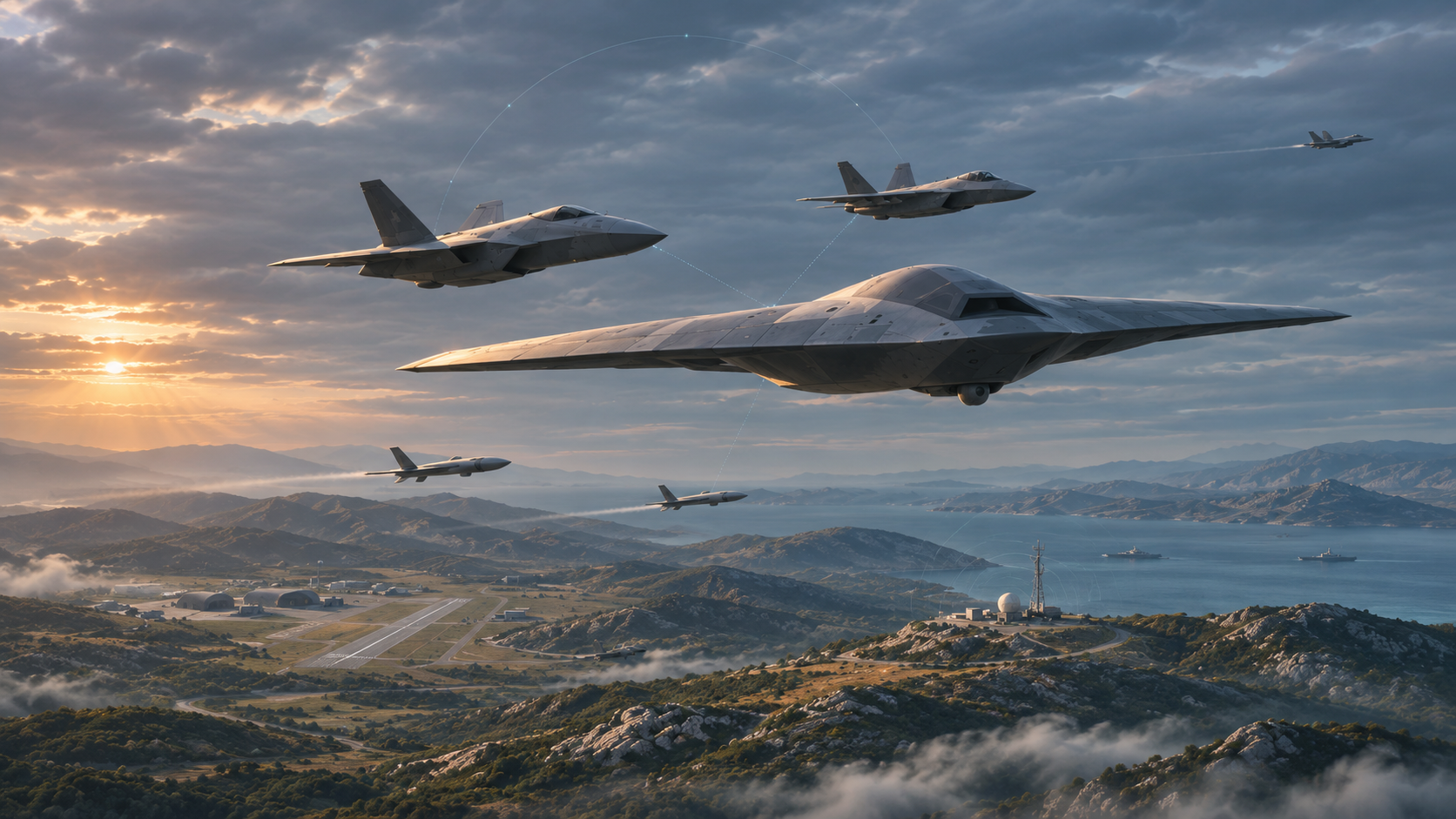
The race to develop autonomous combat aircraft is gathering pace, with the United States, China, Australia, Türkiye and Europe pursuing markedly different approaches. Yet comparing aircraft and development milestones tells us surprisingly little about their eventual military value. The more consequential questions concern how these systems will operate, what air forces can afford to lose, and how much responsibility humans should delegate to machines.
Aerospace Central Europe | Analysis | 17 November 2026
The past few weeks have offered a remarkable glimpse of where military aviation may be heading. Airbus and Kratos completed the first European flight of their U740 Valkyrie in October. Northrop Grumman’s YFQ-48A Talon Blue made its first autonomous flight in California. Shield AI unveiled the first full-scale prototype of its runway-independent X-BAT in early November, while China released unusually detailed footage of the GJ-11 stealth unmanned combat aircraft, revealing its internal weapons bays and offering further indications of its intended operational role.
These developments are attracting considerable attention, and understandably so. They represent substantial engineering achievements, but they also illustrate how difficult it has become to assess progress in autonomous combat aviation. A successful first flight, a weapons demonstration, a production contract and the introduction of an aircraft into military service are fundamentally different milestones. Yet they are regularly presented as comparable evidence in an increasingly crowded international competition.
There is a broader contradiction worth examining. The war in Ukraine has demonstrated the operational significance of relatively inexpensive unmanned systems employed in large numbers, while some of the world’s leading aerospace manufacturers are developing sophisticated unmanned combat aircraft with advanced sensors, electronic warfare systems, substantial payloads and low-observable designs. These aircraft are becoming larger, faster and considerably more capable, although that development is not necessarily inconsistent with the lessons from Ukraine.
A combat aircraft does not escape the laws of physics because its cockpit is empty. Range still requires fuel, weapons require payload capacity, and operating in contested airspace demands appropriate survivability. Internal weapons bays make sense when reducing radar signature is an operational requirement. Removing the pilot offers important design opportunities, but it does not remove the need to accomplish difficult missions against increasingly capable adversaries.
The difficulty is determining which missions justify such sophistication. It is equally important to understand what removing the pilot changes beyond the aircraft itself. Air forces are not simply acquiring new machines; they are reconsidering the distribution of risk, the organisation of combat operations and, increasingly, the relationship between human judgement and military action.
The aircraft is not the capability
Much of the current discussion treats autonomous combat aircraft as though they form a relatively homogeneous category. In reality, the term covers systems developed for very different operational purposes, from comparatively affordable collaborative aircraft carrying additional weapons to sophisticated low-observable platforms intended to penetrate integrated air defence systems.
An air force commander planning an operation against a capable adversary may need aircraft to conduct electronic attack, identify and suppress hostile air defences, provide additional sensors, carry weapons or act as decoys. Some of these tasks could be performed by relatively inexpensive systems, including aircraft whose loss is anticipated. Others may demand greater range, survivability or mission complexity, with a corresponding increase in cost.
The choice should follow the mission rather than the technology available. A highly sophisticated autonomous aircraft is not inherently an inefficient solution, just as a cheap expendable drone is not automatically economical. The relevant question is whether a particular system produces the required military effect at a cost and level of risk that its operator can sustain.
This distinction becomes particularly important when considering the broader combat system. An autonomous aircraft depends on intelligence, communications, weapons, ground support, trained personnel and an appropriate command structure. Its contribution cannot be understood through airframe performance alone. A platform with impressive range and payload may provide relatively little operational advantage if it cannot exchange information reliably, receive timely instructions or be supported under wartime conditions.
The military value of these aircraft will therefore depend less on their individual characteristics than on how effectively they can be integrated into an air force’s existing capabilities. This is already influencing both aircraft development and procurement decisions, particularly in the United States.
America is changing the procurement model
The US Air Force’s Collaborative Combat Aircraft programme represents an attempt to acquire combat capability more rapidly while avoiding some of the constraints traditionally associated with large aerospace programmes. In June 2026, the service entered production for an initial 150 aircraft from General Atomics and Anduril Industries, whose FQ-42 Vengeance and FQ-44 Fury had emerged from the first stage of the competition. The Air Force subsequently confirmed its ambition to acquire approximately 1,000 CCAs, including 500 by 2032.
Maintaining two aircraft manufacturers in the initial production effort is significant, but the more consequential development may be taking place in the software architecture. Rather than relying entirely on aircraft manufacturers to supply the autonomy required for their platforms, the Air Force has established a separate competitive environment for mission autonomy, involving companies such as Shield AI, Anduril, Collins Aerospace, General Atomics, Northrop Grumman and Lockheed Martin.
Its Autonomy Government Reference Architecture, known as A-GRA, is intended to support the integration of different autonomy solutions across different aircraft. Initial flight demonstrations have shown that this separation is technically possible, although its practical implementation remains an extensive engineering task.
Shield AI provided another demonstration in October and November, using its Hivemind software to execute instructions from an F-22 pilot and subsequently coordinate multiple FQ-44 aircraft in formation and simulated beyond-visual-range counter-air manoeuvres. The achievement is relevant because it moves beyond autonomous navigation towards cooperation between aircraft performing tactical tasks under human direction.
However, the ability to transfer autonomy software between platforms should not be interpreted as evidence that aircraft integration has become straightforward. Mission systems must operate within the aircraft’s performance limitations and interact reliably with flight controls, sensors, navigation equipment, communications and weapons. The effects of software changes have to be understood and validated, particularly when they influence behaviour in situations that may be difficult to reproduce during testing.
The separation of aircraft and autonomy also introduces a question of ownership. If an air force can change software providers without replacing the aircraft, it potentially gains flexibility and bargaining power. At the same time, the distinction between owning the software, controlling its development and being able to modify and certify it independently remains important. A government may possess extensive rights to a system without having the technical capacity to maintain or adapt it without industrial support.
There is therefore no simple contest between aerospace manufacturers and software companies. The competitive advantage may lie in combining aircraft design, mission autonomy and systems integration while retaining sufficient flexibility to respond to changing operational requirements.
Different countries, different operational priorities
The American programme is only one approach to autonomous combat aviation, and its priorities should not be used as the universal standard against which every other development is judged.
China’s GJ-11, for example, appears to address a rather different operational requirement. New footage released by Chinese state television on 9 November showed details of its flying-wing configuration and internal weapons bays. Chinese authorities describe the aircraft as capable of strike and suppression-of-enemy-air-defences missions, including cooperation with J-20 and J-16 fighters. The People’s Liberation Army Air Force has stated that the type entered service in 2025 and has reported a successful live-fire mission.
Those statements are significant, but the publicly available evidence does not establish the size or readiness of the operational fleet, the extent of the aircraft’s autonomy or its effectiveness in a heavily contested electromagnetic environment. Nor does the demonstration of cooperation with a manned aircraft necessarily prove that the unmanned system can independently conduct complex combat missions. Nevertheless, the GJ-11 reflects sustained investment in a low-observable platform designed for missions where penetration and survivability may be more important than minimising the cost of each aircraft.
Australia offers an instructive contrast because its MQ-28 Ghost Bat programme has accumulated substantial flight-testing experience. Developed by Boeing Australia in cooperation with the Royal Australian Air Force, Ghost Bat first flew in 2021 and had completed more than 100 flights by March 2025. In December that year, an MQ-28 launched an AIM-120 AMRAAM and destroyed an airborne target during an engagement involving an E-7A Wedgetail and an F/A-18F Super Hornet.
The demonstration was important for more than the successful missile engagement. The E-7A provided command authority, illustrating how an autonomous platform can participate in a complex mission while remaining part of a human-directed combat system. It also highlights the difference between demonstrating an autonomous function and transferring responsibility for the use of lethal force to the aircraft itself.
This distinction is relevant when comparing the Australian achievement with the American FQ-44’s missile test in July 2026. The US Air Force demonstrated the launch of an AIM-120 against a digital target, validating elements of weapons integration and command execution. The Australian test involved the destruction of a physical airborne target. Both represent valuable progress, but they demonstrate different levels of system integration.
Türkiye is following another development path. Baykar’s Kızılelma has completed increasingly sophisticated weapons tests, including the release of guided munitions from its internal weapons bay in July 2026. Turkish Aerospace is simultaneously developing the ANKA III flying-wing unmanned combat aircraft, giving Türkiye more than one significant national programme.
These efforts are supported by experience in unmanned aircraft production, weapons integration and exports. The industrial partnership between Baykar and Leonardo further demonstrates that Turkish technology is becoming part of the European defence aerospace environment. The significance extends beyond individual aircraft: Türkiye has built a substantial unmanned aviation industry with increasingly integrated domestic capabilities.
Taken together, these programmes show why identifying a global leader is problematic. Australia has accumulated extensive experience in collaborative flight testing, Türkiye has demonstrated advanced weapons integration, China claims operational low-observable capability, and the United States is working towards large-scale procurement supported by a more flexible autonomy architecture. Each achievement matters, but none alone establishes that one country has solved the wider problem of employing autonomous airpower in combat.
Shield AI and the question of where aircraft can operate
One of the more interesting developments comes from Shield AI, whose X-BAT programme approaches the problem from a different direction. The company completed its first full-scale prototype in November, approximately one year after publicly presenting the concept, and is preparing for flight testing. It aims to have a mission-capable aircraft in 2028 and begin production in 2029, although those remain development objectives rather than demonstrated operational capabilities.
X-BAT is particularly relevant because it challenges the infrastructure on which conventional combat aviation depends. Designed around vertical take-off and landing, the aircraft is intended to conduct missions without a conventional runway. For military operations in the Pacific, where established airbases may be exposed to long-range precision attacks, such a capability could offer valuable options for dispersal.
The potential advantages should be considered alongside the engineering and logistical penalties. Vertical take-off imposes considerable demands on propulsion and flight control, while the aircraft must still carry enough fuel and payload to perform a useful mission. Operating away from established airbases also requires fuel, maintenance, weapons handling, communications and security at dispersed locations. Eliminating the runway does not eliminate the logistical system; it changes its organisation.
The relevant test will therefore be whether X-BAT can generate sufficient operational capability from dispersed locations to justify its additional complexity. An aircraft that can launch from an isolated site but cannot be refuelled, rearmed or maintained there would offer only limited military advantage.
Shield AI’s wider portfolio is also worth considering. Through its Hivemind autonomy technology, the company is competing as a mission software provider, while its V-BAT reconnaissance aircraft represents an established, smaller runway-independent system. The company is consequently addressing different parts of the unmanned aviation market, rather than relying on a single aircraft concept.
This combination of platforms and software illustrates an important shift in the industry. Traditional aircraft manufacturers are increasingly competing with companies whose initial expertise lies in autonomy, software or systems integration. The distinction between an aircraft producer and a defence technology provider is becoming less clear, particularly as both seek greater control over the complete operational system.
Europe has capability, but procurement remains the critical test
Europe’s position is often described in terms of its need to catch up with the United States or China. That assessment overlooks considerable existing expertise, including decades of work on unmanned aircraft, advanced flight control, electronic warfare and low-observable technologies.
The more immediate challenge is translating that expertise into systems that air forces can acquire and operate within a useful timeframe.
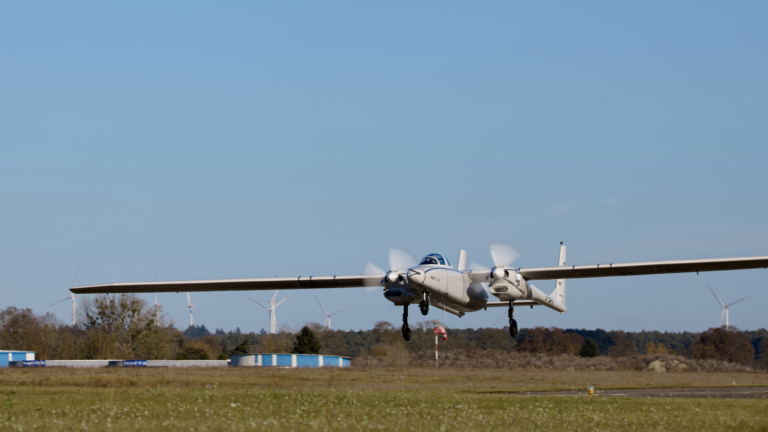
Airbus and Kratos completed the first European flight of the U740 Valkyrie on 12 October 2026, using an established American airframe combined with a development approach centred on European mission systems. Airbus plans to integrate its MARS architecture to provide control over mission applications, data and relevant system functions. The company is targeting a combat-ready capability by 2029, offering an approach that seeks to reduce development risk while retaining a significant degree of European operational control.
Helsing and Grob Aircraft are pursuing a different solution through the CA-1 Europa family. The CA-1KA is intended for kinetic attack missions, while the CA-1EA addresses electronic warfare. Both share a common airframe, propulsion system, autonomy architecture and ground-control infrastructure, with their different operational roles principally determined by mission equipment and payload.
The first flight of the kinetic variant is planned for early 2027, with initial operational capability targeted for 2029. The electronic attack version is scheduled to follow in 2031. This common-platform approach offers potential benefits in production, maintenance and training, although its effectiveness will ultimately depend on how well the shared design accommodates the different demands of the two missions.
BAE Systems has introduced Brontanax, a British collaborative combat aircraft intended to perform precision-strike and electronic warfare tasks alongside manned aircraft. The company is preparing the prototype for flight testing in 2027. Airbus has meanwhile decided to prioritise its U760 Ravenstorm over the earlier Wingman concept, arguing that the less demanding design offers a more realistic route to the capability and delivery schedules sought by customers.
These developments should not be interpreted as evidence that Europe has too many manufacturers pursuing the same solution. Competition can encourage innovation, and different operational requirements may justify different aircraft. The concern is whether governments will establish sufficiently clear requirements and procurement commitments to turn promising development programmes into operational fleets.
Air forces have legitimate reasons to be cautious. They must consider certification, interoperability, maintenance, software assurance and the long-term implications of committing to a platform that may evolve considerably during its service life. Yet there is also a cost to prolonged indecision. A programme designed around requirements that remain unsettled for years can become increasingly expensive while the threat environment continues to change.
The question of European sovereignty adds another layer. Control over mission software is important, but it does not automatically provide independence in propulsion, airframe production, critical components, export permissions or long-term support. These dependencies need to be understood individually rather than reduced to a simple distinction between European and non-European solutions.
For Europe, industrial autonomy may prove almost as important as aircraft autonomy. The ability to modify, manufacture and sustain a system during a prolonged conflict is an operational consideration, not merely an industrial policy objective.
What Ukraine actually tells us about cost and attrition
The war in Ukraine has transformed the use of unmanned systems, but it would be a mistake to apply its lessons indiscriminately to every category of military aircraft.
The operational environment is characterised by extensive land front lines, persistent surveillance, sophisticated electronic warfare and dense air defences. Unmanned systems have become central to reconnaissance, targeting and strike operations, often forcing both sides to adapt equipment and tactics at extraordinary speed.
These experiences are highly relevant to future airpower, particularly in demonstrating the importance of adaptation, production capacity and resilience against electronic interference. They do not, however, establish that inexpensive drones can replace sophisticated combat aircraft performing fundamentally different missions.
The International Institute for Strategic Studies reached a similar conclusion in its March 2026 study UAVs: ISR, Deterrence and War. The analysis highlights the importance of unmanned systems in Ukraine while cautioning against treating that conflict as a universal model. Aircraft size, range, communications requirements, survivability and operational purpose all influence how the lessons should be interpreted.
The economics of unmanned combat aviation are therefore more complicated than comparing purchase prices. A relatively inexpensive aircraft that cannot reach its target or survive the relevant threat environment may provide poor value. Conversely, a sophisticated reusable platform may be economical if it performs missions that would otherwise require greater resources or expose more valuable aircraft and crews to unacceptable risk.
The concept of attrition is central to this calculation. The US Air Force has described its CCAs as optionally attritable, recognising that they may serve for years while remaining available for missions in which their loss is an acceptable consequence.
This is a rational approach, provided the economics are understood. An aircraft can be significantly cheaper than an F-35 without being expendable in any meaningful sense. Its loss still represents the disappearance of a trained, equipped and potentially scarce military asset, particularly if production cannot keep pace with operational demand.
A commander must therefore assess more than the probability of losing an aircraft. The value of the mission, the availability of replacements, the consequences of failure and the cost of alternative approaches all form part of the decision.
The same reasoning applies to the size of the fleet. Acquiring hundreds of unmanned aircraft does not automatically translate into increased combat power. What matters is how many can be kept mission-capable, how effectively they can be employed, and whether sufficient weapons, personnel and infrastructure are available to sustain operations.
In a prolonged conflict, the ability to regenerate combat capability may become as important as the ability to deploy it initially. That is a lesson from Ukraine with implications far beyond the particular categories of drones currently operating there.
Autonomy may change the workload more than we expect
One of the central promises of collaborative combat aircraft is that a single pilot or mission commander will be able to direct several autonomous platforms, increasing the force’s available sensors, weapons and tactical options.
This is attractive, but it introduces a potential contradiction. Autonomous systems are intended to reduce human workload, yet they may also increase the number and complexity of decisions that a commander must make.
A fighter pilot operating in contested airspace already has to interpret sensor information, maintain situational awareness, coordinate with other aircraft and make decisions under considerable time pressure. Adding unmanned aircraft may improve the available tactical options, but those aircraft also create additional responsibilities involving mission priorities, coordination, positioning and the use of weapons.
The objective of autonomy should be to manage these additional tasks without requiring continuous human intervention. Recent demonstrations, including Shield AI’s Hivemind tests, indicate progress towards this model. Nevertheless, a successful formation flight or simulated combat manoeuvre does not establish that the same system will behave reliably under the conditions of an actual conflict.
Communications may be interrupted, navigation degraded and sensor information deliberately manipulated. Targets may change position or status. Friendly aircraft may enter unexpected areas, and the tactical assumptions made before the mission may no longer be valid.
The autonomy system must respond within defined limits, but the nature of those limits is an operational decision. Requiring constant human confirmation may make the system unsuitable for missions involving intermittent communications. Allowing broad independent action may improve resilience while creating uncertainty about how the aircraft will behave when circumstances change.
There is no universal answer. The appropriate level of autonomy depends on the mission, the environment and the consequences of an incorrect decision.
It is also necessary to distinguish between an aircraft’s ability to fly autonomously and its authority to employ weapons. Navigation, formation control, tactical manoeuvring, target identification and weapons release represent different functions with different consequences. Demonstrating one does not necessarily establish competence or authorisation in another.
This distinction is particularly important as manufacturers increasingly promote aircraft as capable of operating independently in contested environments. Independence can be a valuable military characteristic, but its operational meaning needs to be defined precisely.
The human question cannot be separated from the military one
The development of autonomous combat aircraft raises ethical questions that extend beyond software reliability and the technical definition of human control.
For much of aviation history, committing an aircraft to combat also meant accepting the possibility of losing its crew. That risk has influenced military planning, political calculations and public attitudes towards the use of force. Unmanned aircraft change the relationship by allowing certain missions to be conducted without exposing a pilot to the immediate dangers of combat.
There is a legitimate moral argument for reducing those risks. Military personnel should not be placed in unnecessary danger when a mission can be accomplished effectively by other means. Autonomous systems may also improve situational awareness, reduce some forms of human error and support more informed decisions.
Nevertheless, reducing the risks borne by one’s own forces does not necessarily reduce the overall human consequences of military action. The populations affected by an attack experience the effects of the weapons employed, regardless of whether the aircraft carrying them has a pilot.
This introduces a difficult political question. If a government can conduct military operations without exposing its own aircrews to immediate danger, does that make the decision to use force easier?
There is no reason to assume that the answer will always be yes. The risk of escalation, international obligations, civilian casualties and wider strategic consequences remain significant. Unmanned systems may also offer options for restraint, including persistent observation and improved intelligence before an engagement.
But changes in the distribution of risk can influence decision-making. A military capability that lowers the immediate political cost of an operation may affect how readily that option is considered, even when its wider consequences remain substantial.
The ethical implications become more direct when autonomy extends into target selection and weapons employment.
An aircraft can navigate and manoeuvre autonomously without being authorised to make independent decisions about lethal force. The distinction is recognised by the International Committee of the Red Cross, which defines autonomous weapon systems in terms of their ability to select and apply force to targets without further human intervention.
The United States Department of Defense’s Directive 3000.09 similarly requires autonomous and semi-autonomous weapon systems to allow commanders and operators appropriate levels of human judgement over the use of force. It also establishes requirements concerning testing, reliability and the conditions under which such systems may operate.
These safeguards are essential, although their practical application becomes more difficult as systems gain the ability to respond independently to changing circumstances.
Consider an autonomous aircraft assigned to attack an identified military target. During the mission, communications are lost and the situation changes in a way that may affect the legality or appropriateness of the planned engagement. Should the aircraft continue under its original authorisation, suspend the attack or attempt to return to an area where communication can be restored?
The response cannot depend on improvisation after communication has failed. It must be addressed through system design, operational doctrine and mission planning. The aircraft’s authorised behaviour must be sufficiently predictable for commanders to understand the consequences of employing it.
Human responsibility also cannot be reduced to a formal approval given at the beginning of a mission. Effective control requires an understanding of what the system is permitted to do, how it responds to uncertainty and under which circumstances it must refrain from acting.
These questions are currently being considered at the international level. From 16 to 20 November 2026, states are meeting in Geneva for the Seventh Review Conference of the Convention on Certain Conventional Weapons, where the future regulation of lethal autonomous weapon systems is a central issue.
The debate is far from settled. The International Committee of the Red Cross and the United Nations Secretary-General have called for legally binding restrictions, while states differ over whether new international rules are necessary and what form they should take. The United States, Russia and Israel have opposed a new binding agreement, arguing that existing international humanitarian law provides the necessary framework, while several European governments support further negotiations without necessarily agreeing in advance on their legal outcome.
These differences reflect genuine disagreements about military necessity, legal responsibility, technological development and the risks of delegating decisions to machines.
It is possible to recognise the operational benefits of autonomous systems without accepting that every technically achievable function should be delegated to them. Equally, retaining human involvement does not automatically guarantee better decisions if operators lack sufficient information, time or understanding of the system’s behaviour.
The challenge is to establish forms of human control that remain meaningful under real operational conditions rather than existing only as procedural requirements.
A different measure of progress
For an air force considering investment in autonomous combat aviation, the most revealing questions concern the complete operational capability rather than the aircraft alone.
How many missions can the system generate during a sustained campaign? How will it perform when communications, navigation and operating infrastructure are disrupted? Can the manufacturer deliver replacements at a rate consistent with anticipated losses? How quickly can mission software be updated, tested and deployed when an adversary changes its tactics?
The answers may be less impressive than the figures presented in aircraft specifications, but they are likely to be more useful in determining whether a programme represents sound military investment.
They also help explain why the global competition is unlikely to produce a single winner. The United States is developing a new procurement model and a competitive autonomy environment. China is investing in low-observable unmanned combat capabilities. Australia has accumulated substantial operationally relevant flight-testing experience, while Türkiye has demonstrated increasingly sophisticated weapons integration and industrial capacity.
Europe is pursuing several approaches, from new aircraft families to combinations of existing platforms and sovereign mission systems. Shield AI is challenging assumptions about operating infrastructure, while established aerospace manufacturers are seeking to combine their engineering experience with increasingly capable autonomy.
These developments should not be forced into a single ranking. The aircraft are being designed against different requirements, and the eventual success of each programme will depend on factors that cannot yet be established through public demonstrations.
What is becoming clearer is that unmanned combat aviation will not simply produce a cheaper version of the conventional fighter fleet. It is likely to introduce a much wider range of aircraft, with different levels of autonomy, survivability, cost and acceptable risk. Some will complement manned fighters, others will perform missions that were previously impractical, and many will remain dependent on human direction even when capable of operating autonomously for substantial periods.
Managing these capabilities will require changes in doctrine, training, command structures and procurement, alongside continued advances in aircraft and software engineering.
The most significant change may ultimately concern the decisions that become possible when human operators are no longer required to be physically present in the aircraft. This offers substantial military opportunities, but it also places greater importance on understanding where authority resides, how it is exercised and how responsibility is maintained.
The achievement of autonomous flight is no longer in serious doubt. More demanding questions concern the reliability of autonomous combat operations, their economic sustainability and the limits within which independent action should be permitted.
The future of airpower will depend not only on what autonomous aircraft are capable of doing, but on how deliberately we decide to employ them.
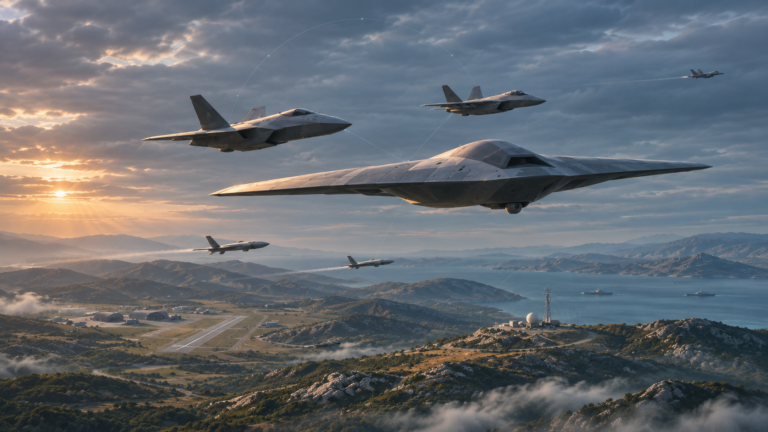
Source: This article was prepared with the assistance of generative AI. Editorial responsibility, including content review and factual accuracy, rests with Aerospace Central Europe. The image is conceptual and does not depict actual aircraft or operational events.
About the Author