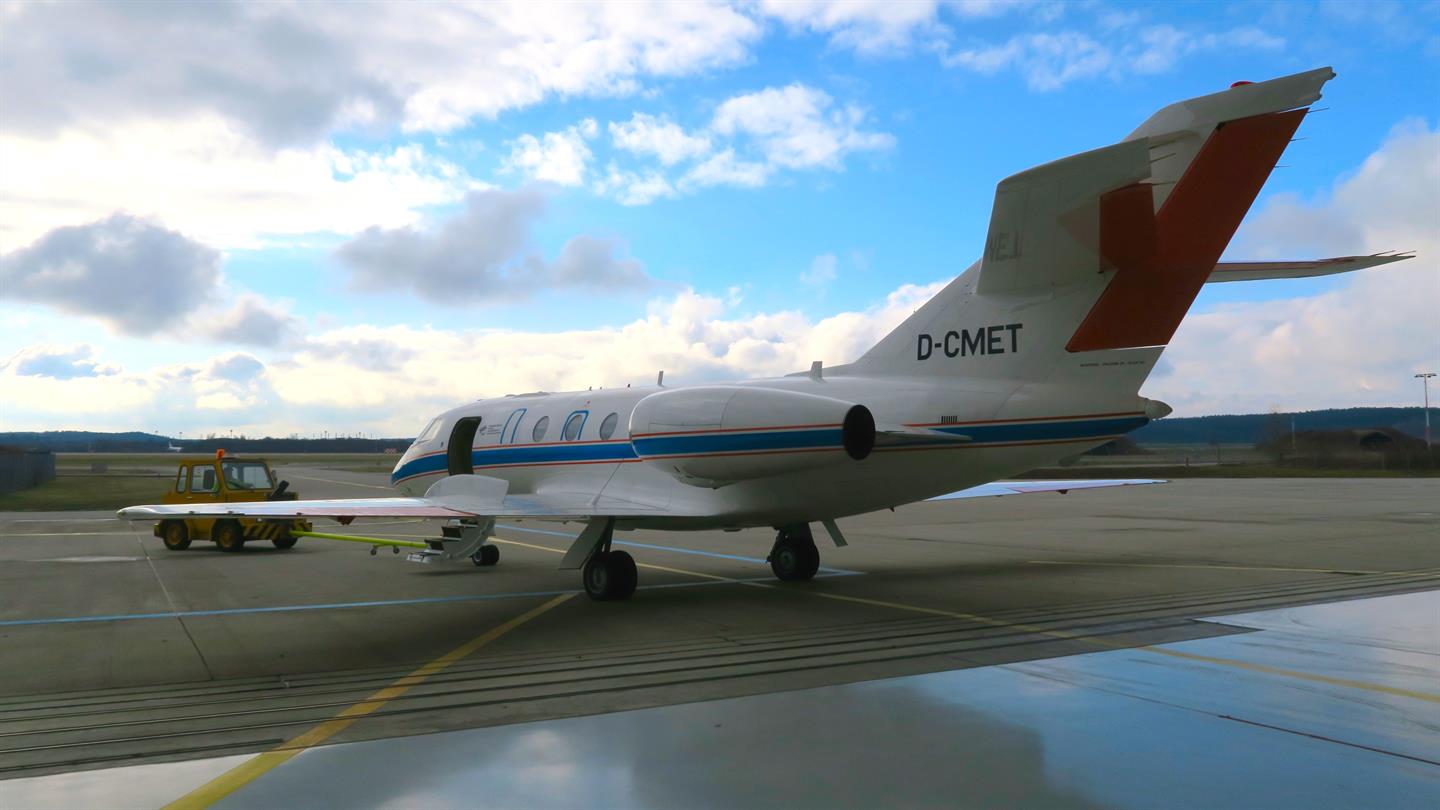
At the end of March 2019, the German Aerospace Center (Deutsches Zentrum für Luft und Raumfahrt; DLR) Falcon research aircraft will be taking off for what will be a world first in aviation. For the first time, a prototype of the new digital aeronautical radio standard LDACS (Lband Digital Aeronautical Communications System) will be tested. In future, this will enable secure and efficient data exchange between air traffic control centres and flight decks, up to and including 4D trajectories. In addition, the new technology is implementing an alternative navigation system for aviation, which determines the aircraft’s position using LDACS signals received by ground stations. The test flights will overfly four ground stations in Upper Bavaria. With these tests, the possibility of introducing the new system worldwide is within reach. “In principle, LDACS for aviation works in a similar way to mobile radio communications on the ground,” explains Michael Schnell, from the DLR Institute of Communications and Navigation in Oberpfaffenhofen, where the new technology has been undergoing development with external partners since 2007. “The ground station corresponds to the mobile phone base station, and the radio in the aircraft corresponds to the smartphone.” The new technology, with which pilots and controllers can benefit from improved communications, enables both highquality voice transmissions and fast data exchange. “The particular challenge was that no new frequencies could be made available for this digital service,” explains Christoph Günther, Director of the DLR Institute for Communications and Navigation. “It was thus necessary to develop procedures to enable the operation of this service in parallel with other services in the same frequency band.” The technology in the research project MICONAV (Migration towards Integrated COM/NAV Avionics) is currently being developed to flight maturity. For 80 years, analogue has been the norm in the air At present, air traffic controllers instruct pilots to change their course or flight altitude using analogue radio. This approach has been used since the 1930s. “It is still safe and robust, but awkward to use,” says Schnell. “The pilots still have to check in and out verbally and enter the radio frequencies manually.” The technology also requires a broad spectrum of frequencies. This is problematic because only limited frequencies are available and the number of flight movements continues to increase. Digital and 4D – flight paths with predicted times With LDACS, pilots and air traffic controllers will not only be able to communicate faster and more efficiently, but will also be able to exchange complex information that cannot be transmitted over analogue radio. In the future, pilots will be able to digitally specify fourdimensional trajectories for the aircraft, that is, flight paths with predicted times. In addition, together with satellite navigation systems, the new technology can provide precise locations for the aircraft by determining its distance from at least four ground stations. “If the signals from the GPS or Galileo satellites are unavailable for any reason, the pilots would still be able to find their precise location via LDACS,” says Schnell. “This creates an additional margin of safety.” Test field in Upper Bavaria “For the current test flights, the aircraft will be heading to newly established LDACS ground stations in Oberpfaffenhofen, Schwabmünchen, Peiting and Königsdorf,” says DLR test pilot Michael Grossrubatscher. The researchers are testing the new technology for adequate data transmission speeds, smooth transitions between ground stations, and the range and accuracy of the navigation function. “Until now, we have just been testing all of this in the laboratory using models, and it is a great moment to finally see the technology becoming fully operational in the air,” says Schnell. It is expected that it will take several years before this new system is actually introduced into control centres and airports worldwide. Since 2016 there has been a DLRled working group for standardisation at the International Civil Aviation Organization (ICAO). “Once the standard is 27 March 2019 5. 4. 2019 Modern technology for the flight deck https://www.dlr.de/dlr/en/desktopdefault.aspx/tabid-10081/151_read-32951/year-all//usetemplate-print/ 2/4 Last modified: 27/03/2019 15:27:02 finalised, manufacturers and airlines will be encouraged to adopt it,” explains Michael Schnell. “This should happen by 2022.” About the MICONAV project The MICONAV project is being cofunded by the aviation research programme LuFo V , organised by the German Federal Ministry for Economic Affairs and Energy. In addition to DLR and consortium leader Rohde & Schwarz GmbH & Co. KG, BPS GmbH and iAd Gesellschaft für Informatik, Automatisierung und Datenverarbeitung mbH (Computer Science, Automation and Data Processing Company) are partners in the consortium.
About the Author