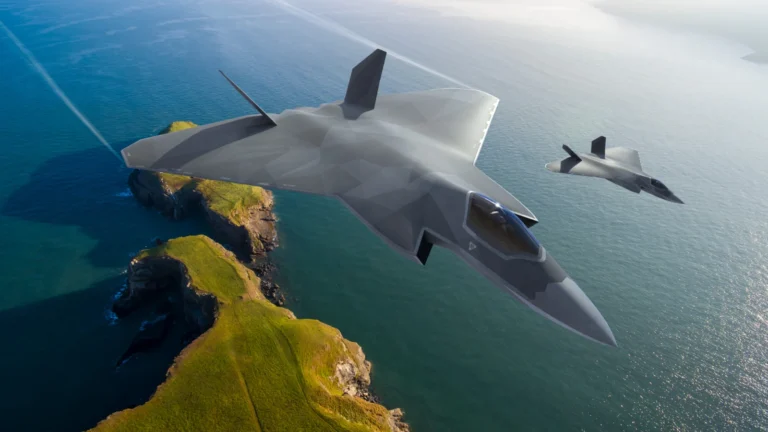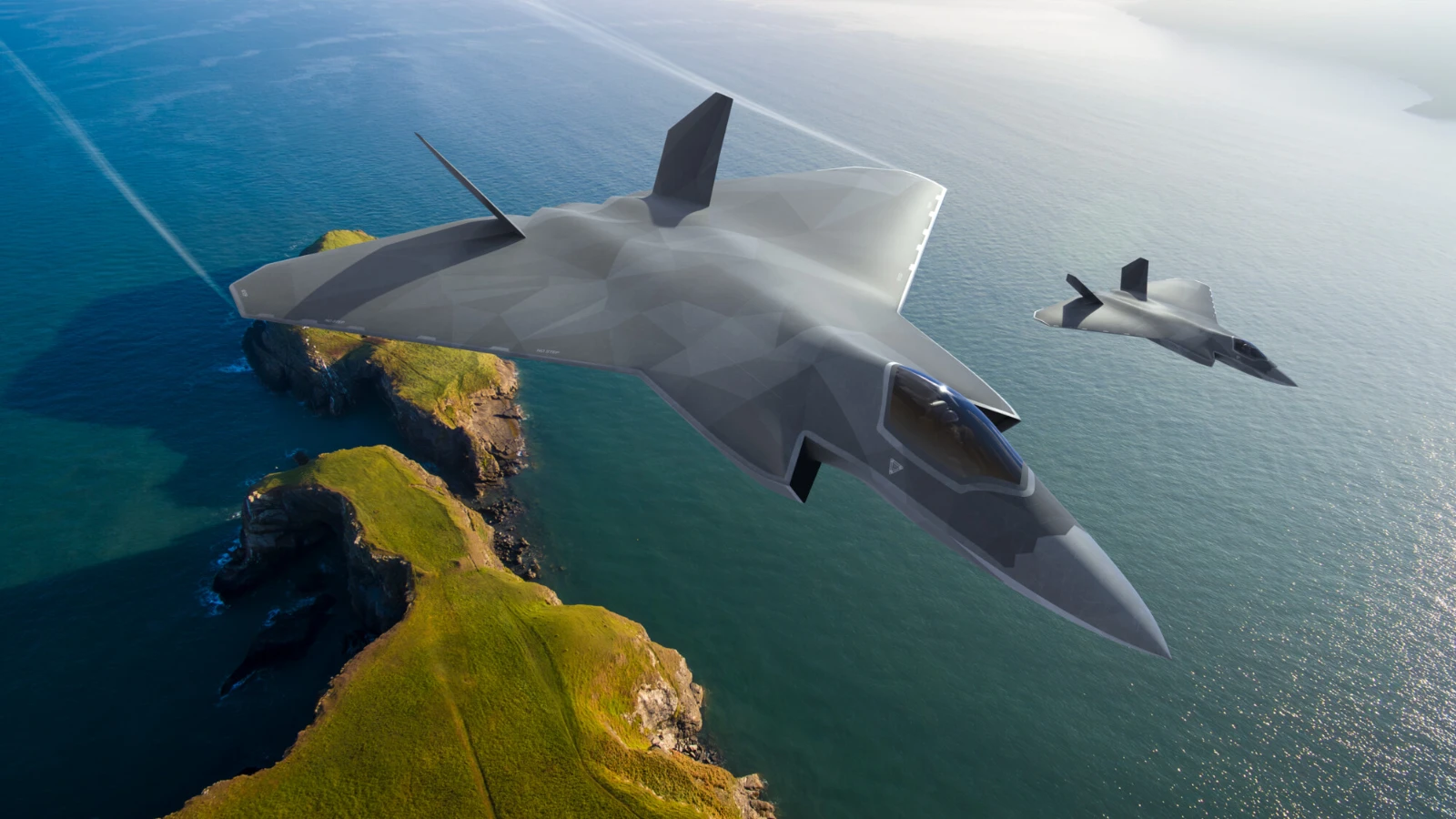
The Global Combat Air Programme. BAE Systems
Britain has publicly opened the door to German participation in the Global Combat Air Programme, creating a potentially significant new option for Berlin only four months after Germany and France abandoned the joint development of their planned sixth-generation fighter. No decision on German participation has been taken, and any expansion of GCAP would require agreement with Italy and Japan.
British Prime Minister Andy Burnham has publicly signalled that the United Kingdom is open to Germany joining the Global Combat Air Programme, or GCAP, currently being developed by Britain, Italy and Japan.
Speaking in Berlin on 8 October after talks with German Chancellor Friedrich Merz, Burnham said he had indicated to Merz Britain’s “openness to Germany joining GCAP” and added that London wanted to progress the issue with the programme’s two other founding partners, Italy and Japan.
The statement is significant because it moves German participation from industry and defence-policy speculation into an explicit discussion at head-of-government level.
It does not, however, mean that Germany has been formally invited to join GCAP as a full programme partner, nor that Berlin has decided to pursue that route.
The German government has so far made no corresponding announcement committing itself to GCAP.
Germany still needs a sixth-generation fighter solution
The timing is particularly important.
Germany and France concluded in June that their industries could not reach agreement on the joint development of the New Generation Fighter that had been intended to form the crewed combat-aircraft component of the wider Future Combat Air System programme.
Berlin and Paris did not abandon FCAS in its entirety.
German Chancellor Friedrich Merz and French President Emmanuel Macron subsequently confirmed that work on elements including the combat cloud and broader System of Systems architecture would continue. Macron explicitly stated that it was the common fighter aircraft that had been stopped, rather than the whole FCAS architecture.
Germany has therefore been left with an unresolved question: what follows the Eurofighter and F-35 in the crewed high-end combat-air role from the 2040s onwards?
The German Defence Ministry confirmed in June that it had already been examining several alternatives for months, including cooperation with European partners and participation in existing international programmes.
GCAP is now clearly one of those possibilities.
GCAP is already well beyond the concept stage
The British-Italian-Japanese programme is targeting entry into service of its next-generation fighter from 2035.
Unlike many future-aircraft concepts, GCAP already has both a formal multinational government structure and a common industrial organisation.
The three governments established the GCAP International Government Organisation, or GIGO, through an international treaty. Their industrial partners — BAE Systems, Leonardo and Japan Aircraft Industrial Enhancement Co., backed by Mitsubishi Heavy Industries — subsequently created the joint venture Edgewing to lead development of the aircraft.
In July 2026, the programme awarded Edgewing a £4.6 billion development contract, jointly funded by the three nations, to advance the aircraft’s design, establish key requirements and conduct testing. Britain has separately committed £8.6 billion to GCAP over four years under its Defence Investment Plan.
The programme is therefore moving deeper into a phase in which key design requirements, industrial arrangements and workshare decisions will become progressively harder to change.
That makes the timing of any potential German involvement important.
Joining a multinational fighter programme early enough to influence requirements and industrial architecture is very different from joining once fundamental design and workshare decisions have already been taken.
Germany would not enter an empty partnership
Adding Germany would also be considerably more complicated than Britain simply extending an invitation.
GCAP was founded on an equal partnership between Britain, Italy and Japan. Its original agreement states that industrial work distribution should be proportionate to each country’s financial and technical contribution, while programme governance has deliberately been balanced between the three countries.
Any substantial German participation would therefore have implications for funding, industrial workshare, technology access and decision-making.
Burnham acknowledged that reality in Berlin by saying Britain would pursue the issue with Italy and Japan rather than presenting German membership as a bilateral UK-German decision.
Japan in particular has a strong schedule interest in protecting the programme’s 2035 target, as GCAP is intended to replace its F-2 combat aircraft.
The three partners have nevertheless repeatedly indicated that GCAP is intended to remain open to cooperation with trusted third countries.
Canada joined GCAP as its first formal Observer Nation in July 2026, but has not become a fourth full development partner.
Germany would represent a significantly larger proposition.
Why Germany is an unusually consequential candidate
There are several reasons why German participation would have much greater impact than adding another export customer or observer.
Germany already develops and operates the Eurofighter alongside Britain, Italy and Spain. Its aerospace industry therefore has decades of experience working with two of GCAP’s three founding nations on a major combat-aircraft programme.
Germany also possesses capabilities directly relevant to a future combat-air system through companies including Airbus Defence and Space, MTU Aero Engines, HENSOLDT, Diehl Defence, MBDA Germany and Rohde & Schwarz.
Those companies have already organised themselves into the Airbus-led Team Gen 6, established following the collapse of the common FCAS fighter programme. The German industrial group says it is prepared to develop a sixth-generation fighter together with European partners while integrating that aircraft into the broader FCAS System of Systems.
Berlin therefore does not face a simple binary choice between France and GCAP.
A German-led or broader European solution built around Team Gen 6 remains another possible route. Germany is also developing a nearer-term uncrewed combat-aircraft capability with Airbus, which aims to provide the Luftwaffe with an operational collaborative combat aircraft system from 2029.
No final German decision between these pathways has been announced.
A potentially major change to Europe’s combat-air landscape
If Germany eventually chose GCAP, the strategic consequences would extend far beyond another participant joining a fighter programme.
Three of Europe’s four Eurofighter nations — Britain, Germany and Italy — would then be aligned around the same future crewed combat aircraft, while France pursued a separate fighter path.
At the same time, Germany and France could continue cooperating on parts of the broader FCAS architecture, including combat-cloud technologies, even if their future fighter aircraft diverged.
That would create a European combat-air landscape quite different from the original FCAS-versus-GCAP division often presented in recent years.
Rather than two neatly separated future-air programmes, Europe could end up with overlapping networks of cooperation: common digital architectures and weapons in some areas, different fighter platforms in others, and increasing integration of autonomous collaborative aircraft across both.
For now, however, one fact matters more than the scenarios.
Britain has publicly put German participation in GCAP on the political table.
The next significant signal must come from Berlin — and from Rome and Tokyo.
What happens next
There are three developments to watch.
First, whether the German government confirms that formal discussions with GCAP have begun.
Second, whether Italy and Japan publicly support consideration of German participation.
And third, whether Berlin sees GCAP as an alternative to the Airbus-led Team Gen 6 proposal or whether German industry could somehow be incorporated into GCAP while retaining substantial sovereign technology and workshare.
Until those questions are answered, Germany joining GCAP remains an option rather than a decision.
But after the collapse of the common Franco-German fighter only four months ago, Britain’s public statement in Berlin represents the clearest political opening yet for Germany to take a fundamentally different path toward its next-generation combat aircraft.
Edited with the assistance of AI.
Sources: UK Prime Minister statements in Berlin; German Federal Government; UK Ministry of Defence; Japanese Ministry of Defense; GCAP International Government Organisation treaty documents; Airbus.
About the Author