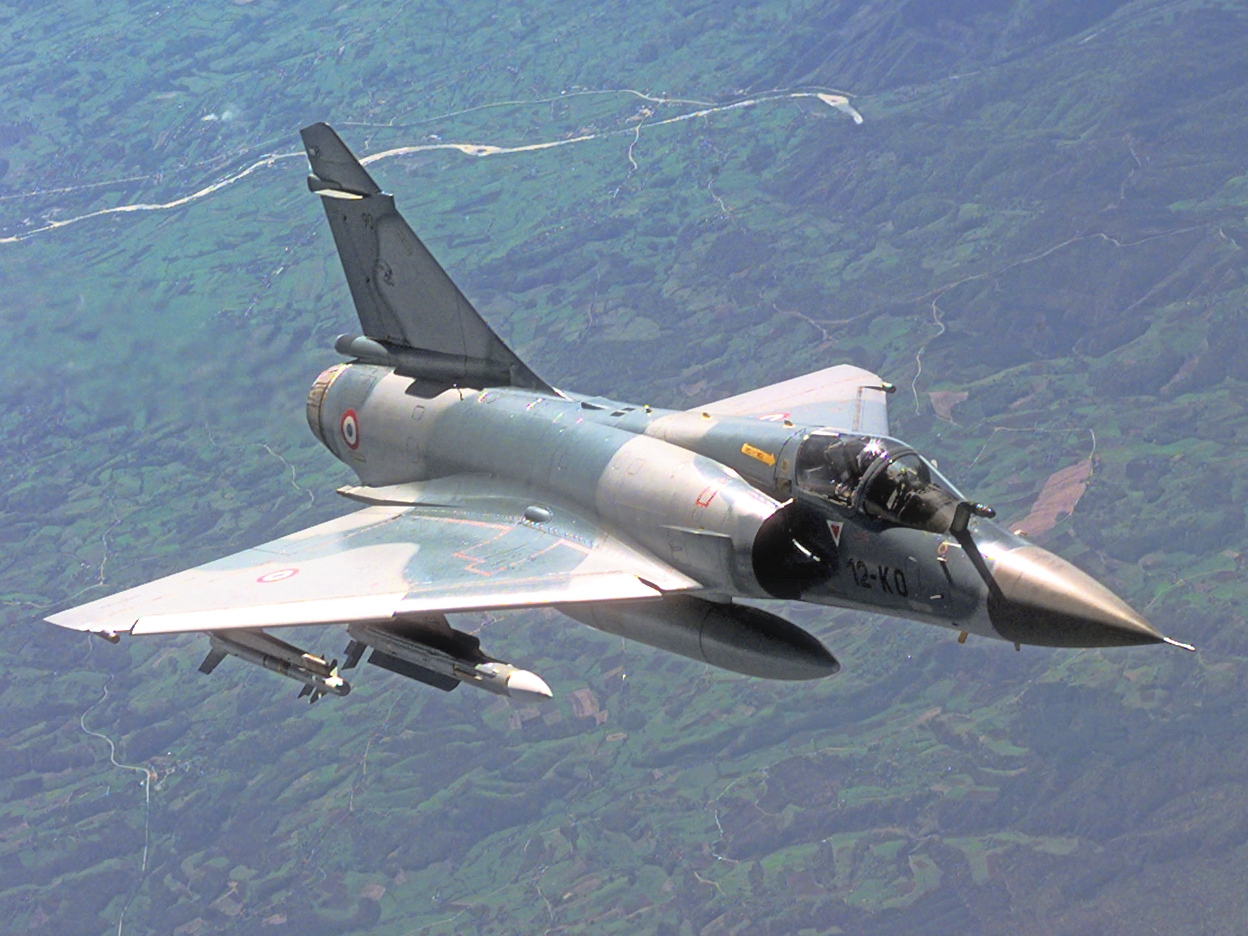
A French Air Force Mirage 2000C drops away from a United States Air Force KC-135R Stratotanker (not shown) after refueling during a Combat Patrol mission while participating in NATO Operation Allied Force. The KC-135R is based at Royal Air Force Mildenhall, England but is being flown by a crew deployed from the 384th Air Refueling Squadron, McConnell Air Force Base, Kansas. Tankers from RAF Mildenhall make-up a large portion of the tanker forces supporting NATO aircraft during NATO Operation Allied Force.
Belgium and France plan to transfer ten F-16 fighters and two Mirage 2000-5F aircraft to Ukraine by the end of 2026. The commitments, announced following the latest Ukraine Defense Contact Group meeting, come as President Volodymyr Zelenskyy publicly acknowledges the growing maintenance demands on Ukraine’s existing fighter fleet. The announcements highlight an increasingly important question: how effectively can Ukraine convert additional aircraft deliveries into sustained combat capability?
The 37th meeting of the Ukraine Defense Contact Group, held in Brussels on 17 November, resulted in several new military assistance commitments. According to an official summary published by Ukraine’s Ministry of Defence on 18 November, Belgium plans to deliver ten F-16 aircraft before the end of the year, while France intends to transfer two Mirage 2000-5F fighters.
The French package also includes AASM Hammer 250 precision-guided bombs, financed by Norway and Germany, as well as 30 mm ammunition and other aviation support. France has additionally committed to providing a Thales GF300 radar capable of detecting and tracking ballistic threats.
The planned deliveries reflect continued European support for Ukraine’s air defence and combat aviation capabilities. However, the announcements provide limited information about the operational condition of the aircraft, their readiness for combat or the extent to which they represent additions to previously announced commitments.
Uncertainty Over the Number of Operational Aircraft
Belgium’s latest announcement requires particular attention.
In June 2026, Belgian Defence Minister Theo Francken outlined plans to transfer seven F-16s to Ukraine during the year, including three intended for operational use and four to provide spare parts. In September, Zelenskyy again referred to an agreement covering three Belgian fighters before the end of 2026.
The latest Ukrainian announcement lists ten aircraft but does not explain whether this represents an expanded commitment, a revised delivery schedule or a combination of operational and non-operational airframes.
Consequently, the figure should not automatically be interpreted as ten additional combat-ready fighters.
Similar uncertainty surrounds the French Mirage 2000-5F commitment. As Yuri Zoria noted in a report published by Euromaidan Press on 19 November, two additional Mirage aircraft had already been expected earlier in 2026. It remains unclear whether the latest announcement refers to those previously planned aircraft or a separate delivery.
Neither Paris nor Kyiv has publicly disclosed the current operational strength of Ukraine’s Mirage fleet.
Zelenskyy Highlights F-16 Maintenance Pressures
During his address to the Contact Group, President Zelenskyy identified aircraft maintenance as a significant constraint on Ukraine’s existing F-16 operations.
He explained that fighters employed in intercepting Russian drones and missiles frequently require extensive servicing and repairs, reducing the number of aircraft available for immediate missions. He also called for another 40 F-16 fighters and additional Mirage aircraft, emphasising that the latter could be integrated more rapidly than new aircraft types requiring entirely separate training programmes.
The remarks underline the distinction between the number of aircraft possessed by an air force and the number available for operational tasks at any given moment.
Ukraine’s F-16 fleet consists primarily of European-supplied aircraft that have already accumulated substantial service histories. Sustaining them requires continuous access to spare parts, engines, specialised maintenance equipment, qualified technicians and facilities capable of performing more extensive inspections and repairs.
These requirements are particularly demanding under wartime operating conditions, when aircraft may be required to conduct repeated defensive missions while maintenance infrastructure and logistical support remain under pressure.
The Growing Importance of Maintenance Infrastructure
International assistance for Ukraine’s fighter fleet already extends well beyond the delivery of aircraft.
In January 2026, the US Department of Defense awarded Sabena Aerospace Engineering a contract with a ceiling value of approximately $235.4 million to support Ukrainian F-16 maintenance, modifications, sustainment and material management, including work on F100 engines.
The arrangement covers intermediate- and depot-level maintenance, tasks that require specialist infrastructure and cannot always be performed by operational squadrons.
This illustrates a fundamental challenge for Ukraine’s air force. Additional fighters can increase the potential size of the fleet, but each aircraft also creates additional maintenance, personnel and logistical requirements.
Aircraft awaiting spare parts, extensive inspections or specialist repairs cannot contribute to immediate operational missions. Meanwhile, aircraft available for flight still depend on sufficient ammunition, fuel, trained crews and ground support.
The ability to generate sorties consistently therefore becomes at least as important as the number of aircraft delivered.
Different Aircraft, Different Operational Requirements
The F-16 and Mirage 2000-5F offer Ukraine complementary combat capabilities, particularly in the interception of Russian cruise missiles and unmanned aircraft.
The Mirage 2000-5F has already entered Ukrainian service and has been employed in air defence operations since 2025. Its continued operation depends on the availability of appropriate weapons, technical support and maintenance capacity.
The newly announced French assistance package includes both aircraft and ammunition, demonstrating the importance of supporting existing operational capabilities rather than concentrating exclusively on fleet expansion.
The AASM Hammer 250 precision-guided bombs provide an additional air-to-ground capability within Ukraine’s broader combat aviation inventory. However, the announcement does not establish which aircraft configurations will employ the newly supplied weapons.
Operating both F-16s and Mirage aircraft offers Ukraine access to different equipment, weapons and operational capabilities. At the same time, maintaining separate aircraft types requires dedicated technical expertise, spare-parts supply chains, training arrangements and maintenance procedures.
For Ukraine’s European partners, providing long-term support for these capabilities will remain essential as additional aircraft enter service.
From Aircraft Deliveries to Sustained Combat Capability
The latest commitments arrive at a time when Ukraine continues to face intensive Russian missile and drone attacks, placing considerable demands on its air defence network.
Additional Western fighters can provide greater operational flexibility, replace aircraft undergoing maintenance and potentially increase the number of missions available to Ukrainian commanders. Their contribution, however, will depend on how quickly they can be prepared for service and integrated into the existing force.
The publicly acknowledged maintenance challenges facing Ukraine’s F-16 fleet demonstrate why the effectiveness of military aviation assistance cannot be assessed through delivery figures alone.
The planned transfer of ten F-16s and two Mirage 2000-5Fs represents a further commitment to Ukraine’s combat aviation capabilities. Its actual operational value will be determined by aircraft condition, maintenance capacity, weapons availability and the ability to sustain flying operations over time.
For Ukraine and its international partners, the longer-term priority is therefore not simply to increase the number of aircraft, but to ensure that the expanding fleet can remain operational under sustained wartime demands.
Sources
Primary sources
- Ministry of Defence of Ukraine / Cabinet of Ministers, 18 November 2026 – Official summary of military assistance commitments following the 37th Ukraine Defense Contact Group meeting.
- Office of the President of Ukraine, 18 November 2026 – President Zelenskyy’s address concerning F-16 maintenance requirements, additional fighters and ammunition.
- US Department of Defense, January 2026 – Sabena Aerospace Engineering contract for Ukrainian F-16 sustainment and depot-level maintenance.
Additional reporting
- Euromaidan Press, Yuri Zoria, 19 November 2026 – Reporting on the Mirage commitment and uncertainty surrounding previously announced deliveries.
Photo Credit: Wikimedia Commons
About the Author