Ten days after Embraer reported the strongest first quarter in its history, the headline number still matters: US$1.4 billion in revenue, up 31% year-on-year. But the more important story sits behind the numbers. Embraer is showing what a balanced aerospace company looks like in 2026: commercial aircraft, executive jets, defence platforms, services, support, industrial investment and a growing backlog — all moving at the same time.
This is not only a quarterly earnings story. It is a signal about production discipline, defence demand, customer confidence and the renewed strategic value of aerospace manufacturing.
Embraer closed the first quarter of 2026 with revenues of US$1.447 billion, the highest first-quarter revenue level ever achieved by the company. Adjusted EBIT reached US$94 million, with an adjusted EBIT margin of 6.5%, compared with 5.6% in the same period of 2025. The company also reiterated its 2026 guidance, including consolidated revenues of US$8.2–8.5 billion, adjusted EBIT margin of 8.7–9.3%, and adjusted free cash flow without Eve of US$200 million or higher.
The figures are strong. But the structure of the growth is more interesting.
Embraer’s performance was not carried by a single business line. All major segments contributed. Commercial Aviation grew 45% year-on-year. Executive Aviation grew 30%. Services & Support grew 15%. Defence & Security grew 63%. For ACE readers, this last number deserves particular attention.
Defence & Security: From Programme Momentum to Industrial Weight
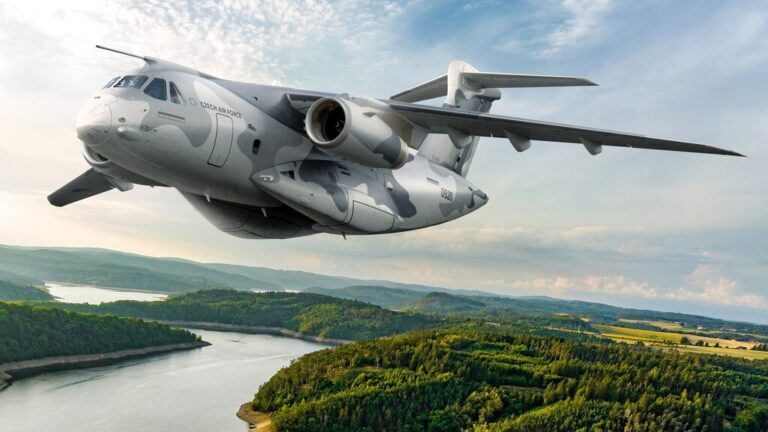
Defence & Security generated US$227 million in first-quarter revenue, up 63% year-on-year. The growth was driven by stronger KC-390 revenue recognition, related to customer mix and programme stage, and by increased production rates of the A-29 Super Tucano. The segment’s gross margin increased from 12.3% to 26.8%, while adjusted EBIT margin moved from -1.6% to 17.0%.
This is where the quarterly result becomes strategically relevant.
The KC-390 Millennium is no longer only a promising programme with export potential. It is increasingly becoming a production, delivery and revenue-recognition story. In practical terms, that means customer decisions are now translating into industrial activity. Orders are becoming aircraft. Aircraft are becoming programme maturity. Programme maturity is becoming financial weight.
For the European defence audience, this matters. Air forces are not only buying platforms. They are buying availability, supportability, interoperability and long-term industrial credibility. Embraer’s results suggest that its defence portfolio is moving deeper into that phase: not just selling capability, but scaling it.
The A-29 Super Tucano also remains relevant in a different part of the operational spectrum. While much of the European debate focuses on fifth-generation integration, air defence, long-range fires and unmanned systems, the global market still demands robust, affordable, deployable aircraft for training, light attack, ISR and security missions. The Super Tucano’s increased production rate underlines that this part of the market has not disappeared. It has simply become more operationally specific.
The Backlog Is the Real Message
Quarterly revenue is important. Backlog is more strategic.
Embraer reported a firm order backlog of US$32.1 billion in the first quarter of 2026 — an all-time high and 22% higher year-on-year. The company also described this as its sixth consecutive all-time high. Commercial Aviation backlog increased 50% year-on-year, while Services & Support and Defence & Security also grew.
That number matters because backlog is not only a measure of sales. It is a measure of trust.
Aerospace customers do not buy into uncertainty lightly. Airlines, governments, executive operators and defence ministries make decisions that depend on product maturity, supply-chain confidence, operational economics, support networks and long-term industrial credibility. A rising backlog across multiple business units indicates that Embraer is not growing through one isolated market cycle. It is building demand across a diversified portfolio.
This diversification is one of the company’s strongest strategic advantages.
Commercial Aviation gives Embraer scale and global airline relevance. Executive Aviation brings margin potential, brand strength and product visibility. Defence & Security gives long-cycle programme depth and sovereign capability relevance. Services & Support creates recurring revenue and long-term customer intimacy.
In a more unstable world, this kind of balance matters.
Deliveries: The Production Question
Embraer delivered 44 aircraft in the first quarter of 2026, compared with 30 aircraft in the same period of 2025 — a 47% increase. The deliveries included 10 commercial jets, 29 executive jets and five defence aircraft: one KC-390 Millennium and four A-29 Super Tucanos.
This is not just a delivery count. It speaks to one of the central challenges in aerospace today: turning demand into output.
Across the industry, the strategic bottleneck is no longer only market demand. It is execution. Can manufacturers stabilize supply chains? Can they increase production without losing quality? Can they protect margins while absorbing tariffs, logistics costs and supplier pressure? Can they deliver aircraft at the tempo customers require?
Embraer’s first-quarter figures suggest progress in production leveling, but they also show the complexity behind that progress. Commercial Aviation revenue grew strongly, but margins remained under pressure due to client mix, logistics costs and prior-year one-time effects. Executive Aviation revenue also grew, but margins were affected by client mix, U.S. tariffs and selling expenses related to the new Praetor 500/600 “E” family models.
That is the reality of aerospace in 2026: growth is possible, but it is not frictionless.
Services & Support: The Quiet Powerhouse
Services & Support generated US$490 million in revenue in the first quarter, up 15% year-on-year. Its adjusted EBIT margin increased from 9.9% to 14.3%, supported by higher volumes across all segments, particularly Defence & Security.
This segment should not be treated as a footnote.
In modern aerospace, the aircraft sale is only the beginning of the relationship. Availability, maintenance, parts, upgrades, training support, fleet management and lifecycle economics increasingly define customer satisfaction. For defence customers in particular, platform performance is inseparable from support performance.
The growth of Services & Support reinforces the idea that Embraer is not simply building aircraft. It is expanding the operational ecosystem around them.
That distinction matters. In both civil and military aviation, customers are under pressure to do more with existing fleets, extend capability, reduce downtime and manage cost. A strong support business gives Embraer resilience when delivery cycles fluctuate and strengthens its long-term position with operators.
Investment: Growth Is Being Built, Not Assumed
Embraer invested US$98.8 million on a stand-alone basis in the first quarter, compared with US$88.2 million in the first quarter of 2025. Including Eve, total investment reached US$148.6 million. The company also highlighted sustainable growth projects in Executive Aviation, Services & Support and MRO capacity, including investments in Brazil, the United States and Portugal.
This is another important signal.
The aerospace industry cannot grow by press release. It grows through facilities, engineering, tooling, production systems, supply-chain depth, workforce capability and after-sales infrastructure. Embraer’s investment profile suggests that the company is preparing not only to win orders, but to support a larger operating base.
For ACE, this is the central point: Embraer’s first-quarter result is not only about what the company sold. It is about what the company is becoming.
Why This Matters for Europe
For Europe, Embraer’s performance should be read in a wider context.
European air forces are modernizing. NATO countries are expanding capability requirements. Air mobility, training, ISR, light attack, special missions, unmanned integration and lifecycle support are all becoming more important. At the same time, commercial operators continue to look for efficient, right-sized aircraft and reliable support networks.
Embraer sits at the intersection of these requirements.
Its portfolio is not built around one mega-platform. It is built around a set of operational niches that are becoming increasingly relevant: regional aviation, executive mobility, tactical airlift, advanced turboprop capability, support services and future mobility through Eve.
That makes the company difficult to categorize — and strategically interesting.
It is not Boeing. It is not Airbus. It is not a niche defence house. It is not only a regional jet manufacturer. Embraer is something more unusual: a mid-sized global aerospace company with enough industrial depth to matter, and enough agility to move.
That may be its real advantage.
The ACE View
The first quarter of 2026 confirms three things.
First, Embraer has demand. A US$32.1 billion backlog is not a symbolic number; it is a long-term industrial workload.
Second, Embraer has momentum across segments. Commercial Aviation, Executive Aviation, Defence & Security and Services & Support all grew year-on-year.
Third, the defence side is becoming increasingly important to the company’s overall story. The KC-390 and A-29 are not peripheral programmes. They are now part of a broader growth engine that connects operational demand with production maturity and support capability.
The most interesting aerospace companies in 2026 are not necessarily the biggest. They are the companies that can connect engineering, production, defence relevance, commercial discipline and customer support into one coherent system.
Embraer’s record first quarter suggests that it is doing exactly that.
Conclusion:
Ten days after the announcement, the news is no longer that Embraer had a strong quarter. The news is that Embraer’s quarter tells us something larger about the aerospace market itself. Demand is returning to companies that can deliver real aircraft, real support, real industrial capacity and real operational relevance.
In that sense, Embraer’s first quarter is not only a result.
It is a reminder: aerospace power is built in factories, sustained through fleets, and measured over decades.
About the Author