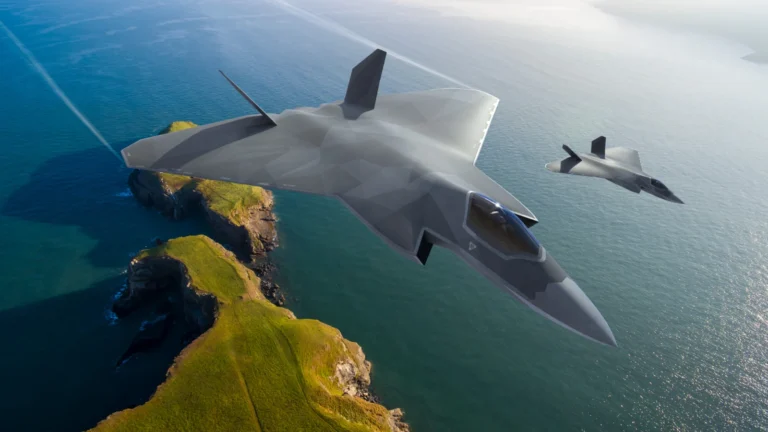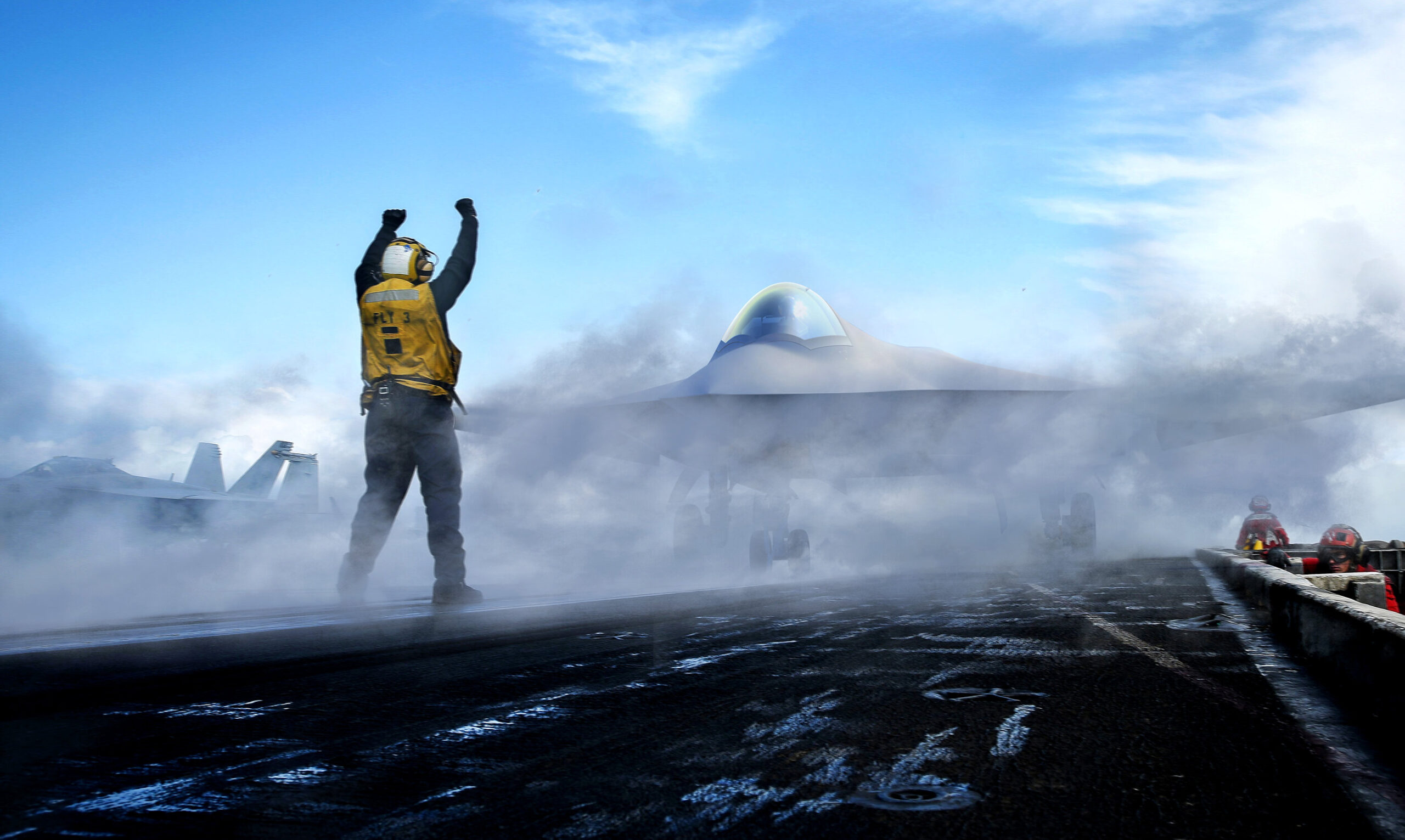
The Navy released this artist’s rendering of the Boeing F/A-XX, highlighting the Navy’s 6th-generation fighter intended to replace the service’s fleet of F/A-18 Super Hornets. Artist rendering: NAVAIR Public Release SPR-2026-0601. Distribution Statement A – “Approved for public release; distribution is unlimited.”
Boeing has been selected to develop the U.S. Navy’s F/A-XX sixth-generation carrier-based fighter, securing a full-scale development contract valued at more than $20 billion. The decision gives Boeing an extraordinary position in the future of U.S. combat aviation: the company is now developing both the Navy’s F/A-XX and the U.S. Air Force’s F-47 sixth-generation fighter.
The U.S. Navy announced the decision on September 29, selecting Boeing over Northrop Grumman after a competition that had become one of the most consequential combat-aircraft contests in decades.
The contract covers the full-scale development phase and includes multiple test aircraft for ground, airworthiness, systems and weapons-integration testing. The more than $20 billion figure therefore represents development rather than the eventual value of production across the future F/A-XX fleet.
The aircraft is intended to begin entering the Navy’s force structure in the 2030s, augmenting and eventually replacing the Boeing F/A-18E/F Super Hornet and EA-18G Growler while operating alongside the F-35C Lightning II.
Boeing now holds both U.S. sixth-generation fighter programs
The significance of the F/A-XX decision extends well beyond naval aviation.
In March 2025, Boeing was selected to develop the U.S. Air Force’s F-47 under its Next Generation Air Dominance program. Less than 18 months later, the company has now also secured the Navy’s separate next-generation fighter program.
It represents a remarkable reversal for Boeing’s combat-aircraft business.
Only a few years ago, the future of the company’s fighter manufacturing operation in St. Louis faced considerable uncertainty as production of established aircraft such as the F/A-18E/F approached its eventual end. Boeing is now positioned at the centre of the next generation of U.S. tactical combat aviation.
The historical parallel is particularly striking. A single manufacturer has not won separate U.S. Air Force and U.S. Navy frontline fighter competitions since the era of McDonnell Douglas, which was selected for what became the F-15 and later, together with Northrop, the aircraft that evolved into the F/A-18. Boeing acquired McDonnell Douglas in 1997.
The F-35 is an important distinction: Lockheed Martin supplies variants to the Air Force, Navy and Marine Corps, but these originate from a single Joint Strike Fighter program. F-47 and F/A-XX are separate service requirements and aircraft programs.
What is the F/A-XX?
Much of the F/A-XX remains classified, including its final configuration and many performance parameters.
The Navy describes the aircraft as a sixth-generation carrier-based strike fighter intended to provide greater operational reach and advanced mission capabilities while operating within a broader family of systems.
Boeing says the aircraft will incorporate advanced mission systems and an open mission systems architecture, with increased operational reach and capacity. Boeing Investors
That reach is particularly important.
Future carrier air wings may have to operate in environments where aircraft carriers remain farther from heavily defended areas than during previous generations of naval warfare. A longer-range combat aircraft would extend the effective striking and air-superiority radius of the carrier air wing without requiring the carrier itself to move closer to potential threats.
F/A-XX is also expected to operate as part of an increasingly mixed crewed-uncrewed force. The future carrier air wing is expected to combine the new fighter with the F-35C, Boeing MQ-25 Stingray unmanned tanker and future Collaborative Combat Aircraft. Aviation Week
This makes F/A-XX more than a direct one-for-one replacement for the Super Hornet. It is intended to become one of the central nodes of a much broader future naval combat system.
The end of one Boeing era and the beginning of another
There is a particularly symbolic detail in the timing of the announcement.
On the same day that Boeing secured F/A-XX, the U.S. Navy awarded the company a separate $16.7 million contract to prepare for the eventual shutdown of the F/A-18E/F Super Hornet and EA-18G Growler production lines.
The transition therefore becomes unusually visible: Boeing is simultaneously preparing the end of the production line that has defined U.S. carrier fighter aviation for decades and beginning development of the aircraft intended to succeed it.
The Super Hornet will not disappear quickly. Existing aircraft will remain operational for years, and the Navy continues modernization and service-life work on the fleet. But industrially, the direction is now clear.
Can Boeing develop F-47 and F/A-XX at the same time?
Winning both programs also creates a challenge.
Developing two highly classified sixth-generation combat aircraft simultaneously will require substantial engineering capacity, secure infrastructure, supplier capacity and capital investment.
Questions over whether the U.S. industrial base — and Boeing specifically — could support both programs had previously contributed to debate surrounding the timing of F/A-XX. Boeing says it anticipated exactly this situation.
Steve Parker, president and CEO of Boeing Defense, Space & Security, said the company had planned for two advanced fighter programs to proceed in parallel and invested accordingly. Boeing has also been expanding secure manufacturing infrastructure in St. Louis for next-generation programs. Breaking Defense
There may also be opportunities for common technologies, engineering processes, suppliers and manufacturing infrastructure between F/A-XX and F-47, although the two aircraft remain separate programs and the extent of any technical commonality is classified.
A broader transformation of Boeing’s fighter business
The F/A-XX award does not arrive in isolation.
On September 29, Boeing also received a $2.38 billion contract for another 22 F-15EX Eagle II aircraft, bringing the number of F-15EX fighters under U.S. Air Force contract to 120. Boeing says it is working toward a production rate of two F-15EX aircraft per month. Boeing
Combined with F-47, F/A-XX, continued F-15EX production and the MQ-25 Stingray program, the picture emerging around Boeing’s St. Louis defence operation is markedly different from only several years ago.
The company is no longer simply managing the final generations of fighter designs inherited from McDonnell Douglas. It is now responsible for a substantial part of the transition between current and future U.S. combat aviation.
For Northrop Grumman, meanwhile, the decision means losing the F/A-XX competition after Boeing had already secured the Air Force’s F-47. Lockheed Martin remains the prime contractor for the F-35, while Northrop continues to lead other major aerospace programs including the B-21 Raider.
What happens next with F/A-XX?
The immediate phase will focus on full-scale development and construction of test aircraft.
Those aircraft will support ground testing, airworthiness work, systems development and weapons integration before the program progresses toward operational capability in the 2030s.
Many of the details aerospace observers would most like to know — range, propulsion, weapons capacity, stealth characteristics, sensors and the aircraft’s precise relationship with Collaborative Combat Aircraft — remain classified.
But one fundamental feature of the future U.S. fighter landscape is now clear.
Two different services chose two different next-generation combat aircraft.
Both chose Boeing.
About the Author