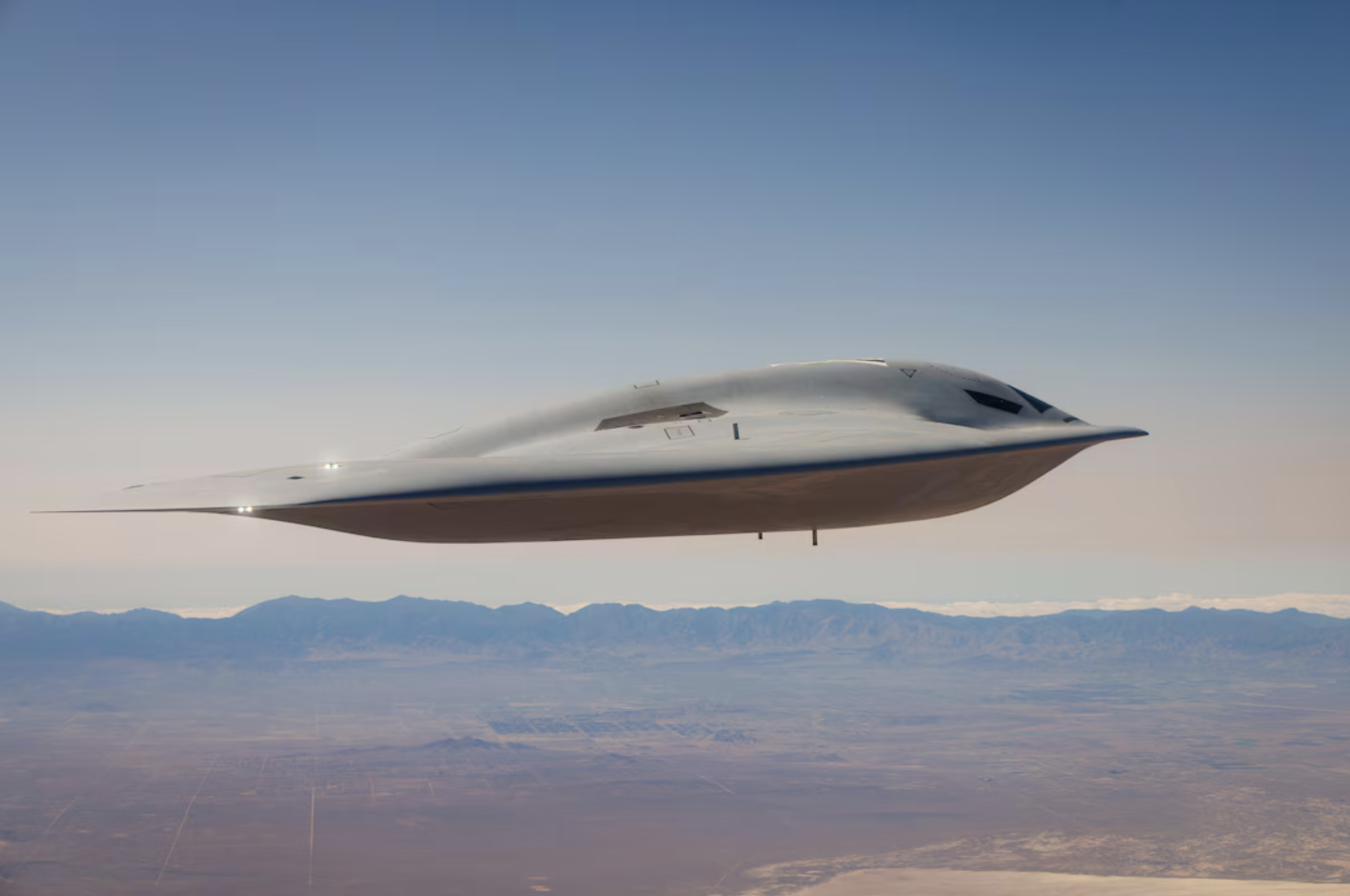
A file photo of the second B-21 Raider, the nation’s sixth-generation stealth bomber, conducting flight testing at Edwards Air Force Base, Calif., Sept. 11, 2025. The program is a cornerstone of the Department of the Air Force’s nuclear modernization strategy, designed to deliver both conventional and nuclear payloads. Photo: U.S. Air Force.
What Happens to Air Power When Everything Can Be Seen?
For decades, military aviation has invested enormous resources in making aircraft harder to detect. But the world around those aircraft is changing. Satellites, passive sensors, infrared systems, distributed radars and artificial intelligence are beginning to create something military planners have rarely experienced: a battlefield in which hiding may become progressively more difficult. That does not necessarily mean the end of stealth. It may mean something more profound — a change in what stealth is for.
The central problem of military aviation has always involved information. Long before radar, pilots attempted to find an enemy before the enemy found them. Radar extended that contest beyond human eyesight, electronic warfare complicated it, and stealth changed it again by reducing the distance at which an aircraft could reliably be detected and engaged. Each technological generation altered the geometry of the contest, but the underlying objective remained remarkably consistent: see the opponent first while delaying the moment at which the opponent can see you.
Something may now be changing in that equation. Speaking in September 2026, Chairman of the U.S. Joint Chiefs of Staff Gen. Dan Caine warned that American forces should increasingly assume that their formations will be tracked in real time. U.S. military leaders have begun using terms such as “hyper-transparent warfare” to describe an environment in which space-based observation, commercial sensors, electronic intelligence and other sources make concealment increasingly difficult.
That proposition deserves to be taken seriously, but also treated carefully. Being observed is not the same as being identified. Identification is not the same as maintaining a track. A track is not necessarily accurate enough to support a weapon. And firing a weapon is not the same as successfully intercepting the target.
Those distinctions may determine the future of stealth.
Stealth was never invisibility
Public discussion of stealth has always suffered from a misleading metaphor. A stealth aircraft is not invisible. It is an aircraft designed to manage the probability and circumstances of detection across relevant parts of the electromagnetic spectrum.
Radar detection depends on many variables: frequency, geometry, aspect, power, processing, atmospheric conditions and the characteristics of both the radar and target. An aircraft optimised against one part of the radar spectrum does not disappear from every radar operating at every frequency and from every direction. Infrared sensors introduce another detection mechanism. Electronic emissions can reveal information without radar illumination at all.
The military value of stealth therefore does not depend upon remaining permanently undetected. Its value comes from changing the engagement problem. Reducing detection range gives an adversary less time. Reducing track quality complicates targeting. Breaking track continuity forces sensors to reacquire. Restricting the angles from which high-quality observations can be made changes where defensive systems must be placed.
Stealth, in other words, manipulates probability and time.
That distinction becomes critical when evaluating claims that new sensors could make stealth obsolete. A sensor capable of detecting the presence of an aircraft is interesting. A system capable of continuously determining its position with sufficient precision to guide a weapon is something quite different.
Detection is only the beginning
Consider what actually has to happen to shoot down an aircraft. A sensor must first detect something. The system must determine whether that detection represents a real target rather than clutter, interference or deception. The target must be classified and, depending on the engagement, identified. Its movement must be tracked with sufficient accuracy and continuity. Information may then need to move between sensors, command networks and weapons platforms. A weapon must receive an adequate firing solution, reach the relevant area and finally acquire or remain guided onto the aircraft during the terminal engagement.
This is a chain, and the chain takes time.
Former U.S. Air Force Lt. Gen. David Deptula has repeatedly emphasised precisely this distinction when discussing claims that emerging sensors could undermine stealth. Detection alone does not defeat low observability. An adversary must complete an entire engagement sequence.
This gives us a more useful way to think about the future. The relevant question is not whether a future sensor can see an F-35, B-21 or F-47. It is whether an integrated sensor and weapon network can convert that observation into a sufficiently accurate, persistent and timely targeting solution before the aircraft completes its mission, leaves the engagement envelope, destroys the sensor or disrupts the network.
That is a much harder problem.
But the sensor is no longer alone
This is where the argument becomes uncomfortable for stealth advocates. Historically, the contest could often be imagined as an aircraft against a radar. That mental model is becoming obsolete.
A modern detection architecture can combine multiple radars operating at different frequencies and locations with infrared search-and-track systems, passive radio-frequency sensors, airborne early-warning aircraft, satellites, electronic intelligence, commercial imagery and potentially even sensors aboard unmanned platforms. None needs to provide a perfect picture independently.
Their observations can be fused.
An infrared sensor might indicate that something is present. A low-frequency radar might provide a rough location. Passive RF sensing might associate an emission with the same area. Another radar observing from a different geometry might obtain a stronger return. A satellite might provide contextual information. Historical behaviour might suggest what kind of platform is likely to be operating there.
Artificial intelligence changes the economics of this process because it allows enormous quantities of imperfect observations to be compared much faster than humans could process them manually. The important development may therefore not be a revolutionary radar capable of defeating stealth. It may be the ability to extract useful information from a network of sensors that are individually insufficient.
That is why DARPA Deputy Director Rob McHenry’s recent comments deserve attention. McHenry has argued that the combination of sensor fusion, tracking, artificial intelligence and eventually quantum technologies could make operational hiding increasingly difficult. He has even questioned whether the stealth era, understood as an era in which platforms can expect to remain hidden, can continue indefinitely.
It is a remarkable argument coming from DARPA, an institution whose technological history is closely intertwined with the development of American low-observable capabilities.
Yet it does not necessarily lead to the conclusion that stealth is becoming obsolete.
It may lead to the opposite conclusion.
The paradox: a transparent battlefield could make stealth more valuable
Suppose a future battlespace contains hundreds or thousands of sensors. Assume that many can detect some indication of an aircraft, some of the time. The objective of low observability then changes.
The aircraft may no longer need to prevent every sensor from seeing anything. That could become impossible. Instead, it needs to prevent the sensor network from constructing a sufficiently accurate and persistent understanding of what it sees.
A weak detection here, an intermittent infrared observation there and an uncertain passive RF contact somewhere else do not automatically produce a weapon-quality track. The network has to determine whether those observations belong to the same object, where that object is going and whether it is the target worth engaging.
This creates a fascinating reversal. The more dependent warfare becomes on sensor fusion, the more valuable it may become to corrupt the information being fused.
Stealth then becomes only one element of a larger architecture including electronic warfare, emissions control, cyber operations, decoys, signature management, autonomous systems and deception. Low observability reduces the quality of some observations. Electronic warfare degrades others. Decoys introduce additional objects. Autonomous aircraft multiply the number of possible targets. Cyber operations may interfere with the networks carrying sensor data. Emissions discipline removes useful clues.
The objective is no longer simply to disappear.
It is to make the adversary uncertain.
From signature management to information management
This may represent the most important conceptual change.
Traditional stealth is primarily discussed as signature management: reduce radar cross-section, infrared signature, electromagnetic emissions and other observable characteristics.
Future stealth may increasingly become information management.
Imagine an air operation involving twenty crewed or high-value combat aircraft, two hundred collaborative autonomous aircraft and thousands of comparatively inexpensive decoys or other objects capable of creating radar, infrared or electromagnetic signatures. Add electronic warfare generating false or distorted information. Add cyber effects. Add sensors operating from aircraft, ships, ground stations and orbit.
The defending network may see an enormous amount.
Its problem becomes determining what matters.
Which tracks represent crewed aircraft? Which are autonomous weapons carriers? Which are decoys? Which emissions are genuine? Which apparent formations represent the real attack? Which target deserves the limited inventory of the most capable surface-to-air missiles?
In such an environment, increasing visibility does not necessarily increase understanding.
It may increase confusion.
The future contest could therefore move from hiding objects towards hiding meaning.
That is a fundamentally different interpretation of stealth.
Artificial intelligence cuts both ways
AI appears to offer the obvious solution to this information overload. A machine can compare radar returns, infrared tracks, satellite imagery and electronic emissions at speeds impossible for a human operator. It can identify correlations across enormous datasets and potentially recognise behavioural patterns that reveal what an aircraft is doing before the aircraft reaches its objective.
That creates the possibility of predictive warfare. A system might not need to continuously track every aircraft if it can infer where aircraft are likely to go based on previous movement, mission geometry, tanker locations, known bases, weapon ranges and hundreds of other variables.
This is potentially more consequential than simply building a more powerful radar.
But AI introduces its own vulnerability. Machine reasoning depends upon data, and an adversary that understands how the system constructs its picture can attempt to manipulate the evidence from which that picture is built. Decoys, deliberately misleading emissions, false tracks and unexpected behaviour are no longer merely ways of confusing a human radar operator. They become ways of attacking the opponent’s model of reality.
The competition then becomes recursive. AI systems interpret sensors. Other systems attempt to deceive those AI systems. The first systems learn to recognise deception. The opponent learns how that recognition works and changes the deception.
Stealth becomes part of an adversarial information problem.
Space changes the geometry
The proliferation of satellites adds another dimension because observation is no longer confined to sensors positioned within the immediate theatre of operations. Military and commercial constellations increasingly provide optical, infrared, radar and radio-frequency observations from orbit.
The consequences should not be exaggerated. Satellites do not provide continuous, perfect, real-time surveillance of every aircraft on Earth. Orbital geometry, revisit rates, resolution, weather, processing latency and the physical limits of individual sensor types still matter.
But the direction is important. More satellites mean more opportunities to observe activity. Commercial providers mean that sophisticated sensing is no longer exclusively the domain of major military powers. Automated processing means enormous quantities of imagery and RF data can increasingly be searched without requiring humans to inspect every observation.
This makes concealment before and after flight potentially as important as concealment during the mission. Aircraft movement on the ground, tanker activity, logistics, communications and patterns of deployment can all reveal information.
The aircraft’s radar cross-section is therefore only one part of its signature.
The entire operation has a signature.
Quantum sensing is not a magic stealth detector
Quantum technology is frequently introduced at this point with extravagant claims about “quantum radar” making stealth aircraft obsolete. The reality is much less convenient.
Quantum sensing is a broad family of technologies, not a single device. Quantum magnetometers, gravimeters, clocks and other sensors exploit quantum effects to achieve extraordinary measurement sensitivity. Some could eventually have important military applications.
Quantum radar is much more problematic. Maintaining useful quantum states across meaningful distances, dealing with photon loss, atmospheric effects, noise and converting laboratory advantages into operationally relevant range and performance are formidable challenges. There is currently no basis for assuming that a magical quantum radar will suddenly make low-observable aircraft transparently visible at combat-relevant ranges.
The more credible possibility is incremental rather than revolutionary. Quantum sensors may eventually become additional nodes within already complex sensor architectures. Better clocks can improve synchronisation. More sensitive measurement systems can detect phenomena conventional sensors struggle to resolve. Individually, none may defeat stealth. Collectively, they may add more information to the network.
And that returns us to the real problem: not the sensor, but the fusion of information.
Stealth itself is not standing still
There is another reason predictions about the death of stealth repeatedly fail: they implicitly freeze one side of the competition.
Sensors improve, but low observability improves too.
New materials can manage electromagnetic energy differently. Manufacturing tolerances improve. Computational electromagnetic modelling becomes more sophisticated. Infrared signature management advances. Electronic warfare becomes increasingly integrated into aircraft design. Adaptive mission planning can exploit gaps in sensor coverage. Uncrewed systems can operate as decoys, sensor nodes, weapons carriers or escorts.
The B-21 Raider and the emerging F-47 are therefore not simply newer versions of 1980s stealth. They belong to a different technological environment and are being designed around different assumptions about networking, sensors, electronic warfare and mission systems.
The competition is evolutionary.
Every improvement in detection changes the value of concealment. Every improvement in concealment changes the requirements for detection.
There is no obvious final winner.
The scarce commodity may become certainty
This leads to a different way of understanding future air warfare.
Perhaps information itself will not be scarce. There may be too much of it.
The scarce commodity will be certainty.
A commander may have hundreds of tracks but not know which represent the primary threat. A missile battery may detect multiple possible targets but hesitate to expend a limited interceptor. An AI system may assign probabilities to each object but still confront uncertainty deliberately manufactured by the opponent.
In that world, the objective of stealth is not necessarily to reduce the amount of information available to zero.
It is to reduce the adversary’s confidence below the level required to act effectively.
That is an important distinction because warfare ultimately requires decisions. Sensors do not shoot aircraft down. Organisations and increasingly autonomous systems use information from sensors to decide whether, when and where to employ weapons.
If uncertainty delays that decision by thirty seconds, those thirty seconds may have enormous tactical value.
If it delays it by five minutes, an engagement opportunity may disappear completely.
Stealth therefore buys something more valuable than invisibility.
It buys time.
What happens when everyone can see everyone?
Take this argument far enough and we arrive at a battlefield very different from the one for which twentieth-century stealth was conceived.
Both sides may possess enormous sensor networks. Both may use AI to interpret them. Both may employ autonomous systems. Both may deliberately manufacture false information. Both may observe the other’s satellites, aircraft, communications and logistics while simultaneously attempting to corrupt the opponent’s picture.
The battlefield becomes increasingly transparent and increasingly deceptive at exactly the same time.
That apparent contradiction may define twenty-first-century warfare.
More observation does not necessarily produce greater clarity. It can produce an arms race over interpretation.
The side with the best sensors may not automatically win. Nor will the side with the stealthiest aircraft.
The advantage may belong to the side that can build the most accurate picture of reality while preventing its opponent from doing the same.
This places stealth inside something much larger than aircraft design. It becomes part of a competition over whose version of reality survives contact with the enemy.
The end of invisibility may not be the end of stealth
So will the sky become transparent?
Probably more transparent than it has ever been.
Satellites will proliferate. Passive sensing will improve. Infrared systems will become more capable. Distributed radars will observe targets from multiple geometries. AI will connect observations that previously existed in separate databases. New sensing technologies will add still more information.
The assumption that a military aircraft can simply disappear from the battlespace may become increasingly difficult to sustain.
But that does not make stealth irrelevant.
It changes the objective.
The twentieth-century ideal was straightforward: do not let the enemy see me.
The twenty-first-century problem may be considerably more sophisticated: let the enemy see thousands of things, but prevent him from knowing which one matters, where it will be next and whether the information he is seeing can be trusted.
That would transform stealth from a primarily physical problem into an information problem.
Radar cross-section would still matter. Infrared signature would still matter. Aircraft geometry and materials would still matter. But their purpose would increasingly be to influence a much larger system: the adversary’s ability to construct reality quickly enough to act upon it.
The future of stealth may therefore not be invisibility at all.
It may be ambiguity.
For more than a century, military aviation has tried to make aircraft harder to see. The next century may be about something considerably more difficult: making what the enemy sees impossible to understand.
Editorial note: This analysis was researched and edited with AI assistance. Technical concepts and attributed positions were checked against publicly available material from DARPA, the U.S. Department of Defense, the U.S. Air Force, specialist air-power research and technical literature on radar, sensor fusion and emerging sensing technologies. Photo: A file photo of the second B-21 Raider, the nation’s sixth-generation stealth bomber, conducting flight testing at Edwards Air Force Base, Calif., Sept. 11, 2025. The program is a cornerstone of the Department of the Air Force’s nuclear modernization strategy, designed to deliver both conventional and nuclear payloads. Credit: U.S. Air Force.
About the Author