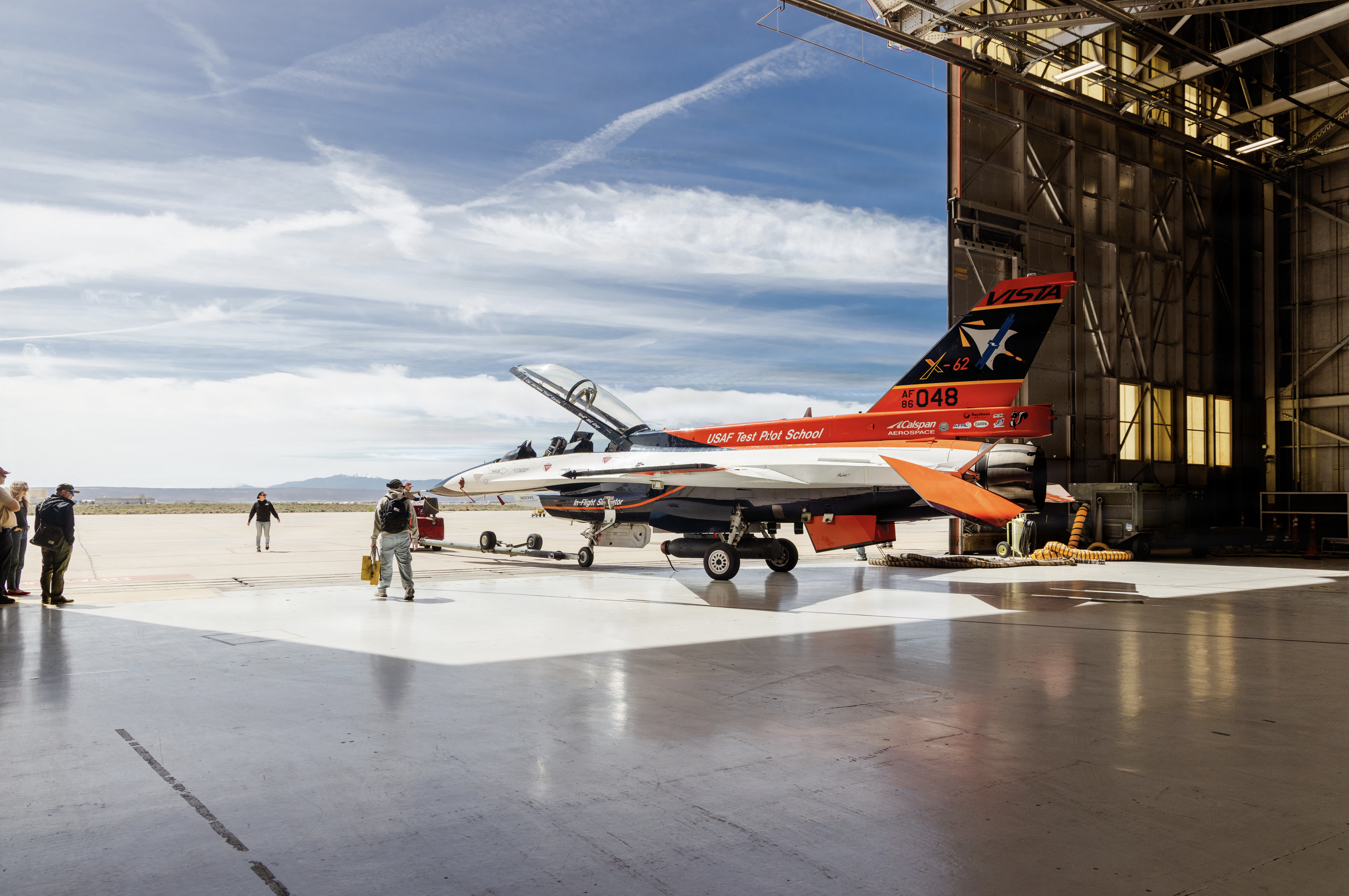
X-62 VISTA sets precedents with Mission Systems Upgrades, aligns human researchers with AI development for the warfighter
AI can already fly fighter aircraft, fight simulated opponents and make tactical decisions at machine speed. The real question is no longer whether machines can fight. It is how much of the fight humans will be allowed — or able — to control.
For more than a century, military aviation has been built around one fundamental assumption.
The aircraft may be the weapon, but the human makes the decision.
Artificial intelligence is beginning to challenge that division.
AI agents have already controlled real fighter aircraft in air-combat scenarios. The United States is converting operational F-16s into autonomous-capable testbeds. Europe has flown an AI agent aboard a Gripen E. Collaborative Combat Aircraft are being developed to accompany crewed fighters. And new autonomous combat aircraft are being designed without a cockpit at all.
Another European demonstration this week, in which experienced pilots reportedly competed against an AI air-combat agent in simulated engagements, generated the inevitable headline:
AI versus fighter pilots.
But whether a machine can win a dogfight may be the least important question.
The bigger question is what happens when the human becomes the slowest component of the kill chain.
The argument for autonomy is brutally simple: speed
Former U.S. Secretary of the Air Force Frank Kendall has been unusually direct about where he believes this leads.
After flying aboard the X-62A VISTA during AI-controlled air-combat testing in 2024, Kendall described the performance of the AI against an experienced human fighter pilot as roughly even.
But he also drew a much broader conclusion.
There are, he argued, inherent limitations to human beings. If machines eventually perform certain tasks better, automation history suggests machines will perform them.
Two years later, Kendall went considerably further.
Speaking about AI and military decision-making in July 2026, he argued that if AI eventually becomes better than humans at making targeting decisions, militaries will face pressure to let it do so.
That is an uncomfortable proposition.
It is also the logical destination of an argument increasingly heard throughout military AI development: future combat may simply move too quickly for humans to remain directly involved in every decision.
Kendall has specifically warned that the pace and density of future combat could exceed the ability of human processes to make sufficiently rapid decisions.
And that creates a paradox.
The better military AI becomes, the harder it may become to justify slowing it down to wait for a human.
DARPA is actually trying to solve a different problem
The famous AI-versus-pilot dogfights can easily obscure what DARPA’s Air Combat Evolution programme is really about.
Dogfighting was chosen as a challenge problem.
The larger objective is trust.
DARPA describes the eventual model as one in which a human pilot orchestrates multiple autonomous aircraft and moves from being the operator of a single platform towards becoming a mission commander.
That distinction matters.
The programme is not simply attempting to build an artificial fighter pilot.
It is exploring a new division of labour between humans and machines.
And the technology continues to move.
In July 2026, DARPA and the U.S. Air Force announced that modified F-16s under the VENOM programme had begun in-flight testing using AI agents to control the aircraft autonomously.
Unlike the unique X-62A experimental aircraft, VENOM converts standard F-16s into autonomy-capable platforms.
A pilot can switch between conventional human control and AI control.
The next step is increasingly clear: not one autonomous fighter demonstrating a manoeuvre, but multiple autonomous aircraft operating as part of a combat formation.
Europe is following a similar path
The same transition is visible in Europe.
In 2025, Saab and Helsing integrated Helsing’s Centaur AI agent into a Gripen E under Sweden’s Future Fighter Concept Studies.
During flights over the Baltic Sea, the Gripen handed control to Centaur.
The AI conducted complex manoeuvres in a Beyond Visual Range environment and, according to Saab, generated weapon cues while operating against another Gripen.
Importantly, the trials deliberately changed starting distances, speeds and geometries and even removed command-and-control data to test the system’s adaptability.
This was not an autonomous weapon independently deciding to kill.
A human remained in the system.
But the boundary between aircraft automation and tactical autonomy had clearly moved.
And that boundary will continue moving.
The fighter pilot may become a commander
One interpretation of this development is reassuring.
AI does not remove the pilot. It changes the pilot’s job.
Heather Penney, a former F-16 pilot and senior fellow at the Mitchell Institute, has argued that successful Collaborative Combat Aircraft will depend not simply on autonomy but on human-machine teaming.
Her concern is particularly important.
Adding autonomous aircraft to a formation does not automatically reduce workload. Poorly designed autonomy can increase it.
Pilots must understand what their autonomous teammates are doing, trust them sufficiently to delegate tasks and still retain enough awareness to intervene when necessary.
That means the future fighter pilot may spend less time physically flying and considerably more time commanding.
One human could establish objectives and tactical priorities while several autonomous aircraft decide how best to manoeuvre, position sensors, conduct electronic attack or employ weapons.
The relationship would no longer resemble pilot and aircraft.
It would resemble commander and formation.
But there is another possibility.
What if the human becomes the problem?
A human commander has enormous advantages.
Judgement. Context. Experience. Intuition. Moral responsibility.
Humans also have limitations.
They become overloaded.
They become tired.
They can monitor only so many sensors and aircraft simultaneously.
And they require time to understand information before making a decision.
Machines have different limitations, but reaction time is not one of them.
An AI system could potentially process sensor information, classify threats, calculate engagement geometries and coordinate several aircraft before a human has fully understood what is happening.
That creates an uncomfortable operational incentive.
If one force requires human approval at every critical stage while an opponent allows machines greater freedom to act, the second force may operate faster.
The question then stops being:
Can we keep a human in the loop?
It becomes:
Can we afford to?
Some technologists believe the answer may eventually be no
Palantir CEO Alex Karp has raised precisely this problem when discussing military AI.
His distinction between offence and defence is revealing.
For offensive action, he argues for human involvement. But in a defensive engagement occurring at machine speed, there may simply not be enough time.
Air warfare already contains examples of this logic.
Modern air and missile defence systems can detect, classify, prioritise and engage incoming threats with levels of automation that would have seemed extraordinary a generation ago.
Against hypersonic weapons, missile salvos or coordinated autonomous swarms, decision windows could shrink further.
The faster the threat, the stronger the argument for automation.
But speed does not resolve responsibility.
It makes it harder.
The counterargument: faster decisions are not necessarily better decisions
The International Committee of the Red Cross approaches the same technological trajectory from almost the opposite direction.
It warns that AI can increase the speed and scale of warfare while reducing human control.
More importantly, an AI system does not understand war in the human sense.
It processes information.
That distinction becomes critical in environments characterised by incomplete intelligence, deception, civilian presence, damaged sensors, electronic warfare and situations that were poorly represented — or entirely absent — from its training.
Researchers studying military AI governance have therefore challenged the assumption that simply placing a human somewhere in the process guarantees meaningful human control.
A person approving a machine-generated recommendation under severe time pressure may technically be “in the loop” while exercising very little independent judgement.
There is even a name for one part of this problem: automation bias.
Humans tend to trust automated recommendations, particularly when systems have repeatedly proved reliable.
Paradoxically, therefore, the better AI becomes, the harder it may become for humans to challenge it.
And this is where the technical debate becomes a political one
The disagreement is no longer hypothetical.
Governments are currently debating precisely how much human control should be required over autonomous weapons.
At United Nations discussions in Geneva in 2026, states disagreed over whether human judgement must involve direct real-time supervision or whether control exercised through system design, operational limits and command structures can be sufficient.
That sounds like a legal distinction.
On a future battlefield, it could determine how wars are fought.
Requiring direct human authorisation could preserve a clear human decision at the moment force is used.
Allowing broader forms of human control could permit autonomous systems considerably greater freedom to act.
The tension is obvious:
The military advantage of autonomy comes partly from removing human limitations.
The legal and ethical argument for human control comes from preserving human judgement.
Both cannot be maximised simultaneously.
Dogfighting is almost a distraction
This is why demonstrations of AI fighting human fighter pilots are fascinating — but potentially misleading.
A one-versus-one dogfight is understandable.
It produces a winner and a loser.
Future air warfare may look nothing like it.
Imagine instead one crewed fighter coordinating four autonomous aircraft.
One carries additional air-to-air weapons.
Another moves forward as a sensor.
A third conducts electronic attack.
A fourth deliberately exposes itself to provoke an adversary into revealing the location of its radar.
Now add space-based sensors, ground-based air defence, long-range missiles, electronic warfare and other autonomous formations.
At that point the question is no longer whether the AI can fly better than the human.
The problem is whether a human can comprehend the entire battle quickly enough to command it.
Perhaps the cockpit is not what disappears first
Predictions about autonomous combat aviation frequently imagine an obvious endpoint: eventually the pilot disappears from the aircraft.
That may happen.
But something more subtle could happen first.
The pilot remains in the cockpit while gradually surrendering tactical functions to machines.
First the aircraft flies itself.
Then AI manages sensors.
Then it recommends manoeuvres.
Then it coordinates accompanying autonomous aircraft.
Then it recommends targets.
Then it recommends weapons.
And eventually the human may be left approving decisions generated almost entirely by machines.
At that point the question of whether there is still a pilot sitting in the aircraft becomes almost secondary.
The real issue is whether the human is still meaningfully controlling the fight.
The final paradox
Military aviation has spent more than a century building better aircraft so that humans can make better decisions in combat.
Artificial intelligence reverses part of that relationship.
We are beginning to build aircraft that may eventually make some decisions better than humans.
Frank Kendall sees the operational logic: if machines can perform a task better, militaries will inevitably be tempted to use them.
DARPA sees a future in which humans rise above individual aircraft and command formations of autonomous systems.
Heather Penney warns that those teams must still be designed around meaningful human understanding and control.
The ICRC warns that accelerating warfare while reducing human judgement could create consequences extending far beyond aircraft performance.
None of these positions is technologically absurd.
That is precisely why the question is difficult.
The defining issue for the next generation of combat aviation may therefore not be whether artificial intelligence can replace the fighter pilot.
It may be whether militaries can preserve human judgement after machines become better at significant parts of the fight.
And if keeping a human in control makes one side slower than an opponent willing to delegate more authority to machines, the most difficult question will no longer be technical.
It will be this:
How much military advantage are we willing to sacrifice in order to keep war human?
Editorial note: This analysis was researched and edited with AI assistance. Technical, programme and policy information was checked against DARPA, the U.S. Air Force, Saab, the International Committee of the Red Cross and other publicly available primary and specialist sources. Photo:X-62 VISTA sets precedents with Mission Systems Upgrades, aligns human researchers with AI development for the warfighter
About the Author