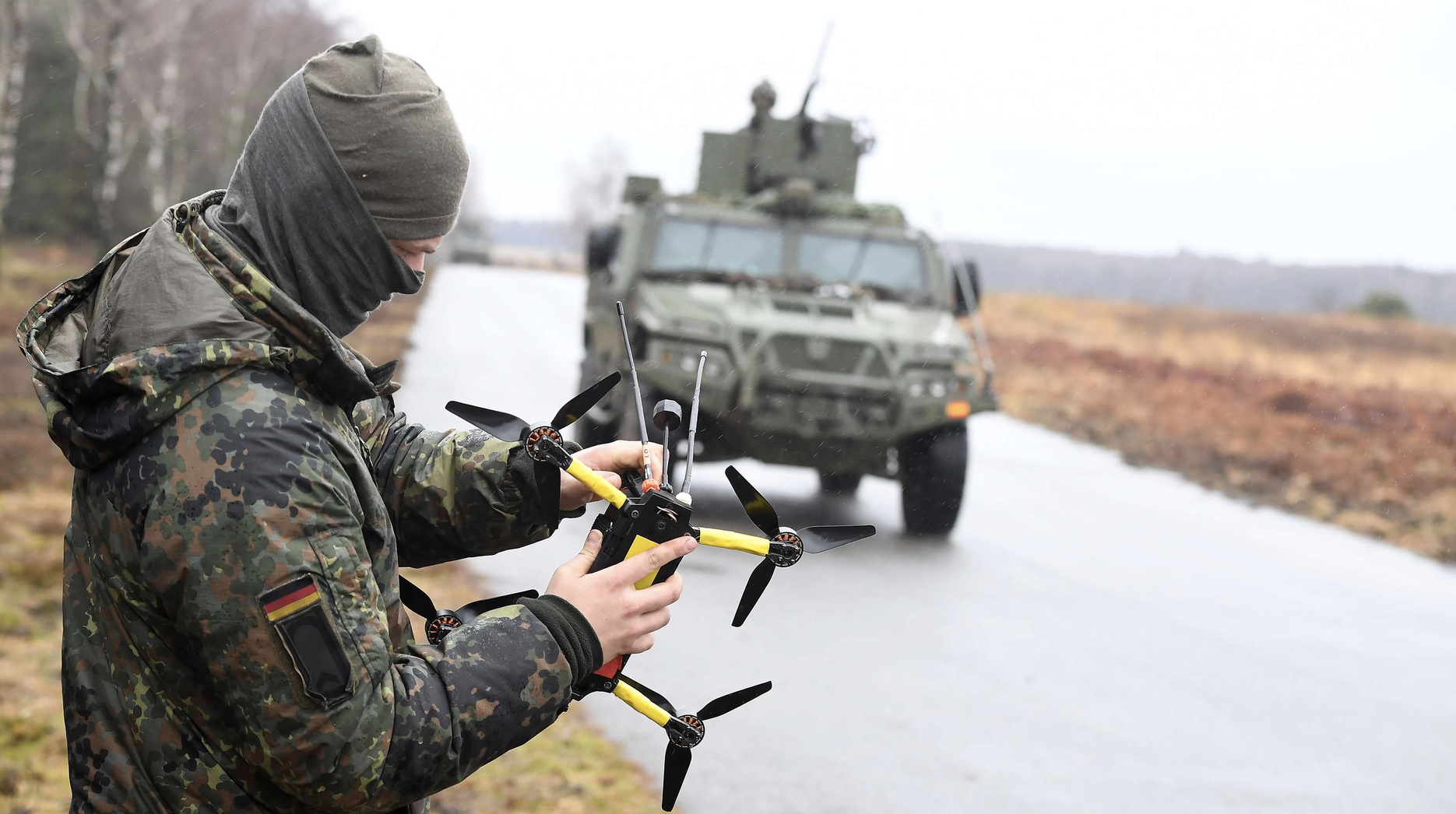
A Bundeswehr soldier operates a small unmanned aerial system during training at Bergen. Germany plans to establish its first dedicated drone regiment in 2027. Credit: Bundeswehr / Carl Schulze
Germany will establish the Bundeswehr’s first dedicated drone regiment in 2027, creating a new formation of up to 600 personnel focused on unmanned systems, loitering munitions and electromagnetic warfare.
Defence Minister Boris Pistorius announced the plan during a visit to the Bundeswehr training area at Bergen in Lower Saxony on 1 October, describing unmanned systems as a fundamental requirement for future land warfare.
The decision represents a structural shift for the German armed forces. Rather than treating drones solely as equipment distributed among existing units, the Bundeswehr will create a formation specifically designed to develop, operate and integrate unmanned combat capabilities.
The move comes as Germany simultaneously begins preparing for large-scale procurement of autonomous reconnaissance and strike drones.
Germany’s first dedicated drone regiment
The new regiment is expected to begin with around 300 personnel before growing to a planned strength of up to 600.
According to German Army Inspector Lieutenant General Christian Freuding, unmanned systems will nevertheless continue to be integrated across traditional formations including reconnaissance, infantry and armoured units.
The regiment is therefore not intended to centralise all Bundeswehr drone operations. Instead, it will provide a specialised capability capable of operating unmanned systems across a much wider operational range.
Pistorius said the regiment will cover systems ranging from very short distances to approximately 500 kilometres.
A dedicated company for electromagnetic warfare will also form part of the new unit.
That combination is particularly significant.
Experience from Ukraine has demonstrated that drones cannot be considered separately from the electromagnetic environment in which they operate. Jamming, navigation denial, datalink disruption and electronic reconnaissance have become integral elements of unmanned warfare.
Germany appears to be building those lessons directly into the organisational structure of the new formation.
Loitering munitions will form part of the new capability
The Bundeswehr says the regiment will also operate loitering munitions currently undergoing trials, with the first systems expected to reach operational units in 2027.
That timeline closely matches Germany’s broader effort to move from relatively small drone inventories toward mass deployment.
In April 2026, Rheinmetall received a Bundeswehr framework contract worth billions of euros for the FV-014 autonomous reconnaissance and strike system.
The first order is worth approximately €300 million, while the framework agreement includes options for a five-figure quantity of FV-014 systems.
Deliveries are scheduled to begin in the first half of 2027.
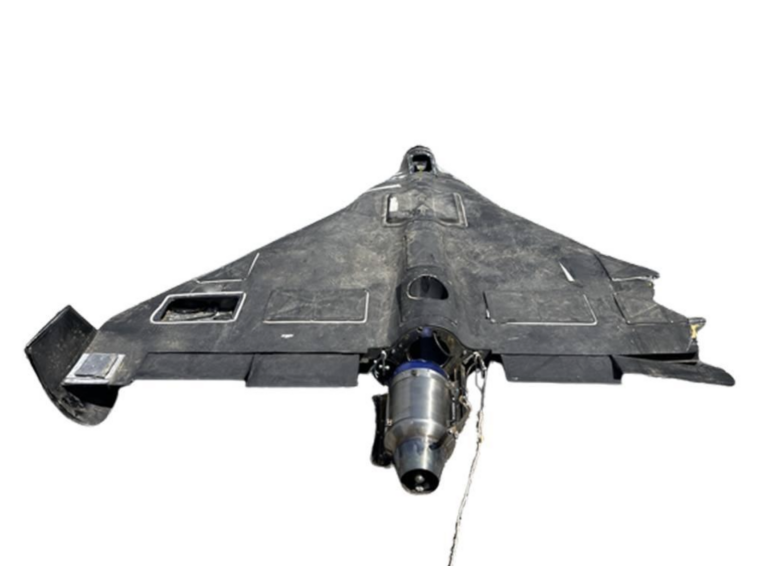
The FV-014 has a stated range of up to 100 kilometres, endurance of around 70 minutes and a four-kilogram warhead. Rheinmetall describes it as an autonomous reconnaissance and strike platform manufactured entirely within the European Union.
The coincidence of the procurement and organisational timelines is significant: Germany is preparing both the industrial supply and the military structures required to operate large numbers of unmanned systems.
Bundeswehr tests 40 systems with industry
The announcement came during a major Bundeswehr experimentation event at Bergen.
Around 40 systems were tested in operational scenarios involving soldiers, researchers and industry developers.
The approach reflects another lesson from Ukraine: drone technology evolves too quickly for traditional military procurement cycles built around platforms expected to remain largely unchanged for decades.
Software, sensors, electronic-warfare techniques and countermeasures can evolve within months or even weeks.
The Bundeswehr is therefore increasingly experimenting directly with industry and attempting to shorten the distance between prototype development and operational deployment.
AI is becoming part of the German drone ecosystem
Germany’s defence industry is meanwhile investing heavily in increasingly autonomous systems.
Rheinmetall describes the FV-014 as an autonomous reconnaissance and strike drone, while German defence technology company Helsing is developing its HX-2 software-defined strike drone.
HX-2 has a stated range of up to 100 kilometres and uses onboard artificial intelligence to continue mission execution in environments where GNSS or continuous communications are unavailable.
According to Helsing, the system can search for and re-identify targets despite electronic-warfare interference, while a human operator remains involved in critical engagement decisions.
HX-2 can also be integrated with Helsing’s Altra software platform for coordinated operations involving multiple drones, ISR assets, artillery and battlefield-management systems.
There is currently no confirmation that HX-2 has been selected for the new Bundeswehr drone regiment. Its development nevertheless illustrates the broader technological direction of Germany’s rapidly expanding autonomous-systems sector.
Ukraine is reshaping German land warfare
Pistorius explicitly linked the creation of the regiment to lessons from the war in Ukraine.
“Anyone who wants to prevail on land must master combat with unmanned systems,” he said during the Bergen visit.
The scale of drone warfare in Ukraine has transformed assumptions about reconnaissance, artillery targeting and precision strike.
Small UAVs provide near-continuous battlefield surveillance. FPV drones attack individual vehicles and positions. Long-range one-way attack systems strike infrastructure hundreds of kilometres behind the front.
At the same time, electronic warfare has become essential both to protecting friendly systems and disrupting those of an adversary.
Germany’s decision to combine unmanned systems and electromagnetic warfare inside a dedicated regiment suggests that the Bundeswehr is beginning to treat this as a coherent combat function rather than a collection of individual technologies.
Germany is moving toward drone warfare at scale
The new regiment should therefore be viewed in the context of a much wider transformation.
Germany is simultaneously building industrial capacity for thousands of autonomous systems, experimenting with new technologies alongside industry, integrating drones into conventional formations and creating a dedicated military organisation for unmanned warfare.
The Bundeswehr also plans to equip its Brigade 45 in Lithuania with counter-drone capabilities before the formation is fully deployed there.
The result is a two-sided effort: Germany is developing both its ability to operate large numbers of unmanned systems and its ability to defend against them.
The first drone regiment will start relatively small.
But its creation signals something much larger: drones, autonomy and electronic warfare are moving from experimental capabilities toward the core structure of the German Army.
About the Author