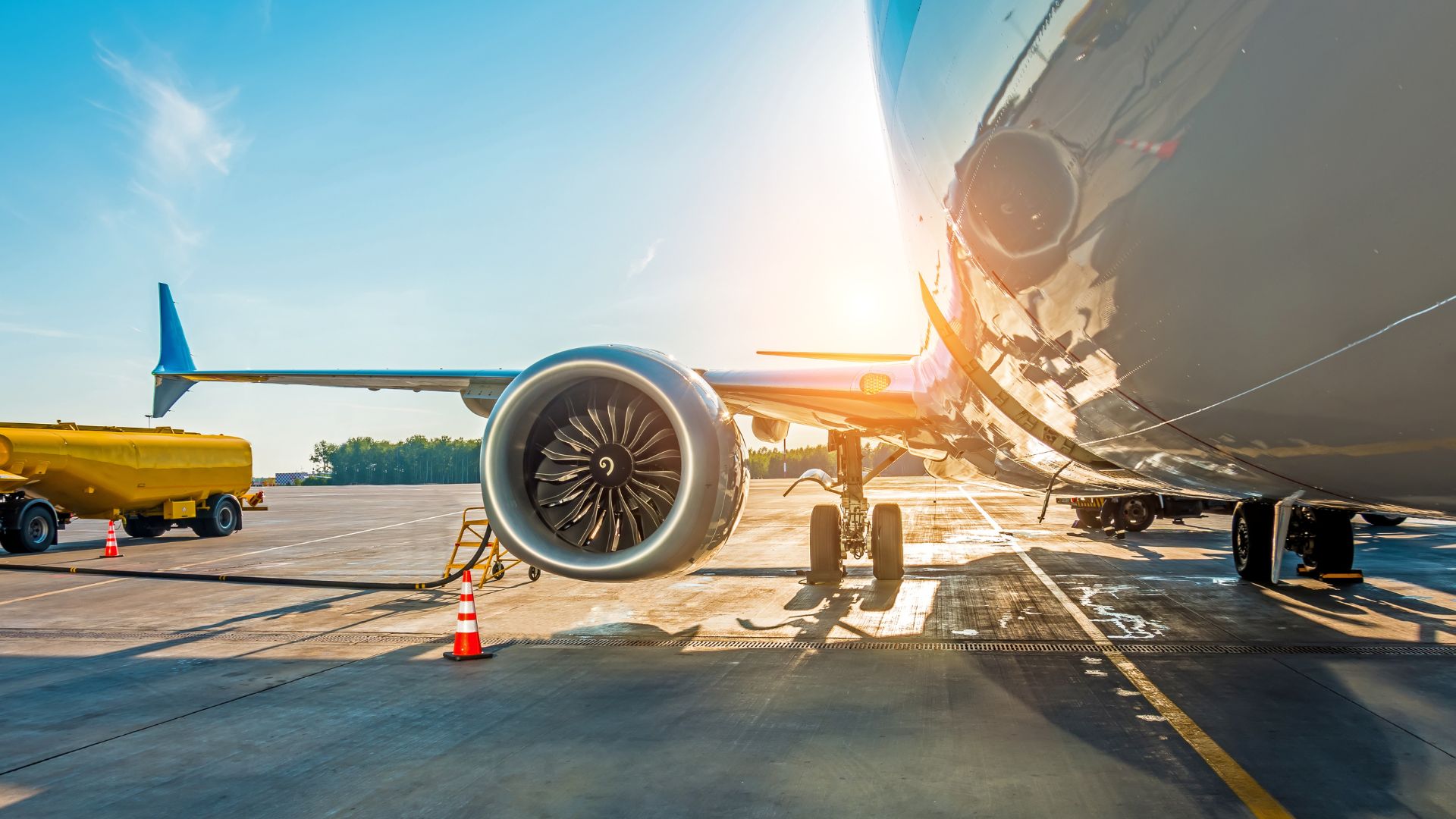
Europe has passed the first real test of its Sustainable Aviation Fuel policy. In 2025, SAF accounted for 2.79% of aviation fuel supplied at EU airports, comfortably exceeding the mandatory 2% ReFuelEU Aviation target. On paper, the policy worked. But underneath that success lies a more complicated market: SAF still costs roughly three times as much as conventional jet fuel, most of its feedstock comes from outside Europe, synthetic fuel remains commercially immature, and airlines argue that regulation is creating costs faster than production. The next SAF battle will not be about percentages. It will be about economics.
The European Union wanted to create a market for Sustainable Aviation Fuel.
It has.
In the first full year of the ReFuelEU Aviation mandate, European aviation fuel suppliers reported 39.3 million tonnes of aviation fuel supplied at EU airports.
Of that, approximately 1.1 million tonnes was SAF.
That corresponds to 2.79% of total supply, comfortably above the 2% minimum that became mandatory in 2025.
The increase was dramatic.
In 2024, only around 193,000 tonnes of SAF had been supplied in the EU. One year later, the volume had increased almost sixfold.
EASA Executive Director Florian Guillermet described the outcome simply:
“The SAF mandate under ReFuelEU Aviation was not only met but exceeded.”
Measured against its first regulatory objective, ReFuelEU Aviation is therefore a success.
But that is only the first question.
The harder one is whether Europe has created a competitive, scalable and economically sustainable SAF market — or primarily a regulatory obligation that airlines and fuel suppliers have successfully complied with.
Those are not the same thing.
The first number looks excellent: 2.79%
The logic behind ReFuelEU Aviation is straightforward.
Aviation cannot rapidly electrify in the way road transport can. Hydrogen may eventually play a role, particularly in smaller aircraft, but large-scale commercial aviation will continue to depend heavily on liquid energy for decades.
SAF is therefore one of the principal tools available to reduce aviation’s lifecycle carbon emissions without replacing the global aircraft fleet.
The European regulation attempts to create predictable demand by progressively increasing the mandatory SAF share.
It started at 2% in 2025.
That rises to 6% in 2030, 20% in 2035, 34% in 2040, 42% in 2045 and ultimately 70% in 2050.
A separate requirement for synthetic aviation fuels — often referred to as eSAF or Power-to-Liquid fuel — begins in 2030.
The policy theory is clear.
Guaranteed future demand should give producers enough confidence to build production capacity. More production should generate economies of scale. Greater scale should ultimately reduce cost.
The first part has demonstrably happened.
Demand exists.
But the second part — competitive economics — is considerably less certain.
The second number is more uncomfortable: €1,925 versus €640
EASA’s first-year data provides a rare opportunity to compare the economics with real market information.
The agency calculated an average 2025 SAF reference price of approximately:
€1,925 per tonne.
For conventional aviation fuel:
€640 per tonne.
SAF therefore cost roughly three times as much.
That price differential is the central economic problem facing aviation decarbonisation.
Airlines operate on notoriously thin margins. Fuel is already one of their largest operating costs.
A regulation can require an airline to consume SAF.
It cannot make the cost difference disappear.
And this is where the view from the airline industry becomes significantly more critical.
IATA argues that the price airlines actually pay can exceed the underlying production premium because certification, trading, logistics, supply-chain margins and — particularly in regulated markets — compliance costs are added along the way.
The association has been unusually blunt.
According to IATA, European compliance fees have in some cases pushed the effective cost of mandated SAF to as much as five times the cost of conventional jet fuel.
That figure requires an important qualification.
IATA itself notes that these compliance-fee estimates come from a sample of airlines and airports, that exposure varies significantly between locations, and that not every carrier has the same fuel-supply arrangements.
Nevertheless, the dispute reveals the fundamental tension in European SAF policy.
The regulator measures physical supply.
The airline measures the final invoice.
Both can simultaneously be correct.
Mandates create demand. They do not automatically create supply.
This distinction becomes even more important when Europe’s experience is placed in a global context.
IATA estimates global SAF production will reach approximately 2.4 million tonnes in 2026.
That sounds substantial until it is compared with global jet-fuel consumption.
It represents only around 0.8% of aviation fuel use.
More surprising is the difference between potential capacity and actual output.
IATA estimates that global SAF production capacity could exceed 9 million tonnes in 2026, yet only around 2.4 million tonnes may actually be produced.
Why?
Because a refinery capable of producing SAF does not necessarily have to produce SAF.
Some flexible facilities can manufacture other renewable products — including renewable diesel — which may provide more attractive returns.
That distinction is crucial.
Building nominal capacity does not guarantee SAF production.
An investment decision ultimately depends on expected returns.
If producers can earn more money making another product, regulation forcing airlines to buy SAF does not necessarily solve the supply problem efficiently.
This is why IATA Director General Willie Walsh argues that policymakers must think carefully about the sequence of mandates and incentives.
His position is essentially that production incentives should create supply before increasingly aggressive mandates force demand.
Europe has largely chosen to use both — but the balance between them is becoming increasingly important.
Europe produces the fuel — but imports the raw material
There is another remarkable contradiction hidden inside the EASA data.
Approximately 86% of the SAF supplied at EU airports in 2025 was produced within the European Union.
That appears to be an important industrial-policy success.
But approximately 85% of the feedstock used to make that SAF originated outside the EU.
China alone accounted for roughly 61% of imported feedstock, followed by Malaysia and Indonesia.
And one feedstock dominates the market:
used cooking oil.
Around 80% of the SAF supplied in Europe in 2025 was produced from used cooking oil.
That raises an uncomfortable question about what European energy independence actually means.
Europe may refine the fuel domestically.
But if the raw material is predominantly imported, part of the supply-chain dependency has simply moved upstream.
The distinction matters even more because SAF is not merely an environmental policy.
It is increasingly being presented as an industrial and energy-security strategy.
Europe wants domestic clean-energy production.
It wants to reduce dependency on imported fossil fuels.
It wants to build a competitive new industrial sector.
A SAF system heavily dependent on imported waste feedstocks only partially achieves those ambitions.
There is another problem with used cooking oil: there is not enough of it
The dominance of used cooking oil also exposes a scaling problem.
HEFA — Hydroprocessed Esters and Fatty Acids — is currently the dominant commercial pathway for producing SAF.
It works.
It is certified.
The technology is mature.
And today it supplies the vast majority of Europe’s SAF.
But the available pool of genuine waste oils and fats is finite.
Aviation is also not the only industry that wants them.
Road transport, chemicals and other energy sectors compete for many of the same sustainable feedstocks.
The implication is unavoidable:
Europe cannot reach 70% SAF in 2050 simply by collecting more used cooking oil.
The future system must diversify.
Advanced biofuels will have to grow.
Other waste streams will matter.
And above all, synthetic aviation fuel will eventually need to become a major part of the market.
That is where Europe’s apparently successful SAF story becomes considerably more uncertain.
2030 looks achievable. eSAF is the harder test.
EASA’s current production assessment is relatively encouraging for conventional SAF.
Its 2026 report estimates that EU production capacity could reach approximately 3.7 million tonnes by 2030 when facilities under construction and projects that have passed final investment decision are included.
More optimistic scenarios incorporating high-credibility projects could provide considerably more.
That suggests Europe’s overall 6% SAF requirement in 2030 is within reach.
But synthetic fuel tells a different story.
Synthetic aviation fuel is produced using renewable electricity, hydrogen and captured carbon rather than biological feedstocks.
Its theoretical advantages are considerable.
It can dramatically reduce dependency on limited waste oils.
Production could eventually be geographically diversified.
And, when produced using genuinely renewable energy, its lifecycle carbon performance can be extremely strong.
But it remains expensive.
And industrial-scale production barely exists.
EASA says roughly 50 European synthetic-fuel projects are currently awaiting final investment decisions.
That phrase — awaiting final investment decision — may be the most important in the entire SAF debate.
An announced plant is not a refinery.
A memorandum is not production.
A project pipeline is not fuel.
Investors need confidence that expensive facilities will have buyers for decades and that the price those buyers can afford will provide an adequate return.
Airlines need exactly the opposite: lower prices.
Bridging those two requirements may prove much harder than setting a blending percentage in legislation.
Europe knows it has an investment problem
The European Commission’s response suggests policymakers are well aware of the issue.
Its Sustainable Transport Investment Plan estimates that more than €100 billion of investment may be needed by 2035to scale renewable and low-carbon fuels for aviation and maritime transport.
Several EU Member States have also formed an eSAF Early Movers Coalition.
Germany, Luxembourg and Austria are preparing a pilot double-sided auction backed by more than €2.1 billion.
The mechanism is interesting because it directly addresses the commercial gap.
Instead of simply ordering airlines to buy expensive fuel, a double-sided auction can provide producers with long-term revenue certainty while giving buyers access to more predictable pricing.
In other words, Europe is beginning to move from:
“You must buy this fuel”
toward:
“How do we make somebody willing to build the plant that produces it?”
That is a much harder industrial-policy question.
And this is where the SAF debate becomes ideological too easily
SAF is frequently discussed in extremes.
One side portrays it as the clear solution to aviation’s climate problem.
The other dismisses it as expensive greenwashing.
Neither position is particularly useful.
The 2025 European data shows that SAF is real.
It was supplied at 121 EU airports across all 27 Member States.
It delivered substantial lifecycle emissions reductions.
EASA estimates the SAF supplied under ReFuelEU Aviation generated weighted average lifecycle emissions reductions of approximately 89%, corresponding to around 3.77 million tonnes of CO₂-equivalent emissions avoided.
That is not hypothetical decarbonisation.
But the same dataset also demonstrates the limits of the current market.
SAF remains expensive.
Feedstocks are geographically concentrated.
The dominant production pathway cannot scale indefinitely.
And the technology required for the next major phase of decarbonisation remains commercially immature.
Both realities deserve to exist in the same discussion.
Airlines have another reason to care: competitiveness
There is also a specifically European concern.
Fuel mandates apply to departures from EU airports.
That means European airlines and foreign carriers operating from Europe face SAF-related costs on those operations.
But aviation is globally competitive.
Passengers can change hubs.
Cargo can move through different gateways.
Long-haul network economics can shift.
This is one reason ReFuelEU Aviation contains anti-tankering provisions designed to prevent airlines from loading excessive amounts of cheaper fuel outside the EU and carrying the additional weight into Europe.
But economic leakage is more complex than fuel tankering.
If decarbonisation materially increases the cost of connecting through an EU hub compared with an alternative outside the regulatory area, passenger and cargo flows can eventually respond.
That does not mean Europe should abandon environmental regulation.
It means the cost and design of that regulation matter.
A climate policy that relocates economic activity without proportionally reducing global emissions would be a poor outcome for both European aviation and climate policy.
Is the SAF mandate therefore a failure?
No.
Based on its first measurable objective, it is difficult to describe ReFuelEU Aviation as anything other than successful.
The required SAF appeared.
The 2% mandate was exceeded.
European production expanded.
Availability spread from a small group of airports to 121 airports across the Union.
And measurable lifecycle carbon reductions resulted.
But the first 2% was never going to be the difficult part.
The regulatory trajectory changes dramatically after 2030.
The overall SAF requirement rises from 6% in 2030 to 20% only five years later.
By 2050 it reaches 70%.
At those levels, Europe’s SAF policy cannot rely primarily on existing HEFA production and imported used cooking oil.
The market itself will have to transform.
The real test starts now
Europe has successfully demonstrated that regulation can create demand for Sustainable Aviation Fuel.
The next phase must demonstrate something more difficult:
that policy can also encourage enough investment, competition, feedstock diversification and technological development to make the market scalable.
That is ultimately the difference between a mandate and an industry.
The 2025 result — 2.79% SAF — deserves to be recognised as progress.
But another number deserves equal attention:
€1,925 versus €640 per tonne.
If that gap does not narrow as volumes increase, the political and economic pressure surrounding SAF will grow with every step of the mandate.
Europe has proved that it can make airlines buy SAF.
It has not yet proved that it can make SAF cheap enough, abundant enough and independent enough to become the foundation of aviation’s energy transition.
That may be the real test of ReFuelEU Aviation.
What’s next?
Three developments now matter most.
First, price. Scaling production needs to begin narrowing the gap between SAF and conventional jet fuel. If it does not, increasingly ambitious mandates will translate directly into higher aviation costs.
Second, feedstocks. Europe will need to reduce its heavy dependence on imported used cooking oil and develop genuinely scalable alternative pathways.
Third, eSAF investment. Dozens of European projects must move from announcements and investment decisions into actual industrial production before the synthetic-fuel mandate becomes significant.
The first SAF target tested whether Europe could create demand.
It passed.
The next one will test whether Europe can create a market.
This article was edited with the assistance of artificial intelligence and reviewed by the Aerospace Central Europe editorial team.
Sources: European Union Aviation Safety Agency (EASA), ReFuelEU Aviation Annual Technical Report 2026 – 2025 in Review, September 2026; EASA ReFuelEU Aviation Dashboard; European Commission Directorate-General for Mobility and Transport, ReFuelEU Aviation and Sustainable Transport Investment Plan; International Air Transport Association (IATA), 2026 SAF production outlook and Global Outlook for Air Transport; IATA SAF policy and pricing analysis.
About the Author