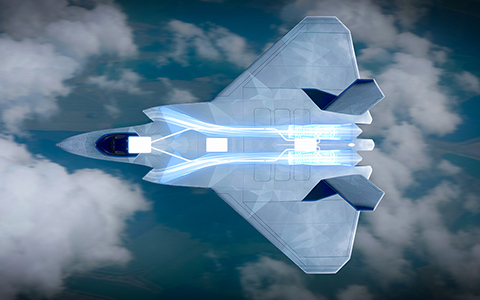
Northrop Grumman's jet-powered Talon Blue
The Royal Navy plans to fly Northrop Grumman’s jet-powered Talon Blue from HMS Prince of Wales in 2027. The announcement marks an important step towards a hybrid carrier air wing. But it leaves a fundamental engineering question unanswered: how do you safely recover a conventional jet-powered unmanned aircraft aboard a carrier without catapults or arresting gear?
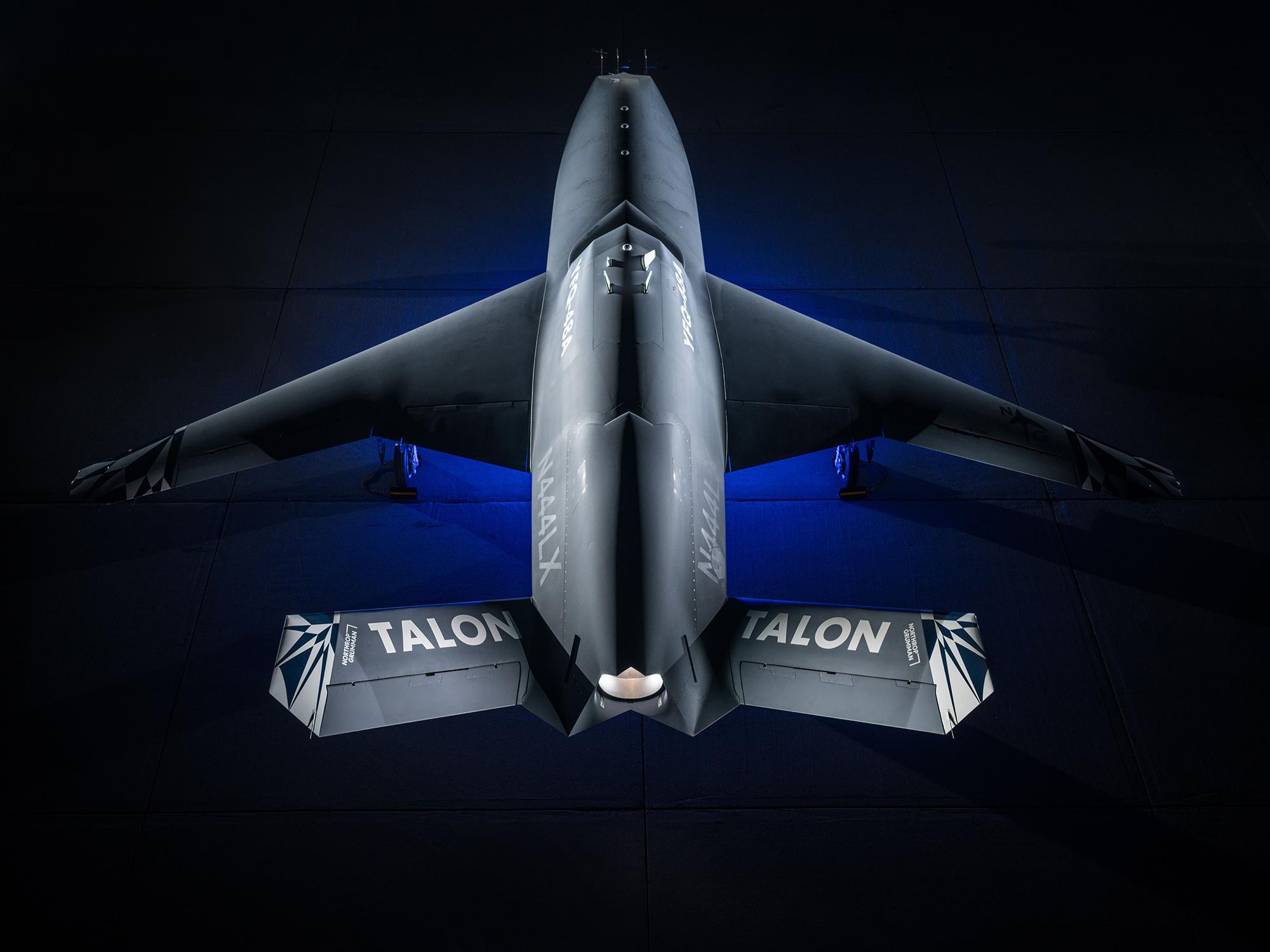
The Royal Navy is preparing to conduct an unusual experiment aboard one of its most valuable warships. In 2027, Northrop Grumman’s YFQ-48A Talon Blue, a jet-powered collaborative combat aircraft, is expected to take off from a Queen Elizabeth-class aircraft carrier as part of Project Vanquish.
The announcement was made by First Sea Lord General Sir Gwyn Jenkins on 10 November 2026 during the International Sea Power Conference in Oslo. Northrop Grumman subsequently confirmed its intention to work with the Royal Navy towards the demonstration.
On the surface, this is another milestone in the rapid development of autonomous military aviation. But the Royal Navy faces an especially difficult technical problem.
Britain’s two aircraft carriers were designed around the F-35B, which can take off over relatively short distances and land vertically. They have neither conventional aircraft-launching catapults nor arresting cables to stop incoming jets.
Talon Blue is not an F-35B. It is a conventionally configured, jet-powered unmanned aircraft, and its successful autonomous flight from a runway in California does not establish that it can operate safely from a moving flight deck.
The Navy has announced a planned carrier launch. It has not publicly established how the aircraft will be recovered during the 2027 demonstration.
That distinction is more important than it might initially appear.
Taking Off Is Only Half the Problem
Northrop Grumman’s Talon Blue completed its first flight on 3 October 2026 at Mojave, California. According to the manufacturer, the aircraft performed taxiing, takeoff, flight manoeuvres and landing autonomously.
This was an important achievement for the programme, demonstrating integrated autonomous operation in a land-based environment. But an aircraft carrier presents a fundamentally different challenge.
A conventional runway provides a relatively predictable landing surface. Its length, orientation and position remain fixed. An aircraft carrier is moving, pitching and rolling, with wind conditions that can change significantly as the ship manoeuvres.
The landing distance available is also severely restricted. Aircraft intended for conventional carrier operations normally require arresting equipment to absorb their kinetic energy after touchdown. Britain’s Queen Elizabeth-class carriers were never equipped with such systems because their primary combat aircraft, the F-35B, does not require them.
An unmanned jet designed for conventional runway operations therefore needs a different solution.
One possibility is to develop a sufficiently capable short-takeoff-and-landing configuration, allowing the aircraft to operate within the available deck length. That introduces demanding aerodynamic and structural requirements, particularly during recovery. Low approach speed, controllability close to the stall and reliable wheel braking all become critical.
Another possibility is that the initial demonstration concentrates on launching the aircraft from the carrier, with recovery conducted elsewhere. This could provide valuable information about launch performance, shipboard integration and autonomous operations without immediately requiring a conventional deck landing.
The Royal Navy has not publicly specified which approach it will adopt for Talon Blue in 2027.
This uncertainty should not be mistaken for evidence that the programme is technically unfeasible. Project Vanquish was created precisely to investigate how jet-powered autonomous aircraft could operate from British carriers without conventional launch-and-recovery equipment.
But it does mean that a successful launch should not automatically be interpreted as proof of a fully operational carrier-based unmanned combat capability.
The Difference Between a Demonstration and an Air Wing
Britain has already demonstrated that unmanned aircraft can operate from its carriers.
In 2023, General Atomics’ Mojave successfully took off from and landed aboard HMS Prince of Wales, demonstrating short-field performance that allowed operations without catapults or arresting equipment.
More recently, in October 2026, the Royal Navy conducted additional drone trials aboard HMS Queen Elizabeth. These included operations with the Tekever AR5 and the launch of British-made Nyan one-way strike drones.
The developments are significant, but the differences between these platforms matter.
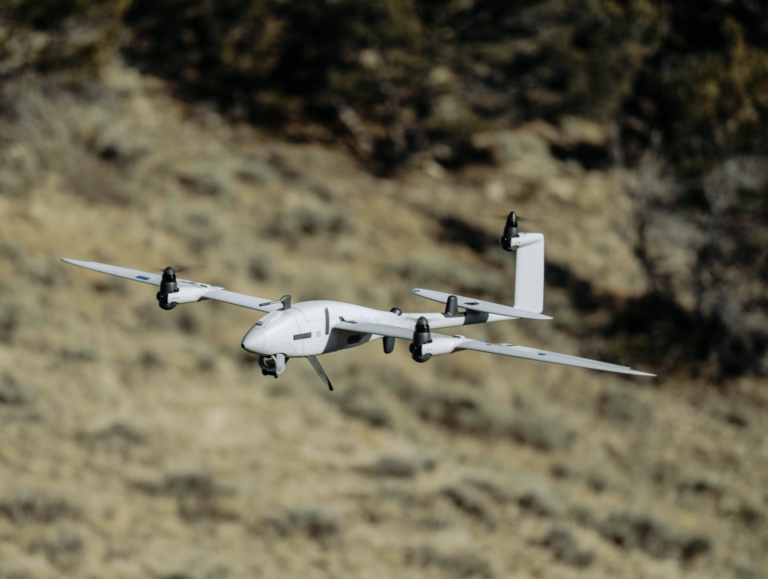
Mojave is a propeller-driven aircraft specifically developed to operate at low speeds and over short distances. The Tekever AR5 is also a propeller-driven unmanned aircraft with different performance requirements from a fast jet.
Talon Blue belongs to another category. It is intended to explore the capabilities of a jet-powered collaborative combat aircraft, bringing higher-speed performance and more demanding flight characteristics into the equation.
Its publicly disclosed specifications do not yet establish whether it can achieve the takeoff and landing performance needed for repeated carrier operations.
Even if those challenges are resolved, the operational problem will extend beyond the aircraft itself.
A carrier air wing depends on predictable sortie generation. Aircraft must be launched, recovered, refuelled, inspected, maintained and prepared for subsequent missions, often within tight schedules.
The introduction of autonomous combat aircraft will also require new procedures for deck handling, flight control, emergency recovery and integration with manned aircraft.
A drone that successfully flies from a carrier once is an experimental achievement. A drone that can be repeatedly launched and recovered while the ship continues normal F-35B operations is an operational capability.
The distance between those achievements may prove considerable.
Why the Royal Navy Is Pursuing It Anyway
Despite the technical difficulties, the strategic logic is compelling.
Modern aircraft carriers concentrate enormous military value in a relatively small number of platforms. Their combat effectiveness depends heavily on the aircraft they carry, the range at which those aircraft can operate and their ability to maintain awareness of threats across large areas.
The Royal Navy’s F-35Bs provide advanced combat capabilities, but they remain expensive aircraft operated by human pilots. Their numbers are finite, and every deployment requires careful decisions about how much risk to accept.
Autonomous aircraft could offer additional options.
Depending on their eventual configuration and payloads, collaborative combat aircraft could extend sensor coverage, support electronic warfare, provide decoys or undertake selected missions where employing a manned aircraft would involve unacceptable risk.
That does not necessarily mean replacing the F-35B. The more credible near-term objective is to supplement it, giving carrier commanders greater flexibility in how they employ their available airpower.
The British government is already committing resources to that transition. Its November defence announcements identified almost £250 million for Project Pantheon, which includes work on the hybrid carrier air wing and trials of jet-powered unmanned systems alongside the F-35B force.
But funding and technological ambition do not eliminate the physical constraints of naval aviation.
A jet-powered drone that cannot return to the carrier must either be considered expendable, operate in conjunction with a suitable land base or rely on some other recovery solution.
Each approach has implications for range, cost, logistics and operational independence.
An expendable aircraft may be appropriate for selected combat missions. Losing a reusable aircraft during routine training or ordinary reconnaissance operations is a different matter.
Equally, an autonomous aircraft that must return to a land base after launch cannot provide the same operational flexibility as one that can be maintained and relaunched from the ship.
Recovery is therefore not merely an engineering detail. It helps determine what kind of military capability the system can ultimately provide.
The Real Test Comes After the First Flight
There is another reason to watch the 2027 demonstration carefully.
Northrop Grumman is developing Talon Blue at a time when collaborative combat aircraft are becoming an increasingly important element of future airpower planning. The United States Air Force is already testing competing systems, while the US Navy is exploring how unmanned aircraft might complement future carrier-based fighters.
A successful British demonstration could provide useful evidence about the feasibility of operating autonomous jets from carriers that were not originally designed for them.
It could also influence future aircraft designs, especially if engineers demonstrate that useful carrier-based capabilities can be achieved without the weight, expense and complexity associated with traditional catapult-and-arresting systems.
But the programme should ultimately be judged on what it proves, rather than what its technology promises.
Can the aircraft take off within the available deck length under meaningful operational conditions? Can it be recovered safely and repeatedly? What modifications will be required? How will its presence affect the existing F-35B air wing? And perhaps most importantly, will the resulting capability justify the additional investment and operational complexity?
These questions remain open.
The Royal Navy is right to explore them through practical flight testing rather than relying entirely on theoretical studies. Indeed, the stated purpose of Project Vanquish is to gather evidence and determine what is technically achievable.
The planned Talon Blue launch in 2027 could become an important moment in the development of naval unmanned aviation.
But the achievement that would truly change the future of Britain’s aircraft carriers is not simply getting an autonomous jet into the air.
It is getting it back on deck, ready to fly again.
About the Author