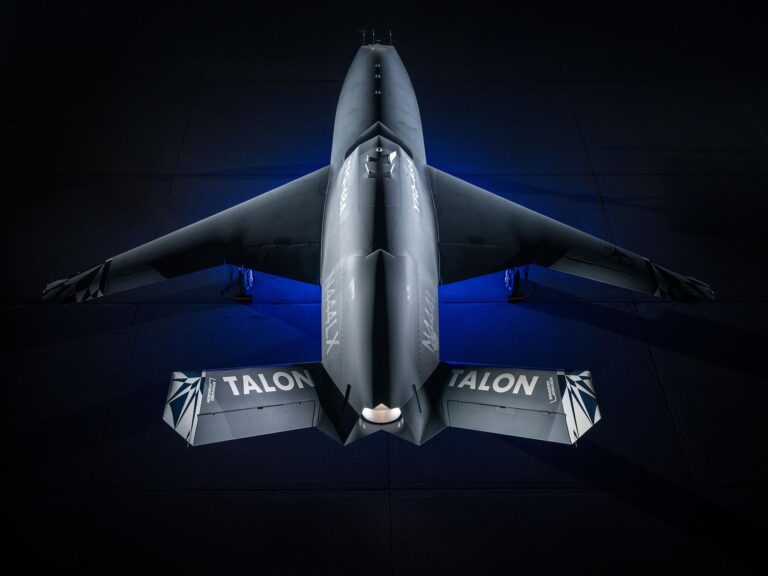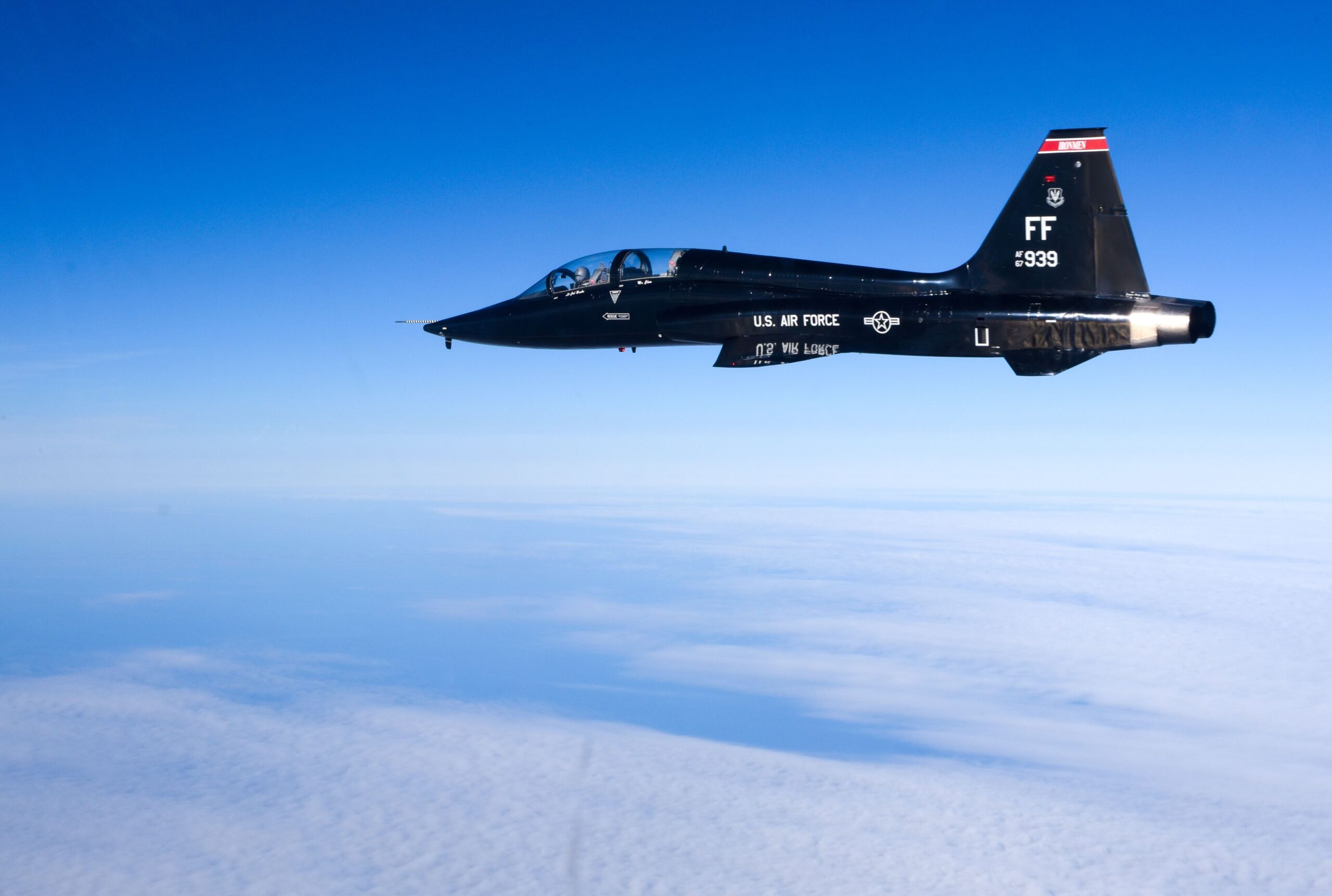
A pilot assigned to the 71st Fighter Training Squadron flies a T-38 Talon over the Atlantic Ocean, Jan. 24, 2018. The T-38 Talon is a twin-engine, high-altitude supersonic pilot trainer aircraft. (U.S. Air Force Photo by Staff Sgt. Carlin Leslie) Share 71 FTS trains over Atlantic A pilot assigned to the 71st Fighter Training Squadron flies a T-38 Talon over the Atlantic Ocean, Jan. 24, 2018. The T-38 Talon is a twin-engine, high-altitude supersonic pilot trainer aircraft. (U.S. Air Force Photo by Staff Sgt. Carlin Leslie)
The Northrop T-38 Talon first flew in 1959. Nearly eight decades later, it may still be training America’s future fighter pilots. Its replacement is finally entering production, but the US Air Force faces a difficult transition — and an ageing fleet with a mission-capable rate of only around 50 percent.
The US Air Force expects to keep its Northrop T-38 Talon advanced jet trainers flying until 2037 or 2038, according to Lieutenant General Clark J. Quinn, commander of Air Education and Training Command (AETC). Speaking on 16 November, Quinn acknowledged that the aircraft, originally designed in the 1950s to prepare pilots for the Century Series fighters, would remain an essential part of American military pilot training for another decade.
The announcement is remarkable not simply because of the aircraft’s age, but because of the increasingly difficult balance between sustaining the existing fleet and introducing its long-awaited successor, the Boeing-Saab T-7A Red Hawk.
The USAF currently operates approximately 490 T-38s, averaging nearly 60 years in age. According to Quinn, their mission-capable rate is only around 50 percent. Maintaining even that level of availability is becoming increasingly challenging as the aircraft grow older, replacement components become more difficult to obtain and engines require repeated overhauls.
The problem is not hypothetical. In May 2026, the Air Force temporarily suspended operations across its T-38 fleet following an accident involving an aircraft from Columbus Air Force Base. Flying resumed after inspection procedures were established, but the incident highlighted the vulnerability of a training system that continues to depend heavily on a decades-old aircraft.
Meanwhile, the T-7A programme is progressing, although the transition will take considerably longer than originally anticipated. The Air Force approved low-rate initial production in April 2026, with a $219 million contract covering the first 14 production aircraft and associated equipment and support.
AETC is targeting initial operational capability in August 2027, but Quinn has acknowledged that this date remains at risk. The command currently has only three T-7A aircraft and eight pilots qualified to fly the type. Before reaching initial operational capability, it needs 14 aircraft, 14 certified instructors and an expanded, validated flight envelope.
Even achieving that milestone will not mean the immediate retirement of the T-38. The Air Force plans to acquire 351 T-7As, with deliveries and training infrastructure developing progressively over several years.
Keeping the Talon operational therefore requires substantial additional investment. Earlier this year, Boeing received an avionics sustainment contract with a ceiling of $900 million, running through March 2036. In parallel, the Air Force is undertaking major structural maintenance under the Talon Repair, Inspection and Maintenance programme. Approximately 270 aircraft have been identified for work through 2030, with the US Navy’s Fleet Readiness Center Southeast supporting the effort.
There is also a deeper question about the future of military pilot training.
The T-38 was developed to prepare pilots for aircraft such as the F-100 Super Sabre and other early supersonic fighters. The T-7A, by contrast, is intended to prepare crews for increasingly complex combat aircraft, where managing sensors, information and onboard systems is just as important as traditional aircraft handling.
Quinn has emphasised that distinction. The challenge is no longer simply teaching students to fly demanding high-performance aircraft. It is preparing them to process information and make decisions in cockpits designed around digital systems and increasingly networked operations.
For the USAF, the transition is therefore more than an aircraft replacement programme. It involves changing how future fighter pilots are trained while preserving sufficient training capacity during a prolonged period of overlap.
The Talon’s extraordinary longevity is a testament to its original design and decades of engineering work. But it also illustrates the difficulty of replacing an entire military training ecosystem.
By 2038, nearly 80 years will have passed since the T-38’s first flight. Whether the Air Force can maintain sufficient aircraft availability and sustain its pilot training requirements throughout that period may prove as important as the eventual introduction of the Red Hawk itself.
About the Author