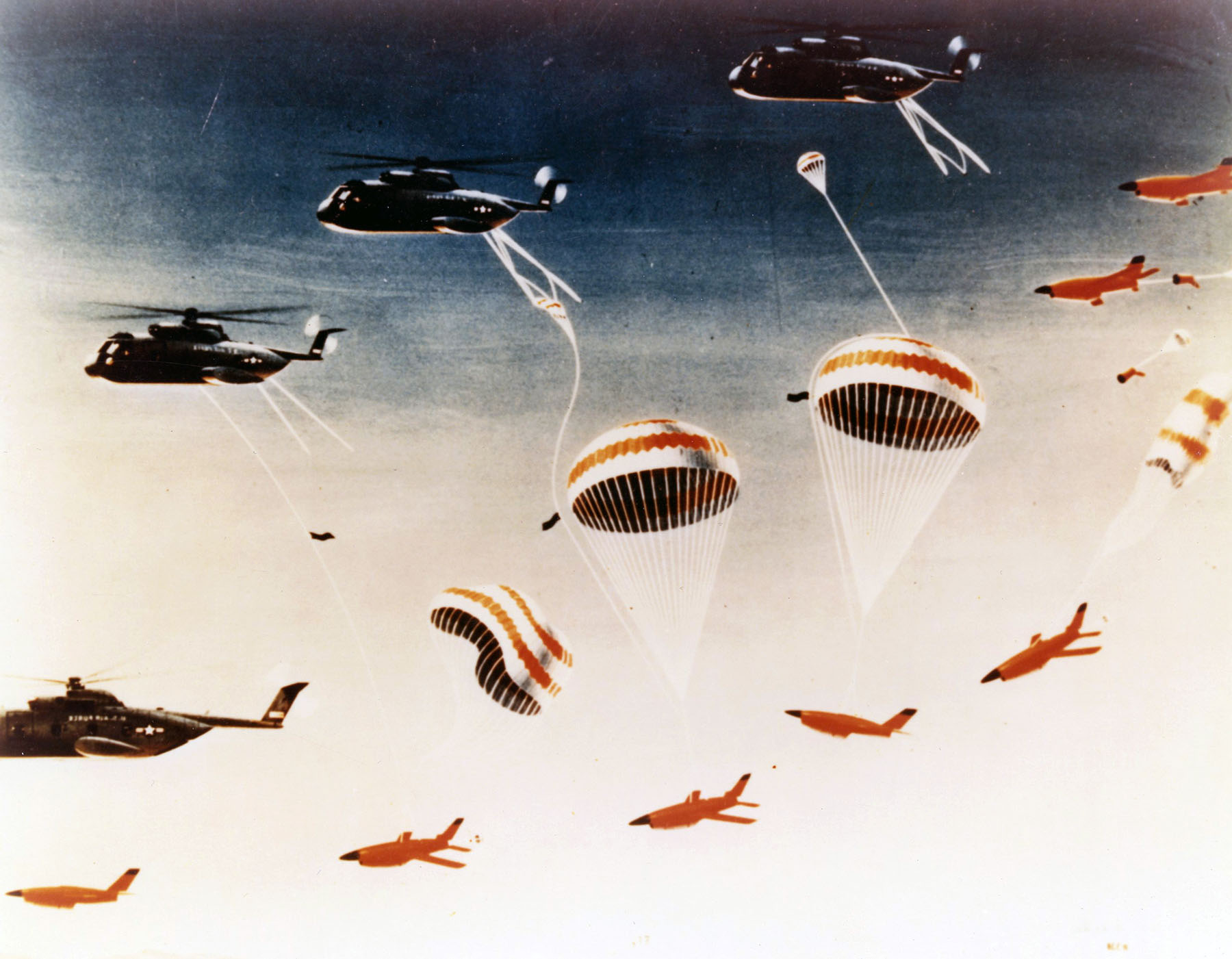
Long before unmanned aircraft became central to modern warfare, American reconnaissance drones were flying dangerous missions over Vietnam. Bringing them home required an extraordinary solution: helicopters that caught them in mid-air. The system worked remarkably well, but it also exposed a problem military aviation is still trying to solve.
Somewhere over South Vietnam in the late 1960s, a small jet-powered aircraft is descending beneath a parachute. There is no pilot on board. A Sikorsky CH-3 helicopter approaches, positioning itself to intercept a smaller parachute trailing from the recovery assembly. Beneath the helicopter, a specially designed hook is lowered into the airflow. The crew must catch the parachute line, secure the descending aircraft and lift it clear of the ground. If everything works, the helicopter will return to base carrying an unmanned jet suspended beneath its fuselage.
It sounds like an experimental flight-test operation. In reality, it became an established part of American military reconnaissance during the Vietnam War. Between 1966 and 1975, helicopter crews attempted 2,745 mid-air drone recoveries and successfully completed 2,655 of them. Their success rate was 96.7 percent.
More than half a century before the current fascination with reusable unmanned aircraft, the United States Air Force had already developed a remarkably effective method of recovering drones without allowing them to land. The aircraft involved were Ryan Model 147 Lightning Bugs, jet-powered reconnaissance machines developed from the Ryan Firebee aerial target. Their missions helped establish the operational potential of unmanned aviation long before the arrival of the Predator, Reaper or today’s increasingly sophisticated combat drones.
Yet the most revealing part of the story is not simply that the Americans managed to catch an aircraft in the air. It is why they needed to do so, and what the enormous effort required tells us about the economics of unmanned warfare.
From Flying Targets to Secret Reconnaissance Aircraft
The origins of the Lightning Bug programme lie in the growing vulnerability of manned reconnaissance aircraft during the Cold War. The Soviet Union’s development of increasingly capable air defence systems, demonstrated dramatically by the destruction of Francis Gary Powers’ U-2 in May 1960, made intelligence flights over defended territory exceptionally dangerous.
Unmanned aircraft offered an alternative. They could penetrate hostile airspace, photograph sensitive installations and, if necessary, be sacrificed without losing a pilot or creating the political complications associated with a captured aircrew.
Ryan Aeronautical already had a suitable starting point. Its Firebee was a jet-powered aerial target originally developed to support air defence and fighter training. Modified with additional fuel, navigation equipment and reconnaissance cameras, it became the basis of the Model 147 family, eventually encompassing several variants designated AQM-34.
The first operational Lightning Bug reconnaissance missions were flown over southern China in August 1964. Operations subsequently expanded to North Vietnam, where American commanders increasingly needed detailed imagery of airfields, missile installations, transport infrastructure and other heavily defended targets.
These aircraft were considerably more sophisticated than the simple radio-controlled targets from which they had evolved. Their missions were generally programmed before launch, using onboard navigation systems to follow predetermined routes. Operators aboard supporting aircraft could intervene when necessary, particularly during launch and recovery.
Unlike conventional aircraft, however, the Lightning Bugs could neither take off from nor land on a runway independently. They were launched from modified DC-130 Hercules aircraft, which also carried the equipment and personnel necessary to monitor and control their flights.
A typical operation therefore required not only the unmanned aircraft, but also a manned transport aircraft serving as a launch and control platform. Once its reconnaissance mission was complete, the drone had to return to a designated recovery area and deploy its parachute.
And that was where the problems began.
The Aircraft Was Back. The Mission Was Not Over.
In the early years, recovering a Lightning Bug often meant allowing it to descend by parachute onto land or into the sea. The approach was relatively simple, but its consequences could be expensive. Hard landings damaged airframes and sensitive equipment, while saltwater threatened electronics and exposed photographic film. A drone that descended into difficult terrain might require a substantial recovery operation, and one that landed in the wrong location could be lost entirely.
Recovering the aircraft was particularly important because many missions still depended on conventional photographic film. Unlike modern ISR platforms capable of transmitting high-resolution imagery directly to operators, the early Lightning Bugs often had to return physically before their intelligence could be exploited. A successful flight was of limited immediate use if the photographs could not be recovered, developed and delivered to analysts.
The problem became more serious as the programme expanded. Larger and heavier reconnaissance variants carried increasingly sophisticated payloads, while operational demand continued to grow.
The Air Force therefore turned to an unusual solution, drawing on technology already explored in another secret American programme: the airborne recovery of photographic capsules from reconnaissance satellites.
Under the CORONA programme, specially equipped aircraft had been used to intercept film capsules descending by parachute. The underlying principle could also be applied to recovering unmanned aircraft, although the mass of a Lightning Bug and the operational conditions in Southeast Asia created very different challenges.
The result was the Mid-Air Recovery System, or MARS.
Introduced into operational Lightning Bug recovery in 1966, MARS employed modified Sikorsky CH-3 helicopters fitted with a winch, cables and a specialised capture mechanism. As the drone approached the recovery area, its parachute system deployed. The helicopter manoeuvred towards a smaller engagement parachute, using a suspended hook assembly to capture its line.
Once the connection was secured, the recovery system collapsed the main parachute and transferred the load to the helicopter. The drone was then drawn closer beneath the fuselage, remaining suspended on a cable for the flight back to base.
The operation was technically demanding. The helicopter crew had to judge the relative movement of the descending aircraft, position the capture equipment accurately and manage the sudden transfer of a substantial load. The recovered drone could weigh approximately 2,000 pounds, or 900 kilograms. Unlike a conventional external load picked up from the ground, this aircraft was already moving through the air when the helicopter intercepted it.
There was little room for improvisation once the capture began.
Nevertheless, the method proved remarkably reliable. Over the course of the programme, 2,655 recoveries were completed successfully out of 2,745 attempts. Just as importantly, catching the drones before they reached the ground reduced damage and improved their availability for subsequent missions.
Historical accounts indicate that a drone recovered through MARS could typically be prepared for another mission in approximately one and a half working days, compared with two to ten days for earlier ground-recovery methods.
The Lightning Bug was no longer merely an aircraft that might survive its mission. It had become part of a system designed to bring valuable airborne intelligence equipment home repeatedly and return it to service.
The Hidden Cost of Flying Without a Pilot
The scale of Lightning Bug operations was considerable. Between 1964 and 1975, the programme recorded approximately 3,435 reconnaissance sorties over China, North Vietnam and North Korea. More than a thousand aircraft were employed across the various versions, which were continually adapted for different operational requirements.
Some carried photographic equipment for high- or low-altitude reconnaissance. Others collected electronic intelligence, monitored communications or supported the suppression of enemy air defences. In February 1966, a specially equipped Model 147E deliberately provoked a North Vietnamese SA-2 missile engagement and successfully transmitted valuable guidance-related signals before being destroyed.
The aircraft were not merely passive observers. They became part of the electronic contest between American aviation and increasingly sophisticated Soviet-designed air defence systems.
Their operational endurance could also be impressive. One AQM-34L, nicknamed Tom Cat, completed 68 reconnaissance missions before being lost in September 1974. It was an exceptional record for a type originally expected to have a much shorter combat life.
But the programme also demonstrated that removing the pilot from an aircraft did not necessarily make the operation inexpensive.
Every Lightning Bug sortie depended on a much larger organisation. DC-130 aircraft launched the drones and provided command and control. Helicopters conducted recoveries. Ground personnel maintained and prepared the unmanned aircraft, while specialised facilities processed the photographic intelligence. Other manned aircraft sometimes provided electronic warfare support or protection for the launch platforms.
In an important retrospective study, Air Force UAVs: The Secret History, aviation historian Thomas P. Ehrhard documented the extraordinary resources consumed by the programme. During 1969 alone, low-altitude drone operations accounted for approximately $100 million in procurement and another $250 million in operating and maintenance expenditure, expressed in contemporary dollars.
A separate US defence assessment published in 2013 estimated the total Lightning Bug and Buffalo Hunter programme cost at approximately $5.8 billion in fiscal-year 2010 dollars. Despite its considerable achievements, the programme still represented only a small proportion of the Air Force’s overall combat reconnaissance effort in Vietnam.
The drones had solved one fundamental problem: they could undertake dangerous reconnaissance missions without exposing pilots to enemy fire. But they had not removed the need for manned support aircraft, extensive maintenance or complicated logistics.
There was another limitation. The aircraft could return safely without necessarily collecting the required intelligence. Navigation errors remained a persistent problem, particularly during low-altitude reconnaissance, when a relatively small deviation could cause cameras to miss their intended targets. Modern GPS navigation, satellite communications and real-time data transmission were still decades away from the capabilities available today.
The 96.7 percent MARS recovery figure was therefore a measure of successful airborne captures, not the success rate of all combat missions.
This distinction matters. A drone can survive, be recovered and fly again, yet still fail to achieve its operational objective. Equally, an aircraft deliberately sacrificed to obtain critical electronic intelligence may have achieved an exceptionally valuable mission.
The real measure of effectiveness was never simply how many drones returned.
An Old Problem Returns
In October 2021, the US Defense Advanced Research Projects Agency demonstrated the successful airborne recovery of an X-61 Gremlins unmanned aircraft by a modified C-130 transport aircraft. The programme explored the possibility of launching groups of reusable unmanned systems from larger aircraft, recovering them in flight and preparing them for subsequent missions.
There are important technological differences between Gremlins and Lightning Bug. Modern systems benefit from digital flight controls, advanced navigation, automation and far more capable communication links. Recovering an aircraft into a transport aircraft is also different from lifting a parachute-suspended drone beneath a helicopter.
Nevertheless, the fundamental operational question is remarkably similar.
If an unmanned aircraft is sufficiently capable to justify recovering and reusing it, how much additional complexity, cost and risk should an air force accept to bring it home?
For today’s military planners, the answer is becoming increasingly important. At one end of the spectrum are inexpensive, expendable drones that can be deployed in large numbers and deliberately sacrificed. At the other are highly sophisticated unmanned aircraft carrying valuable sensors, electronic warfare equipment and other mission systems that cannot easily be replaced after every sortie.
Between these extremes lies a difficult calculation involving survivability, sortie generation, maintenance, payload value and the resources required for recovery.
The Lightning Bug experience provides a useful historical reference because the Americans encountered this dilemma under genuine operational conditions. Their aircraft were capable, adaptable and, in many cases, remarkably successful. But the infrastructure required to operate and recover them imposed substantial costs of its own.
By the time the Vietnam War ended, the US Air Force had demonstrated that unmanned reconnaissance aircraft could penetrate defended airspace, collect valuable intelligence and return for repeated missions. It had also demonstrated that airborne recovery could be performed routinely, even using the technology available in the 1960s.
The extraordinary image of a helicopter carrying a captured jet beneath its fuselage remains one of the most unusual episodes in the history of military aviation.
Its significance, however, extends well beyond the ingenuity of the recovery system. More than fifty years later, air forces are still confronting the same choice: whether to build unmanned aircraft cheap enough to lose, or capable enough to make bringing them home worthwhile.
About the Author