USAF F-5Es flying with a Soviet MiG-17 and MiG-21 of the 4477th Tactical Evaluation Squadron Date 1980s Source USAF Photo via Peake, William R, (2005), McDonnell Douglas F-4 Phantom II: Production and Operational Data, Midland Pub Ltd, ISBN: 9781857801903 Author United States Air Force
For more than a decade, the US Air Force operated a classified squadron of Soviet-built fighter aircraft in the Nevada desert. Its pilots flew genuine MiG-17s, MiG-21s and MiG-23s against American fighter crews, revealing something that intelligence reports and simulated adversaries could never fully reproduce: what it was actually like to fight the enemy.
The American fighter pilot approaching the engagement area over Nevada knew he was about to face an adversary. He had been trained in Soviet tactics, studied the performance of enemy aircraft and practised air combat manoeuvres against American fighters playing the role of MiGs. There was little reason to expect anything fundamentally different from another training sortie.
Then he saw the aircraft.
It was smaller than expected, difficult to identify at a distance and carried the unmistakable red star of the Soviet Air Force. Its silhouette did not resemble the American fighters he was accustomed to fighting. Neither did its performance. Depending on the aircraft, it could turn far more tightly than anticipated or accelerate away with startling speed.
What the pilot was seeing was not an American F-5 simulating a Soviet fighter. It was an actual Soviet-designed MiG, flown by an American pilot whose job was to demonstrate precisely how dangerous an unfamiliar opponent could be.
The encounter was part of one of the most unusual training operations in the history of the US Air Force. Between 1977 and 1988, the classified programme known as Constant Peg exposed nearly 6,000 American aircrew members to genuine Soviet combat aircraft. The pilots of the 4477th Test and Evaluation Squadron, known as the Red Eagles, completed 15,264 sorties with MiG-17s, MiG-21s and MiG-23s.
Only 69 American pilots qualified to fly the MiGs during the programme’s operational history.
The aircraft were maintained without ordinary access to Soviet manufacturers, operated from a remote airfield and concealed from public view. Even the American pilots who arrived to train against them were required to protect the programme’s existence.
For much of the Cold War, the United States was secretly operating the very aircraft its fighter pilots might one day encounter over Europe or another contested region.
But the origins of the programme had less to do with Soviet espionage than with a painful lesson from Vietnam.
Knowing the Enemy Was Not Enough
By the end of the Vietnam War, the American military had been forced to reconsider several assumptions about modern air combat. The appearance of increasingly capable guided missiles had encouraged expectations that many engagements would be decided before opposing fighters came within visual range.
Combat over North Vietnam demonstrated that this was not always the case. Restrictive rules of engagement, limitations in identification systems, missile performance and the tactical environment repeatedly brought American pilots into close-range encounters with MiG fighters.
Some of those encounters exposed weaknesses in established training practices.
American aircrews had learned formation tactics and weapons employment, but they had not always been adequately prepared for dissimilar air combat against small, agile aircraft employing unfamiliar techniques. A pilot flying the F-4 Phantom could possess a substantial advantage in engine power and weapons capability, yet still find himself in a dangerous position against a MiG-17 manoeuvring at low speed.
The problem was not simply a lack of information.
US intelligence organisations had already begun examining Soviet-designed aircraft obtained through various channels. During the late 1960s, programmes such as Have Doughnut, Have Drill and Have Ferry evaluated MiG fighters and documented their performance characteristics. The tests provided valuable information about aerodynamic behaviour, operating limitations, cockpit systems and tactical vulnerabilities.
But reading about an aircraft’s performance was different from experiencing it in flight.
A technical report could describe a MiG-17’s turning capability. It could not reproduce the visual impression of the aircraft suddenly changing direction in front of a pilot accustomed to fighting larger American jets. Nor could it fully teach the timing required to avoid overshooting such an opponent.
Gaillard R. Peck Jr., a former F-4 combat pilot and Fighter Weapons School instructor, became one of the principal advocates of turning this intelligence into a practical training capability.
Peck understood the value of conventional aggressor squadrons, which employed aircraft such as the F-5 to represent potential adversaries. But he also recognised their fundamental limitation. However skilfully the pilots reproduced Soviet tactics, the aircraft themselves remained American designs with their own aerodynamic characteristics.
What if selected US pilots could train directly against the actual aircraft?
The idea was ambitious. The Air Force would need to obtain and maintain Soviet fighters, establish a secure operating location, select highly experienced pilots and prevent the programme from becoming publicly known.
Nevertheless, the proposal found support. The new organisation was established in April 1977, initially at Nellis Air Force Base. Its name, Constant Peg, had an unusually personal origin. According to Peck’s recollection, General Charles L. Donnelly Jr., who supported the project, used the call sign Constant. Peck combined it with the name of his wife, Peg.
The resulting code name concealed a programme that would eventually become an important part of American fighter training.
A Soviet Fighter Squadron in the Nevada Desert
The Red Eagles eventually operated from the Tonopah Test Range, a remote installation in Nevada where secrecy was easier to maintain than at a conventional military air base. The unit began flying its operational training missions there in 1979.
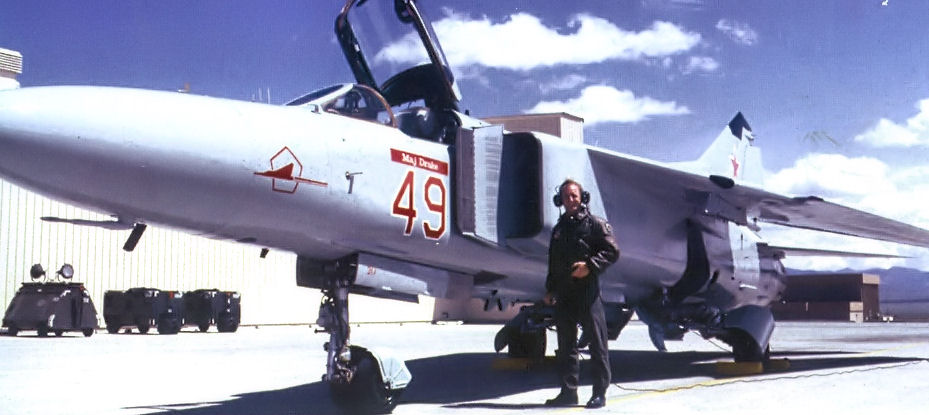
Date 1986
Source Photo scanned from “Red Eagles: America’s Secret MiGs”, ISBN 1846033780. Photo in book is credited to the United States Air Force
Author United States Air Force
The Air Force assembled its MiG fleet from aircraft acquired through intelligence and diplomatic channels. Public historical accounts identify Israel, Indonesia and Egypt among the countries associated with the acquisition of Soviet-designed fighters. The details of individual aircraft transfers were not all disclosed when the programme was publicly acknowledged.
What mattered operationally was that the Americans had obtained flyable examples of three Soviet fighter families.
The MiG-17 represented an older generation of combat aircraft. Subsonic, relatively small and highly manoeuvrable, it had proved unexpectedly dangerous in Vietnam. Its aerodynamic performance made it particularly effective in certain close-range, low-speed engagements.
The MiG-21 introduced a different set of characteristics. A compact supersonic interceptor with a delta wing, it had impressive acceleration and climb capabilities, but its handling and energy retention imposed different tactical considerations. Its small size also made visual acquisition difficult, particularly against a complicated background.
The MiG-23 was more sophisticated in concept. Its variable-sweep wing and powerful engine provided high-speed performance that could be troublesome for opponents attempting to intercept or pursue it. Yet the versions operated by the Red Eagles also presented significant handling and reliability problems.
These differences were the entire point of the programme. The Red Eagles did not need to demonstrate that one Soviet fighter was universally better or worse than an American equivalent. They needed to show how each aircraft behaved under specific tactical conditions, and how an American fighter crew could exploit its weaknesses without underestimating its strengths.
Security was exceptionally strict.
Aircraft were concealed in hangars, and operations were planned to reduce the possibility of observation by Soviet reconnaissance satellites. Visiting aircrews were required to maintain secrecy about what they had seen.
Tonopah also became associated with another classified aviation programme. While the Red Eagles operated their MiGs during daylight hours, the base supported the secret F-117 Nighthawk programme at night.
It was an extraordinary combination. At the same isolated airfield, the United States was simultaneously exploring one of the most advanced approaches to penetrating enemy air defences and teaching its pilots how to fight Soviet aircraft developed decades earlier.
Both activities reflected the same underlying concern: surviving against an adversary whose capabilities could not be fully understood through theoretical analysis alone.
The First Encounter Was the Most Important
Constant Peg did not initially place visiting pilots into unrestricted mock combat against experienced MiG operators. Training followed a carefully structured progression designed to familiarise them with the aircraft before exposing them to increasingly demanding engagements.
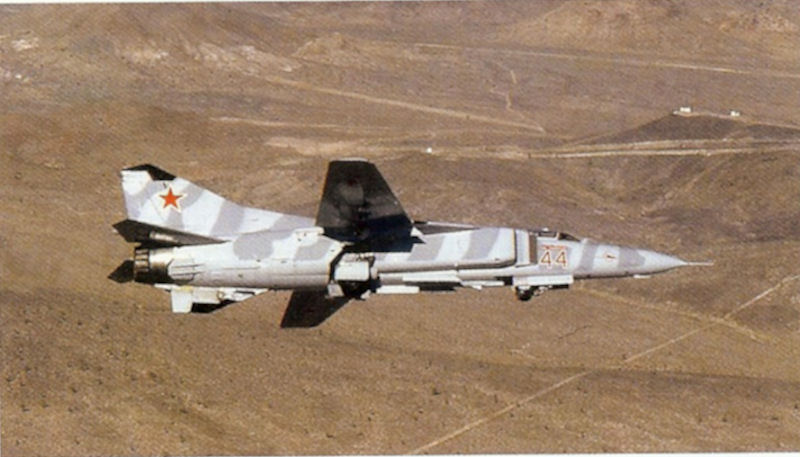
Date 1980s
Source United States Air Force photo via Peck, Gaillard R, Jr. (2012) America’s Secret MiG Squadron: The Red Eagles of Project CONSTANT PEG (General Aviation), Osprey Publishing; First Edition, ISBN-13: 978-1849089760
Author United States Air Force photo
The first flights allowed American crews to observe the MiGs and their distinctive characteristics. The exercises then moved into offensive and defensive manoeuvres, individual engagements and eventually more complex situations involving multiple aircraft.
The psychological effect was an important part of the process.
During the Cold War, American fighter pilots spent considerable time preparing for an encounter with Soviet aircraft. Yet the prospect of seeing an actual MiG, complete with its distinctive markings, remained an unfamiliar experience for almost everyone.
The Red Eagles wanted pilots to overcome that initial reaction before entering combat.
American instructors sometimes referred to the phenomenon as buck fever, a term borrowed from hunting to describe the nervous excitement and hesitation associated with a first encounter with the intended target.
The operational logic was straightforward. If a pilot needed several seconds to recognise an unfamiliar aircraft, judge its manoeuvre or recover from the surprise of seeing an actual enemy fighter, those seconds could become decisive in combat.
Against the MiG-17, American crews learned why engaging in a sustained turning fight could be dangerous. The older Soviet fighter could produce exceptionally tight turns, making it possible for an opponent pursuing from behind to overshoot. The preferred solution often involved exploiting an American fighter’s greater thrust and vertical manoeuvring capability rather than attempting to remain in the same horizontal turn.
The MiG-21 presented different challenges. Its small profile complicated visual tracking, while its acceleration and ability to change attitude demanded careful attention to energy and relative position. Pilots had to recognise when the MiG was operating near its strengths and when it could be forced into a less favourable engagement.
With the MiG-23, speed was a dominant consideration. The aircraft could accelerate rapidly and disengage from a fight in circumstances where other fighters might struggle to follow. But the Red Eagles found that their particular MiG-23s were less comfortable in sustained manoeuvring combat.
These lessons had practical consequences. Fighting a MiG was no longer an abstract exercise in applying published performance tables. It required the pilot to recognise the aircraft’s behaviour, make an appropriate tactical decision and execute it quickly enough to prevent the opponent from gaining an advantage.
There was also a critical limitation. The Red Eagles were operating specific aircraft and export variants, sometimes with different equipment and performance from contemporary Soviet frontline examples. Their findings could not automatically be generalised to every version of the MiG-21 or MiG-23, much less to the entire Soviet air combat system.
Nevertheless, the programme offered an experience unavailable through conventional aggressor training.
It allowed American crews to make mistakes against a real MiG and survive to discuss them afterwards.
The Maintenance Problem Nobody Could Solve Normally
Flying Soviet fighters was only part of the challenge. Keeping them airworthy without normal manufacturer support created a problem that demanded exceptional technical ingenuity.
The 4477th could not simply order replacement components through a conventional supply system. Maintenance documentation was incomplete, aircraft histories were not always fully available and many parts were difficult or impossible to obtain.
The Red Eagles relied on a hand-picked group of maintainers capable of repairing, adapting and sometimes reverse-engineering equipment.
Some components could be replaced with parts from American aircraft. Historical accounts describe the use of T-38 nosewheel tyres on MiG-21s and hydraulic pumps originally designed for the F-100. But such substitutions addressed only a small part of the overall maintenance requirement.
Most components had to be repaired or reconditioned.
One incident illustrates the difficulty particularly well. When the unit began running out of MiG-21 brake components, worn examples were sent away to be duplicated. The replacement parts returned several weeks later, manufactured to match the supplied samples so precisely that they reproduced the wear of the originals.
Instead of receiving new brakes, the maintenance team had obtained expensive copies of worn-out ones.
The story is almost absurd, but it demonstrates a serious engineering limitation. Reverse-engineering an aircraft component is not simply a matter of reproducing its dimensions. Without original specifications, material data and manufacturing tolerances, even a precisely duplicated part may not reproduce its intended performance.
The MiG-23 proved particularly demanding. Its complex variable-sweep wing mechanism and associated structural components required careful attention. Cracking and other maintenance concerns complicated operations, while the aircraft’s handling characteristics also placed substantial demands on pilots.
The Red Eagles could not afford to treat safety casually. Their aircraft represented scarce intelligence assets, and losing a pilot would carry consequences far beyond the squadron.
Despite careful selection and operating restrictions, serious accidents occurred. Former unit officials later reported a mishap rate substantially higher than that of contemporary American fighter aircraft. Two pilots died in crashes during the programme.
One of the better-known survivors was Hawk Carlisle, who later became a senior Air Force commander. During his service with the Red Eagles, Carlisle entered a flat spin in a MiG-23 and was forced to eject. The Soviet ejection system’s altitude-dependent parachute deployment mechanism delayed the opening of his parachute until he was below the surrounding mountain ridges.
He survived because the aircraft happened to be over lower terrain.
The episode demonstrated another problem associated with operating foreign military aircraft: systems designed around one air force’s procedures, assumptions and operating environment did not necessarily fit those of another.
In addition to learning how to defeat Soviet fighters, American pilots and engineers were learning how to operate them safely without the organisations that had designed and supported them.
The maintenance experience became an integral part of Constant Peg’s history. Without the technicians at Tonopah, the programme’s extensive flying schedule would never have been possible.
When the Secret Became Less Valuable
Constant Peg’s operational contribution extended well beyond the small number of pilots assigned to the unit.
The programme exposed 5,930 American aircrew members to genuine MiGs. The training was integrated with the broader transformation of American fighter tactics after Vietnam, alongside initiatives such as Red Flag, the Navy’s Topgun programme and conventional aggressor squadrons.
The goal was not to produce pilots who could recite the performance characteristics of Soviet aircraft. It was to give them practical experience against a credible opponent and improve their ability to make correct decisions under pressure.
By the 1980s, however, the environment was changing.
The MiG-17 was becoming less representative of the threats facing contemporary American fighters, and its continued operation was increasingly difficult to justify. The aircraft was eventually withdrawn from flying. Meanwhile, increasingly sophisticated Soviet aircraft and weapons systems were entering service, reducing the relevance of some older MiG variants available to the Red Eagles.
The cost and risk of maintaining the classified fleet also continued to grow.
Constant Peg ceased flying operations in March 1988. The decision came before the collapse of the Soviet Union, and the programme’s termination should not be interpreted simply as a consequence of the Cold War ending. Its aircraft were ageing, their operational relevance was declining, and the Air Force was restructuring its aggressor capabilities.
The programme remained classified for another eighteen years.
On 13 November 2006, the US Air Force publicly acknowledged Constant Peg, allowing the contribution of the pilots and maintenance personnel to become part of the official history of American military aviation.
The Air Force subsequently linked the programme to improvements in combat readiness, including the ability of American fighter crews to confront Iraqi MiGs during Operation Desert Storm in 1991. That influence is credible within the broader development of realistic training, although the combat results of Desert Storm cannot be attributed to Constant Peg alone.
By then, the immediate operational purpose of the Red Eagles had passed into history. Their wider lesson had not.
The Adversary Is More Than an Aircraft
Modern aggressor programmes have become far more sophisticated than those of the 1970s. Military and commercial Red Air providers operate dedicated aircraft, employ highly experienced former combat pilots and increasingly incorporate advanced electronic warfare, threat replication and networked training capabilities.
The aircraft performing the adversary role no longer need to resemble the enemy physically to reproduce useful elements of the threat.
But this creates a distinction that Constant Peg helps explain.
An aircraft’s observable flight performance is only one part of its combat effectiveness. Modern air combat is influenced by radar capability, electronic warfare systems, missile performance, sensor fusion, data links and the ability to coordinate engagements across multiple platforms.
A training aircraft can reproduce a particular flight profile or simulated weapons employment without possessing the complete capabilities of the aircraft it represents.
That may be sufficient for many training objectives. For others, the difference matters.
The central challenge is therefore no longer simply how to reproduce the speed, turn rate or acceleration of an opposing fighter. It is how to represent the behaviour of the entire adversary system with enough fidelity to expose friendly crews to realistic operational problems.
Constant Peg demonstrated the value of authenticity at a time when air combat still depended heavily on visual identification and aircraft manoeuvring characteristics. Its pilots discovered that even extensive intelligence about an enemy fighter could not eliminate the surprises encountered when fighting against the actual aircraft.
Today, the same principle extends into the electromagnetic environment and the digital systems that increasingly determine the outcome of an engagement.
The Americans operating MiGs over Nevada were not attempting to recreate every aspect of Soviet air warfare. They were solving one specific weakness in their training system: pilots were being prepared to fight an enemy they had never encountered.
The solution was expensive, technically difficult and dangerous. But over more than a decade, thousands of American aircrew members were given the opportunity to face the aircraft of their potential adversary before doing so in combat.
The extraordinary achievement of Constant Peg was not simply that the United States managed to acquire Soviet fighters and keep them flying in secret.
It was the recognition that knowing what an enemy aircraft can do is not the same as knowing how to fight it.
And that remains one of the fundamental challenges of military aircrew training today.
About the Author