Starship V3: SpaceX Scrubs First Launch Attempt of Its Next-Generation Megarocket
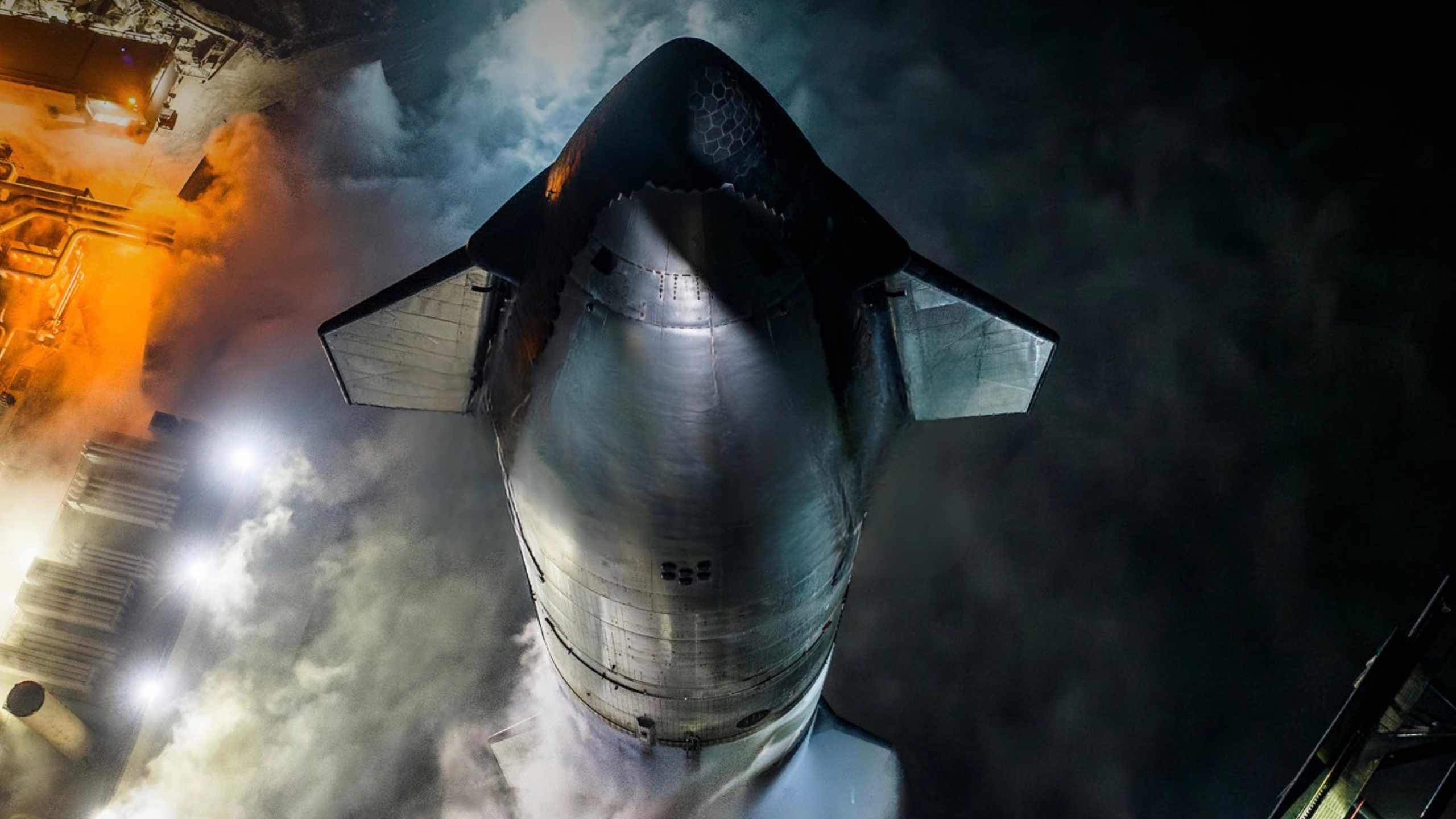
A new vehicle, a new pad and a higher-stakes phase in the Starship campaign
SpaceX’s first attempt to launch the upgraded Starship V3 system was called off in the final phase of the countdown, delaying what is expected to be one of the most important test flights in the Starship programme to date. The vehicle, consisting of a redesigned Super Heavy booster and upgraded Starship upper stage, had been scheduled to lift off from SpaceX’s Starbase facility in South Texas on 21 May 2026. SpaceX later prepared for another attempt during a 90-minute launch window opening at 5:30 p.m. Central Time on Friday, 22 May.
The scrub came only seconds before the planned liftoff. Reuters reported that the countdown had experienced several pauses linked to propellant temperature and pressure readings, and that Elon Musk later referred to a hydraulic pin on one of the launch tower’s mechanical arms that did not retract as intended.
For SpaceX, this was not simply another Starship flight attempt. Flight 12 is intended to introduce a substantially upgraded version of the world’s largest and most powerful launch system, debut a new launch pad at Starbase, and validate hardware required for the company’s long-term goals: rapid reusability, large-scale Starlink deployment, NASA lunar operations and eventually missions to Mars.
SpaceX describes Starship and Super Heavy as a fully reusable transportation system designed to carry crew and cargo to Earth orbit, the Moon, Mars and beyond. The current Starship system stands approximately 124 metres tall, has a 9-metre diameter and is designed to carry more than 100 metric tonnes to orbit in a fully reusable configuration.
Why Flight 12 matters
Starship has already become the most closely watched launch vehicle development programme in the world. Earlier test flights proved progressively more ambitious capabilities: surviving ascent, staging, atmospheric re-entry, controlled splashdown, mock satellite deployment and, in October 2024, the first catch of a Super Heavy booster by the launch tower’s mechanical arms.
But Flight 12 is different.
It is expected to be the first flight of Starship V3, the first flight of an upgraded Super Heavy booster and the first Starship launch from the new Pad 2 at Starbase. Reuters described the test as the debut of a redesigned vehicle equipped with new features intended to support future lunar and Mars missions.
That makes the mission less a repeat of previous flights and more the opening of a new development phase. SpaceX is moving from proving that Starship can survive major parts of its flight profile toward proving that the system can become operational: reusable, refuellable, rapidly turned around and useful for real missions.
The immediate objective remains a test flight. The larger objective is industrialisation.
The new Starship V3 system
The upgraded Starship configuration introduces changes across almost every major subsystem: propulsion, tanks, avionics, thermal protection, structures, ground operations and mission architecture.
A larger, more capable launch system
The overall Starship system remains a two-stage architecture:
Super Heavy is the first-stage booster. It is powered by 33 Raptor engines burning sub-cooled liquid methane and liquid oxygen. SpaceX lists Super Heavy at roughly 72 metres in height, with a propellant capacity of around 3,650 tonnes and liftoff thrust of 8,240 tonnes-force.
Starship is both the spacecraft and upper stage. SpaceX lists the ship at roughly 52 metres in height, with a propellant capacity of about 1,600 tonnes, six engines and a payload capacity of more than 100 tonnes.
Together, the system reaches around 124 metres, making it taller than any operational launch vehicle and central to SpaceX’s plan for fully reusable heavy-lift space transportation.
Raptor 3: the core of the upgrade
One of the most significant changes is the introduction of the latest-generation Raptor 3 engine.
SpaceX’s Starship architecture depends on methane-oxygen staged-combustion engines that can be reused repeatedly and produced in large numbers. The Raptor is already central to that approach, but V3 represents a major integration step. The upgraded engines are designed to deliver higher thrust with a cleaner, more integrated architecture.
SpaceX lists the Raptor engine thrust at 250 tonnes-force, with Super Heavy using 33 engines and Starship using three sea-level Raptors plus three vacuum-optimised Raptor Vacuum engines.
The significance of Raptor 3 is not only thrust. It is also packaging and maintainability. The engine has been redesigned to reduce external plumbing and integrate more systems into the engine body. That matters because Starship is not supposed to be a traditional expendable launch vehicle inspected and refurbished for months after flight. It is supposed to become a high-cadence reusable system. In that model, fewer exposed components, less thermal shielding and simpler ground inspection are not marginal improvements; they are part of the economic case.
For Super Heavy, the impact is multiplied by scale. With 33 engines on the booster, even small reductions in mass, complexity and turnaround burden become strategically important.
Super Heavy V3: fewer fins, stronger structures, revised staging
The new Super Heavy booster is not merely a previous booster with improved engines. It introduces structural and aerodynamic changes that indicate SpaceX is preparing the vehicle for more demanding reuse operations.
One visible change is the revised grid-fin arrangement. Earlier Super Heavy versions used four grid fins. The upgraded booster uses fewer but larger control surfaces, positioned and strengthened to support future catch operations by the launch tower. These fins are not only aerodynamic control devices; they are increasingly part of the recovery architecture.
The hot-staging system has also changed. Starship uses hot staging, meaning the upper-stage engines ignite while the vehicle stack is still in the process of separating. Earlier flights used a hot-staging ring that was treated more like a separate expendable element. In the upgraded configuration, the structure is more integrated with the booster, reflecting SpaceX’s effort to remove throwaway components from a system intended for full reusability.
The booster also features redesigned propellant feed systems. These changes are intended to support more reliable ignition sequences, rapid manoeuvres after separation and controlled descent.
For Flight 12, however, SpaceX is not expected to attempt a tower catch of the booster. The plan is for Super Heavy to conduct a controlled descent and simulated landing over the Gulf of Mexico. That is a cautious choice. With new engines, new structures, new ground infrastructure and revised control systems flying together for the first time, SpaceX is prioritising data over spectacle.
Starship V3: built for longer missions
The upper stage has also been extensively redesigned.
The most important long-term change is not simply larger tanks or higher payload potential. It is the move toward a spacecraft capable of longer-duration operations in space.
That matters because Starship’s future missions depend on capabilities that have not yet been demonstrated at operational scale. NASA’s Artemis lunar architecture requires a Starship Human Landing System variant. SpaceX’s Mars ambitions require orbital refilling, long-duration cryogenic propellant management and repeated operations beyond low Earth orbit. Starlink deployment at scale requires reliable payload release mechanisms and higher launch cadence.
The V3 ship therefore incorporates changes related to:
- increased propellant capacity;
- improved cryogenic propellant management;
- revised aft-section design;
- reduced enclosed spaces where leaked propellant could accumulate;
- improved flap actuation and redundancy;
- upgraded avionics;
- enhanced camera coverage and telemetry;
- mission hardware relevant to future docking and propellant transfer.
SpaceX has publicly emphasised that on-orbit refilling is a central element of Starship’s future architecture. The company describes tanker Starships as vehicles that would refill a Starship spacecraft in low Earth orbit before departure to Mars or other destinations.
That is why Flight 12 matters beyond the launch itself. Starship does not become a lunar or Mars transportation system merely by reaching space. It becomes such a system only if SpaceX can master the chain of capabilities around reusability, refilling, thermal protection, docking, cryogenic management and rapid relaunch.
Pad 2: the ground system becomes part of the test
Flight 12 is also expected to be the first Starship launch from SpaceX’s new Pad 2 at Starbase. This is strategically important.
For a fully reusable launch system, the pad is not passive infrastructure. It is part of the vehicle system.
Starship’s long-term promise depends on rapid launch cadence. That cannot happen if every launch requires slow tanking, extensive pad refurbishment or long recovery cycles. Pad 2 is intended to support the more powerful V3 vehicle and improve operational flow at Starbase.
The first launch attempt also showed why ground systems matter. The scrub was linked not to a dramatic in-flight event but to late-countdown technical issues involving the launch infrastructure and vehicle systems. That is normal in a development programme of this scale. It is also exactly why the first use of a new pad is itself a major test event.
As SpaceX’s live commentary noted, a new rocket and a new pad inevitably generate new lessons during first use.
Mission profile: familiar trajectory, new objectives
Although the hardware is new, the planned Flight 12 trajectory is expected to remain broadly similar to recent Starship tests.
The mission is uncrewed. Super Heavy is planned to separate from Starship, return toward the Gulf of Mexico and perform a simulated landing burn over water. Starship is planned to continue on a transatmospheric trajectory, conduct in-space demonstrations and later re-enter for a controlled splashdown in the Indian Ocean.
The difference is in the payload and the test objectives.
Starship is expected to deploy a larger batch of Starlink mass simulators than on previous flights. These are not operational satellites in the traditional commercial sense; they are test articles used to validate the payload deployment system and mission sequence.
Two modified payloads are expected to have an additional role: observing Starship’s thermal protection system before re-entry. This is intended to test whether external inspection of the heat shield can be used on future missions, particularly when the spacecraft is expected to return to Starbase for reuse.
That is a critical step. A reusable spacecraft that re-enters from orbital velocity must be inspected, assessed and cleared for another flight. Doing that quickly and reliably is one of the hardest practical challenges in the entire Starship concept.
Heat shield testing: the quiet centre of the mission
The thermal protection system may be the most important part of Flight 12.
Starship’s black windward side is covered by thousands of heat shield tiles designed to protect the stainless-steel vehicle during re-entry. Damage to these tiles has already been visible in earlier test flights. Reuters noted that during Flight 4 in June 2024, Starship survived a fiery hypersonic return and achieved controlled splashdown, but heat-shield tiles and metal fragments tore away and parts of the steering flaps were damaged.
For Flight 12, SpaceX is expected to use the mission to gather more specific data on tile behaviour. According to the supplied mission materials, some tiles were painted white to simulate missing or damaged tiles and serve as imaging targets, while one tile was intentionally removed to measure aerodynamic loading on adjacent tiles during re-entry.
This is exactly the kind of test that separates a launch demonstration from a reusable spacecraft development campaign. SpaceX does not only need Starship to survive re-entry once. It needs to understand how the heat shield ages, how damage propagates, how tiles behave under asymmetric loads and how quickly the system can be inspected between flights.
The ability to inspect the thermal protection system in flight or before re-entry could become a major contributor to operational safety and turnaround speed.
Why no booster catch this time?
For many observers, the most spectacular Starship milestone so far was the booster catch in October 2024, when SpaceX used the mechanical arms of the launch tower to catch Super Heavy during descent. Reuters described that event as a breakthrough for a vehicle intended to carry larger payloads to orbit, ferry astronauts to the Moon for NASA and eventually fly to Mars.
Flight 12 is not expected to repeat that catch.
That may appear conservative, but it is technically sensible. The booster, engines, launch pad, control surfaces and staging architecture are all new or significantly modified. Before attempting to bring a massive booster back to the tower, SpaceX needs to validate the vehicle’s flight dynamics, engine performance, separation behaviour and descent control.
A simulated landing over water is less dramatic than a tower catch. It is also the right kind of engineering step: collect data first, increase risk later.
The NASA and Starlink context
Starship is not just a SpaceX technology demonstrator. It is increasingly tied to two major strategic programmes.
The first is Starlink. Starship’s large payload bay and high payload capacity are intended to support deployment of larger and more capable Starlink satellites. The ability to deploy many satellites per launch is central to SpaceX’s satellite-internet business model.
The second is NASA’s Artemis programme. Starship has been selected as the basis for NASA’s Human Landing System architecture for lunar surface missions. For that role, Starship must demonstrate capabilities far beyond a single launch: docking, cryogenic propellant transfer, long-duration operations, landing and ascent from the lunar surface, and crew-rated mission assurance.
That is why orbital refilling is so important. A Starship lunar lander or Mars-bound vehicle cannot rely only on the propellant loaded before launch from Earth. It must be refilled in orbit. SpaceX’s own Starship architecture explicitly includes tanker vehicles for refilling Starship in low Earth orbit.
In this context, Flight 12 is not only about whether the rocket flies. It is about whether SpaceX’s next-generation hardware brings the system closer to the operational architecture it has promised.
A programme built on public failure and rapid iteration
Starship’s development path has been unusually visible. The programme has included explosions, partial successes, regulatory pauses, debris concerns, spectacular recoveries and rapid redesigns.
Reuters summarised the trajectory clearly: the first integrated test flight in April 2023 ended in an explosion after liftoff; later flights gradually achieved more objectives; Flight 4 delivered a controlled splashdown; Flight 5 achieved the first booster catch; Flight 10 deployed mock Starlink satellites; and Flight 11 completed the final flight before SpaceX moved to the new version of the vehicle.
This is SpaceX’s development philosophy in practice. The company accepts high test risk in order to accelerate learning. That approach is not universally comfortable in aerospace, especially where public safety, regulatory oversight and commercial obligations intersect. But it has become central to how SpaceX develops launch systems.
Flight 12 will therefore be judged in two ways.
The public will ask whether it launches, survives and splashes down.
Engineers will ask what it teaches.
What success would look like
A completely successful Flight 12 would include:
- clean launch from Pad 2;
- stable performance of the upgraded Raptor 3 engines;
- successful hot staging;
- controlled Super Heavy descent and simulated Gulf landing;
- nominal Starship ascent;
- successful payload deployment sequence;
- useful heat-shield inspection data;
- successful in-space engine demonstration;
- controlled re-entry;
- stable splashdown in the Indian Ocean;
- high-quality telemetry throughout the mission.
But even a partial success could be valuable. For a vehicle at this stage of development, the most important outcome is usable data. If SpaceX validates the new engines, the pad, the revised booster architecture or the heat shield test objectives, the mission may still represent a meaningful step forward even if not every objective is completed.
The reverse is also true. A clean launch without useful data on the new systems would be less valuable than it appears.
Conclusion: Starship enters its harder phase
The first attempted launch of Starship V3 was delayed, but the significance of the mission remains unchanged.
This is the point where Starship’s development becomes harder, not easier. SpaceX is no longer only trying to prove that the largest rocket ever built can fly. It is trying to prove that it can become an operational transportation system: reusable, inspectable, refuellable, rapidly launched and economically meaningful.
The scrub underlines that reality. A new rocket and a new pad are not a media event; they are an engineering system under test. Every valve, arm, sensor, tanking sequence, engine start and thermal protection tile matters.
If Flight 12 succeeds, it will not make Starship operational overnight. But it could mark the beginning of the phase in which SpaceX starts proving the capabilities that actually matter for the Moon, Mars and high-cadence orbital logistics.
The real question is no longer whether Starship can be spectacular.
The question is whether it can become reliable.
Source basis: SpaceX Starship specifications , and current public reporting from Reuters and SpaceX.
About the Author