DIU Reveals Structure of russia’s New Jet-Powered Strike UAV
Russia used nearly 3,500 jet-powered UAVs against Ukraine in September, according to the Ukrainian Air Force — ten times the number recorded only three months earlier. Faster, higher-flying and increasingly resistant to traditional counter-drone measures, these systems are beginning to occupy an uncomfortable space between the inexpensive Shahed-type threat and the cruise missile. The result is not simply another drone problem. It is forcing Ukraine to redesign the lower layers of its air-defence architecture.
Russia’s use of jet-powered unmanned aircraft has accelerated at a remarkable rate.
Ukrainian Air Force spokesman Yurii Ihnat said on 8 October that Russian forces employed approximately 350 jet-powered UAVs in June, 1,500 in July, 2,800 in August and almost 3,500 in September.
In three months, monthly use therefore increased by a factor of ten.
The absolute numbers are important. But the more consequential development is what these aircraft are doing to the economics and architecture of Ukrainian air defence.
The original Shahed problem encouraged Ukraine to build a relatively inexpensive defensive layer around mobile fire groups, electronic warfare and, increasingly, interceptor drones. Jet propulsion threatens to erode some of those advantages.
Why are jet-powered drones harder to stop?
Speed is only part of the problem.
Reuters reported in September that jet-powered Russian UAVs were increasingly operating at altitudes of four to seven kilometres, compared with around one to 1.5 kilometres for many earlier Shahed attacks. Ukrainian mobile air-defence teams told Reuters that this placed some targets beyond the practical engagement envelope of the weapons they had previously used effectively.
Reaction time is also compressed.
Ukraine currently assesses its interception rate against jet-powered drones at roughly 57–60%, compared with approximately 85–90% or more for conventional propeller-driven attack drones, according to statements from President Volodymyr Zelenskyy and the Ukrainian Air Force.
Those figures should be treated as Ukrainian operational assessments rather than independently verified statistics. But the difference is large enough to illustrate the problem confronting defenders.
And Russia is not simply fitting a jet engine to an unchanged Shahed.
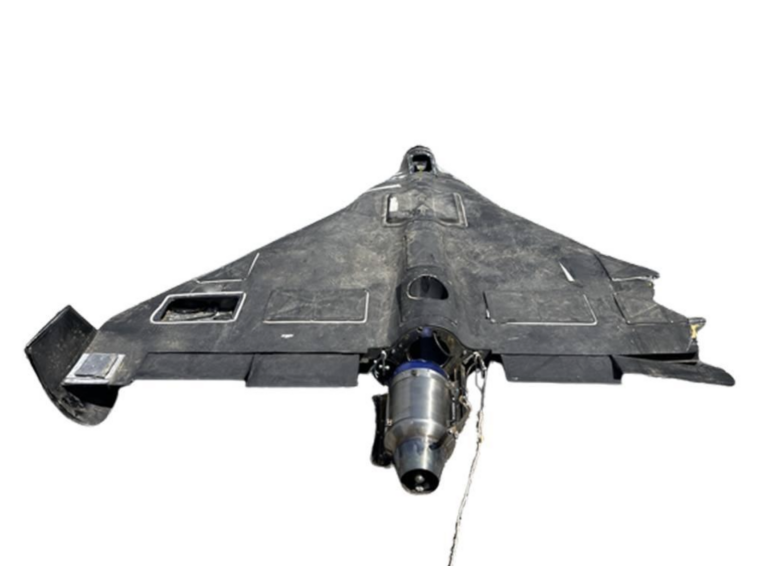
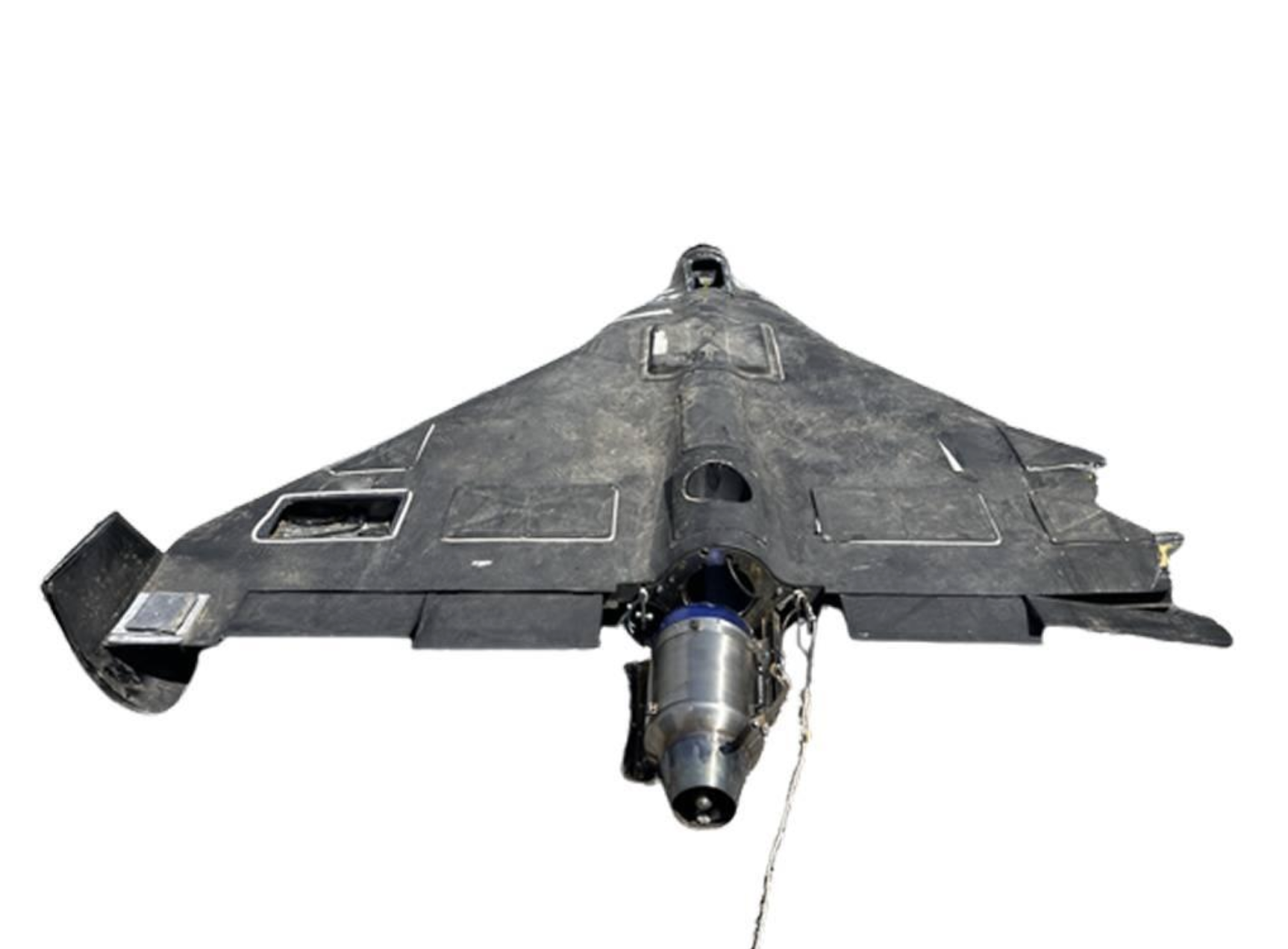
Ukraine’s Defence Intelligence has documented several generations of Russian jet-powered one-way attack UAVs, including the Geran-3, Geran-4 and Geran-5, alongside other systems such as the jet-powered Banderol.
The latest Geran-4 examined by Ukrainian intelligence has a reported cruise speed of about 320 km/h, maximum speed around 450 km/h, range of approximately 770 km and maximum take-off weight of up to 450 kg. Depending on configuration, Ukrainian intelligence lists warheads of up to 90 kg.
That remains substantially slower than most conventional cruise missiles. But operationally, the gap between the two threat categories is narrowing.
Russia is adapting specifically to Ukraine’s defences
One particularly important detail is why the Geran-4 exists.
Ukraine’s Defence Intelligence says Russia developed the aircraft partly in response to the growing effectiveness of Ukrainian interceptor drones against slower Geran and Shahed-type systems.
That makes the Geran-4 an unusually clear example of the technological action-reaction cycle now defining the air war.
Ukraine develops inexpensive interceptor drones capable of destroying Shaheds.
Russia increases the speed and altitude of its attack drones.
Ukraine then needs faster interceptors.
Russia improves navigation and countermeasures.
The cycle continues.
The newest Geran-4 modification documented by Ukrainian intelligence on 5 October illustrates this process particularly well.
It includes an electro-optical correlation navigation system known as Susanin, which compares imagery from an onboard sensor with reference terrain data. It also incorporates inertial navigation assisted by a high-precision magnetometer.
The significance is straightforward: the aircraft becomes less dependent on satellite navigation alone.
Electronic warfare remains an important part of air defence, but an aircraft capable of navigating through a combination of inertial and optical methods becomes more difficult to defeat simply by denying GNSS.
Ukraine also reports that newer Geran-4 aircraft are using a Russian-produced turbojet replacing an earlier Chinese Telefly engine, indicating that Moscow is attempting to localise a strategically important component of the production chain.
Is the cheap-interceptor model reaching its limit?
Not necessarily — but it is being forced to evolve.
Ukraine has turned interceptor drones into an increasingly important part of its air-defence network. In March alone, Ukraine’s Ministry of Defence reported more than 33,000 enemy UAVs of various types destroyed by interceptor drones.
Most of those targets were not high-speed jet-powered strike aircraft.
The jet threat demands a different class of interceptor.
Colonel Yurii Cherevashenko, deputy commander of the Ukrainian Air Force responsible for air defence, said this week that roughly 20 companies are currently engaged with the military on high-speed interceptor solutions.
Fourteen reportedly have physical products undergoing testing. Six have achieved some success against jet-powered UAVs and three are regarded by the Air Force as promising solutions.
One system has already entered service.
The problem is scale.
Current production is measured only in tens of aircraft, according to Cherevashenko. Ukraine does not expect the necessary quantities of high-speed interceptors to become available before at least the end of November.
The interceptors themselves currently reach around 460–500 km/h, while some manufacturers claim designs capable of approximately 700 km/h.
President Zelenskyy has separately said that Ukraine is testing five interceptor models and expects production of one design to reach roughly 400 aircraft by the end of October.
The bottleneck is not only manufacturing capacity. Turbojet engines have themselves become a limiting component.
Ukraine consequently announced in September that it intends to establish domestic production of several types of jet engine specifically as part of the response to Russia’s evolving UAV threat.
The defensive economics are beginning to change
This may be the most important consequence for NATO.
A slow one-way attack drone creates an awkward cost problem for conventional air defence because using an expensive surface-to-air missile against an inexpensive UAV is difficult to sustain.
Ukraine’s answer was partly to move downward in cost: machine guns, mobile teams, electronic warfare and eventually interceptor drones.
Russia’s jet-powered systems are attempting to push the defender back upward.
If a target flies too high for gun teams, too fast for inexpensive propeller-driven interceptors and is increasingly capable of navigating despite GNSS disruption, the defender has fewer cheap options available.
That does not mean every jet-powered UAV requires a Patriot, NASAMS or fighter aircraft. Nor would that be economically sustainable.
It means that the low-cost layer itself has to become faster and more sophisticated.
Ukraine is therefore effectively trying to create a new category of air-defence weapon: a relatively inexpensive, rapidly producible interceptor with enough speed, sensors and guidance capability to defeat a threat approaching some of the characteristics traditionally associated with cruise missiles.
Germany has already identified this as a priority. The German government confirmed on 5 October that a new €1 billion military assistance package for Ukraine includes funding for long-range weapons, combat drones and specifically “anti-jet drones” intended to counter the new Russian threat.
The requirement is no longer uniquely Ukrainian.
What happens if jet drones become the majority?
The numbers suggest that possibility has to be taken seriously.
In June, jet-powered systems represented only a relatively small share of Russian long-range UAV attacks. By October, Colonel Cherevashenko said they accounted for around 40% of UAVs used across Ukraine and as much as 60% in certain attack packages.
He said the Ukrainian Air Force is preparing for a scenario in which the figure could eventually reach approximately 80%.
That is a forecast, not an established production target, and should be treated accordingly.
But Russia’s direction of travel is already evident. General Oleksandr Syrskyi said as early as June that Moscow intended to move toward a force in which approximately half of its long-range one-way attack UAVs were jet-powered.
September’s 3,500 aircraft suggest that transition is no longer theoretical.
The lesson for NATO air defence
Europe should be careful not to learn yesterday’s drone lesson.
The enormous success of inexpensive interceptor drones against slow-moving UAVs has understandably generated interest throughout NATO. But the Russian response demonstrates how quickly the threat can move.
Counter-UAS therefore cannot be based around one perfect interceptor.
It has to be layered.
Electronic warfare remains useful against vulnerable navigation and communications systems. Guns and inexpensive interceptors remain efficient against slower targets. Faster interceptors are needed against the emerging jet threat. Conventional surface-to-air missiles and combat aircraft remain necessary against the highest-performance threats.
The critical challenge is keeping the cost of each defensive layer proportionate to the target it is intended to defeat.
That is where Russia’s current jet-drone expansion becomes strategically important.
The Geran-4 is not a cruise missile.
But it does not have to be.
If it is cheap enough to manufacture in large numbers while being fast, high-flying and autonomous enough to force the defender to employ increasingly sophisticated weapons against it, it has already achieved much of its purpose.
What’s next
Three indicators will show whether Russia is fundamentally changing the long-range UAV threat.
First is volume: whether the September figure of almost 3,500 jet-powered UAVs continues to rise.
Second is performance: whether operational systems move beyond today’s roughly 300–500 km/h class toward the much higher speeds Ukrainian officials believe Russia is pursuing.
Third is the defensive cost curve: whether Ukraine can scale jet-powered interceptors fast enough to preserve the economic advantage it achieved against earlier Shahed-type aircraft.
That last question may matter far beyond Ukraine.
Because if inexpensive jet-powered attack drones can be produced by the thousands each month, NATO may soon need an air-defence layer that largely does not exist today.
Edited with the assistance of AI.
Primary sources: Ukrainian Air Force; Defence Intelligence of Ukraine; Office of the President of Ukraine; Ukrainian Ministry of Defence; German Federal Government.
About the Author