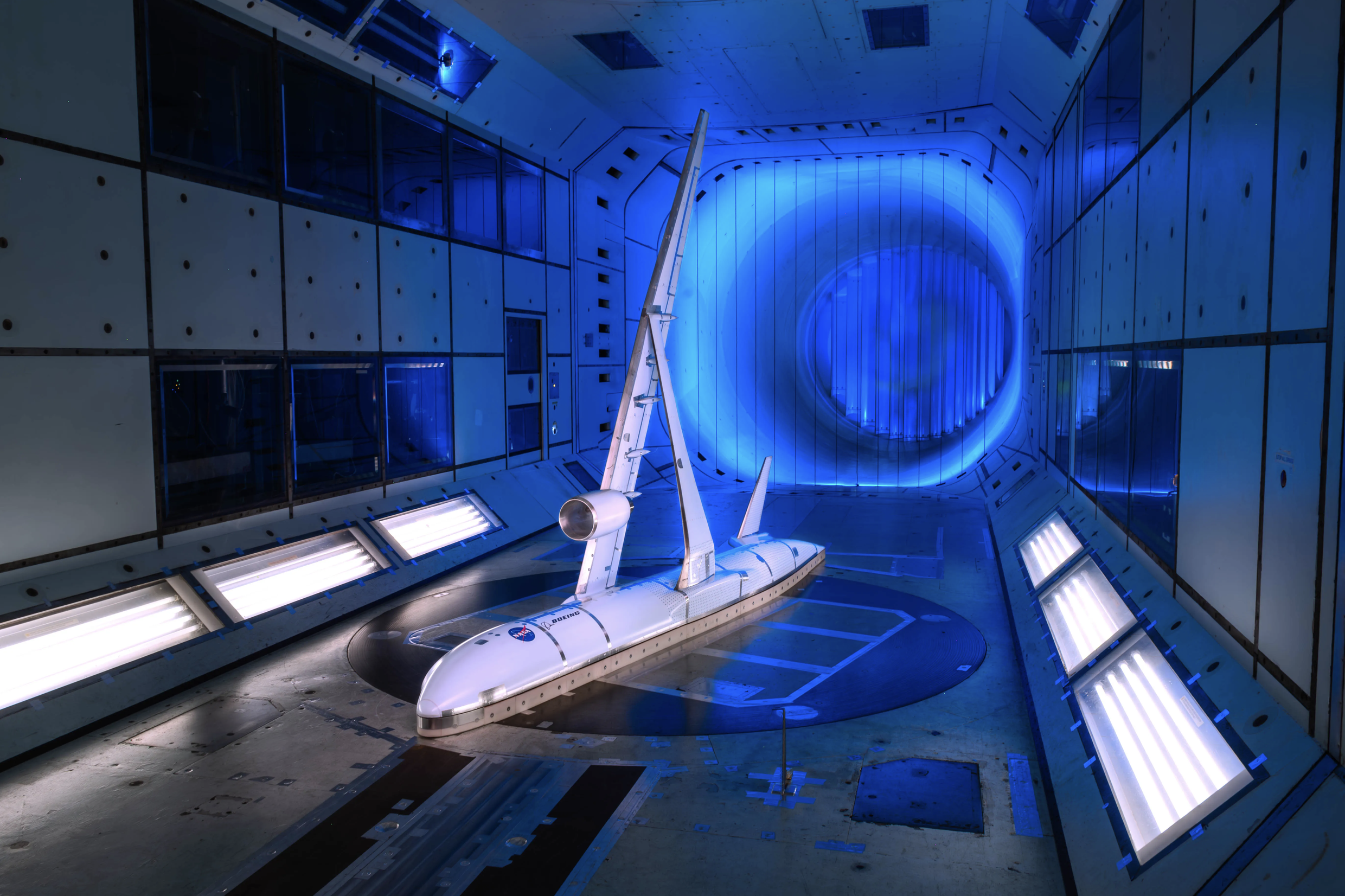
A scale model of Boeing’s Subsonic Ultra Green Aircraft Research concept undergoes testing in a 5-meter wind tunnel operated by the company QinetiQ in December 2025. QinetiQ
For 120 years, humans have decided what an aircraft should look like and computers have helped us make it better. A new generation of research is beginning to reverse that relationship. What happens when machines are allowed to explore aerodynamics beyond the boundaries of human intuition?
Put a Boeing 707 from the 1950s next to a modern airliner and the technological difference is enormous. Engines, materials, avionics, aerodynamics, manufacturing and efficiency have advanced almost beyond comparison.
Yet step far enough away and the basic idea remains remarkably familiar.
A cylindrical fuselage. Swept wings. Engines attached to or integrated with those wings. A vertical tail. Horizontal stabilisers. Control surfaces whose ancestry reaches back almost to the beginning of powered flight.
Military aircraft have evolved much further geometrically, driven by supersonic flight, stealth and radically different mission requirements. Experimental aviation has produced flying wings, lifting bodies, variable geometry, forward-swept wings and aircraft without conventional tails. But even here, aerospace design usually begins with something recognisable as an aircraft and then asks how to improve it.
There is a perfectly good reason for that. Aircraft are not sculptures shaped only by aerodynamics. They must carry people or weapons, survive structural loads, accommodate engines and fuel, fit inside hangars, operate from existing runways, be manufactured repeatedly, inspected, repaired, certified and — eventually — make economic or military sense.
But a new generation of research raises an uncomfortable possibility.
What if the aircraft we know are not the best shapes physics allows? What if they are simply the best shapes humans learned how to design, calculate and manufacture?
The tyranny of what already works
Engineering advances by building upon previous knowledge. That is one of its greatest strengths, but it also creates boundaries.
Once an architecture works, enormous ecosystems develop around it. Universities teach engineers how to analyse it. Manufacturers learn how to build it. Regulators learn how to certify it. Airports adapt to it. Suppliers optimise components for it. Computer models become extraordinarily good at predicting its behaviour.
The design gets better and better.
But optimisation and discovery are not necessarily the same thing.
If an engineer begins with a conventional wing and asks a computer to optimise it, the result may be an extraordinarily good conventional wing. The computer is searching inside a design space whose fundamental boundaries were already chosen by a human.
The more interesting question is what happens when we stop defining those boundaries.
DARPA is now asking something remarkably close to that.
DARPA thinks conventional simulation is running into a wall
Modern aircraft design relies heavily on computational modelling. Computational fluid dynamics can reproduce increasingly complex flows at levels of fidelity that previous generations of aerodynamicists could only imagine.
The obvious assumption is that more computing power and more detailed models will eventually solve increasingly difficult aerodynamic problems.
DARPA is challenging that assumption.
Its AutoDIDACTS programme — Automated Discovery for Design and Control of Turbulent Systems — starts from the observation that increasingly detailed simulation models can suffer from diminishing returns. As models grow more sophisticated, the number of interacting variables can make problems computationally intractable, while results may remain difficult to generalise beyond the specific conditions being modelled.
DARPA wants to approach the problem differently.
Rather than simply building ever larger simulations, AutoDIDACTS aims to combine precision experimental data, artificial intelligence and automated discovery to identify predictive, generalisable principles that can guide aerodynamic design across dramatically different regimes — potentially from small drones to hypersonic vehicles.
The programme is led by physicist Mukund Vengalattore, a former Cornell professor now at DARPA’s Defense Sciences Office. His background is not conventional aircraft design but quantum science, ultracold gases and quantum systems.
That matters because one of the programme’s most unusual tools is something DARPA calls a quantum wind tunnel.
A wind tunnel that fits on a table
A conventional wind tunnel recreates airflow around a physical object. The more extreme the flight regime, the harder and more expensive reproducing the relevant conditions becomes.
DARPA’s related APAQuS research is exploring something radically different: using ultracold quantum fluids and other controllable quantum systems as tabletop simulators for turbulent behaviour.
The objective is not to put a miniature Boeing wing into a quantum wind tunnel.
It is to reproduce aspects of the underlying physics of turbulence in an experimental system that can be controlled and measured with extraordinary precision. Those measurements could then provide ground-truth data for AI models attempting to discover more general descriptions of turbulent behaviour.
The ambition is important.
For more than a century, engineers have used wind tunnels primarily to test aircraft configurations humans had already imagined.
DARPA is exploring whether experiments can help machines discover aerodynamic principles humans have not yet formulated.
That changes the role of the computer.
It is no longer merely calculating the answer to an engineering question.
It may begin helping us discover which questions to ask.
Machines are beginning to rediscover physics
This idea extends well beyond DARPA.
Steven Brunton at the University of Washington has become one of the leading researchers working at the intersection of machine learning, dynamical systems and fluid mechanics. His work explores not simply using AI to predict flows, but using data-driven methods to identify reduced-order models and even governing equations underlying complex physical systems.
That distinction is fundamental.
Traditional computational engineering begins with equations describing physics and uses computers to calculate what those equations predict.
Machine-learning approaches can invert part of that process: provide observations of a physical system and ask algorithms to identify mathematical structures capable of explaining what is happening.
Brunton’s work also provides an important warning against simplistic claims about AI replacing physics. Machine learning becomes considerably more useful when physical knowledge is embedded into the problem — into the architecture, training data, constraints or optimisation process.
The future therefore may not be AI versus physics.
It may be AI discovering useful representations of physics that humans struggle to extract from enormously complex data.
And fluid mechanics is an unusually fertile place to try.
Turbulence remains one of physics’ great problems. We know the equations governing fluid motion, but predicting their behaviour across all relevant scales can become extraordinarily difficult.
An aircraft flying through the atmosphere therefore presents exactly the kind of system in which greater computing power alone may not provide the entire answer.
Then Mark Drela asks an even stranger question
Mark Drela has spent decades doing almost the opposite of abandoning classical aerodynamics.
The MIT professor, National Academy of Engineering member and director of the Wright Brothers Wind Tunnel is one of the world’s leading figures in computational aerodynamic design. Software and methods he developed are used across academia and the aircraft and gas-turbine industries.
Yet some of his recent work illustrates how even familiar engineering concepts become less obvious as aircraft architectures evolve.
Consider two of the most basic words in aviation:
Thrust and drag.
For a conventional aircraft, the distinction appears straightforward. Engines produce thrust. The aircraft produces drag. Subtract one from the other and we obtain the net streamwise force.
But increasingly integrated aircraft and propulsion concepts complicate that division.
If a propulsion system ingests the aircraft’s boundary layer, for example, the flow around the airframe and the flow through the propulsor interact. Where does airframe drag end and propulsion begin?
In a 2024 NASA seminar, Drela asked the question directly: Is thrust well defined?
For highly integrated configurations, separating thrust and drag can become ambiguous.
That may sound like an academic technicality. It isn’t.
It hints at something much larger.
Many of the categories engineers use to understand aircraft were developed around architectures in which wings, fuselages and engines were comparatively distinct systems.
If future aircraft integrate propulsion, aerodynamics, structures and active flow control much more deeply, even the language used to describe their performance may need to evolve.
Perhaps machines will not simply discover different aircraft shapes.
They may force us to rethink some of the engineering concepts with which we describe aircraft in the first place.
Nature never discovered the fixed wing
There is another useful way to look at the problem.
Birds have been flying for millions of years, yet almost nothing in nature resembles a conventional aircraft wing.
A bird changes its wing continuously. Span, sweep, camber, twist, surface characteristics and effective control geometry change throughout flight. Feathers interact with airflow in ways that conventional aircraft structures cannot easily reproduce.
Aircraft, by comparison, are remarkably rigid.
This is not because engineers failed to notice birds.
It is because a fixed wing has historically been easier to understand, manufacture, inspect, control and certify.
We built the aircraft our engineering system could support.
That distinction becomes increasingly important as materials, sensing, active flow control, morphing structures and computation improve.
Perhaps the rigid wing was not aerodynamics’ final answer.
Perhaps it was the best compromise available to twentieth-century engineering.
But AI can design useless aircraft too
At this point it is tempting to imagine feeding the laws of physics into a sufficiently powerful machine and waiting for it to produce an aircraft no human could have conceived.
Reality will be much less convenient.
An aerodynamically brilliant aircraft may be structurally impossible. A structurally brilliant aircraft may be impossible to manufacture. A manufacturable aircraft may be impossible to inspect. A flyable aircraft may be impossible to certify.
An airliner still needs doors, seats, cargo space and emergency exits. A fighter needs sensors, weapons, fuel and maintainability. Both must operate in weather, tolerate damage, survive thousands of cycles and interact with infrastructure designed around existing aircraft.
And machine learning itself introduces new problems. An algorithm is only as useful as the data, physical assumptions, objectives and constraints that shape it.
Ask a machine to minimise drag and it may discover something extraordinary.
Forget to tell it that mechanics need access to the engine and it may also discover something completely useless.
That is why the most credible researchers in this field generally do not describe the future as AI replacing engineering.
The more interesting possibility is AI expanding what engineers are capable of exploring.
The real revolution may be the design space
For most of aviation history, designers could explore only a tiny fraction of all physically possible aircraft.
Human intuition narrowed the options. Analytical tools narrowed them further. Manufacturing imposed another boundary. Certification, economics and infrastructure imposed more.
That produced extraordinarily successful machines.
But it also means that enormous regions of the possible design space were never seriously explored.
Machine learning, automated experimentation, high-performance computing and new manufacturing techniques could begin opening parts of that space.
The result may initially look familiar. A slightly different wing. A more integrated propulsion system. Active flow control replacing part of a conventional control surface.
Then the changes could compound.
Distributed propulsion alters where thrust can be generated. Active flow control changes how aerodynamic forces are produced. Morphing structures change the assumption that geometry remains fixed. Additive and advanced manufacturing make previously impractical internal and external shapes possible.
Once enough assumptions disappear simultaneously, the aircraft itself may begin to look different.
Not because an AI wanted something futuristic.
Because some of the constraints that made twentieth-century aircraft look the way they do no longer exist.
Maybe aircraft look like aircraft because humans designed them
This leads to a provocative thought.
The familiar shape of an aircraft may represent more than aerodynamic optimisation.
It may also be a fossil record of human engineering.
The tools we possessed. The materials we could manufacture. The mathematics we could solve. The factories we built. The regulations we wrote. The risks we were prepared to accept.
Change those constraints and the optimum may move.
Change enough of them and perhaps the definition of an aircraft moves with it.
That does not mean the Boeing 707 was wrong, or that today’s A350, 787, F-35 or Gripen represent obsolete thinking. Quite the opposite: they are extraordinary solutions to enormously complicated sets of requirements.
The question is whether those requirements — and our methods of solving them — have quietly defined the boundaries of our imagination.
DARPA’s experiments, Brunton’s work on machine learning and physical systems, and Drela’s questions about integrated aerodynamics all point towards different pieces of the same possibility.
The next revolution in aviation may not begin with a revolutionary aircraft.
It may begin with a revolutionary way of discovering one.
For the first 120 years of powered flight, humans imagined aircraft and taught machines how to analyse and fly them.
The next 120 may be defined by machines teaching humans what is possible to fly.
Editorial note: This analysis was researched and edited with AI assistance. Technical and research information was checked against DARPA, NASA, MIT and peer-reviewed work in machine learning and fluid mechanics. Photo: A scale model of Boeing’s Subsonic Ultra Green Aircraft Research concept undergoes testing in a 5-meter wind tunnel operated by the company QinetiQ in December 2025. Credit: QinetiQ
About the Author