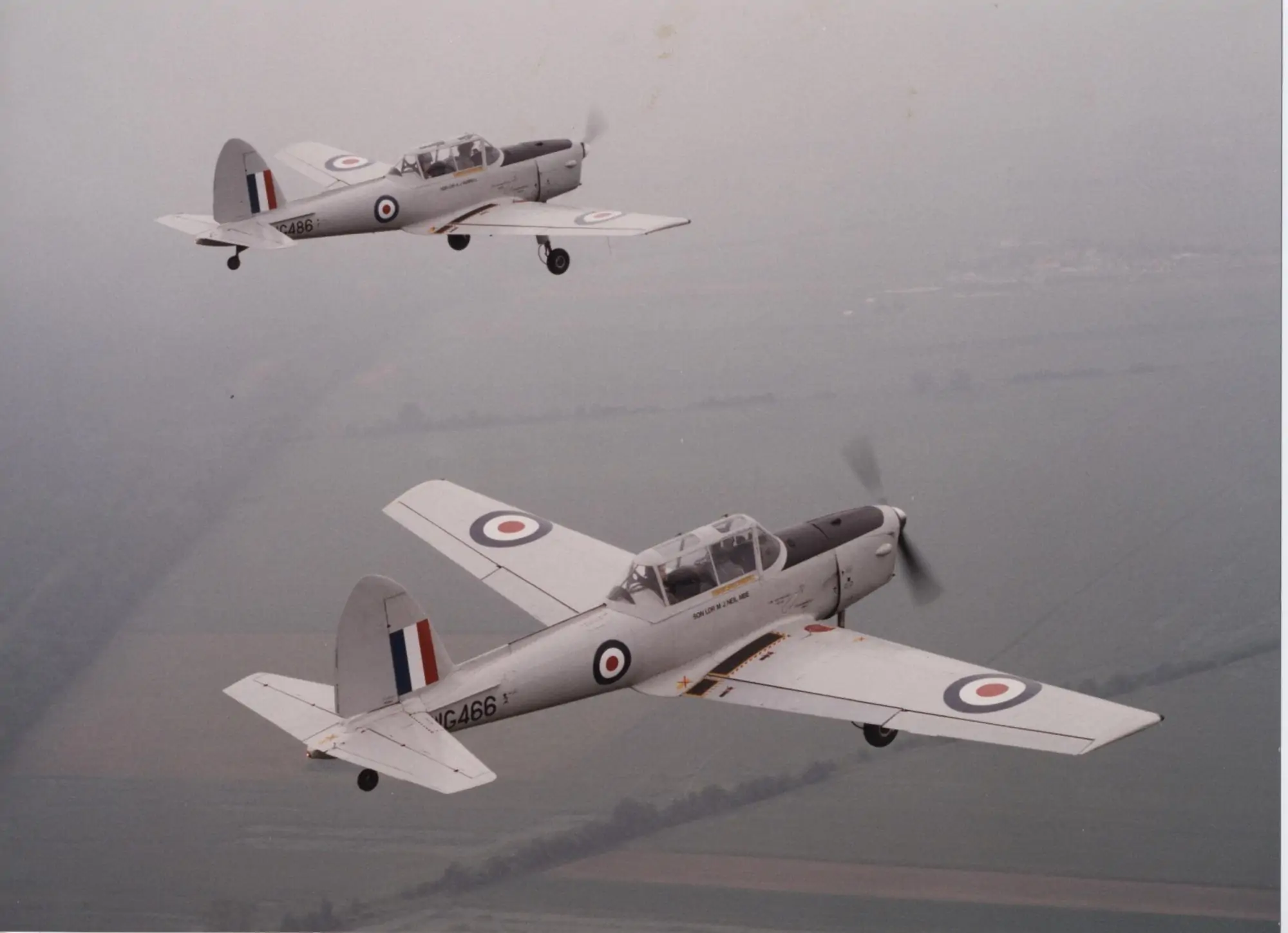
Chipmunks WG 486 und WG 466 fliegen in Formation, 1994 (AlliiertenMuseum/Crown Copyright)
No Mach 3. No stealth. Just a trainer, a camera – and one of the Cold War’s strangest intelligence loopholes.
When we think of Cold War reconnaissance aircraft, certain names come naturally.
U-2. SR-71 Blackbird. Canberra. MiG-25.
The de Havilland Chipmunk does not.
It was a small, piston-engined training aircraft. Two seats in tandem. Fixed wings. A de Havilland Gipsy Major engine producing around 145 horsepower.
For generations of Royal Air Force pilots, it was simply one of the aircraft on which they learned to fly.
But in divided Berlin, the Chipmunk acquired another job.
It became a spy plane.
For more than three decades, RAF Chipmunks operating from RAF Gatow flew reconnaissance missions over Berlin, photographing Soviet and East German military installations from an aircraft so modest that it seemed almost absurd alongside the sophisticated reconnaissance platforms of the Cold War.
There was no extraordinary speed to protect it.
No extreme altitude.
No stealth.
What protected the Chipmunk was something quite different.
A legal loophole created by the settlement of the Second World War.
The strange airspace above Berlin
After Germany’s defeat in 1945, Berlin was divided among the United States, United Kingdom, France and Soviet Union.
The city lay deep inside Soviet-controlled East Germany, but the Western Allies retained access rights to their sectors.
The resulting aviation arrangements created three air corridors connecting West Germany with Berlin and a Berlin Control Zone extending approximately 32 kilometres around the city.
Aircraft belonging to the four occupying powers could operate within this airspace.
That arrangement created an unusual intelligence opportunity.
The British had an aircraft at RAF Gatow that was ideal for exploiting it.
Not because it was fast.
Because it was slow.
An innocent-looking trainer
The Chipmunk had first flown in Canada in May 1946 and became the RAF’s primary elementary trainer during the post-war period.
The RAF eventually operated 735 of them.
It was simple, manoeuvrable and inexpensive to operate. More importantly in Berlin, it was a legitimate training aircraft.
That gave Britain a plausible reason to fly it regularly inside the Berlin airspace system.
Beginning in the 1950s, however, some of those apparently routine training flights had another purpose.
They were collecting intelligence.
The covert reconnaissance programme became known initially as Operation Schooner and later as Operation Nylon.
The aircraft operated from RAF Gatow, in the British sector of West Berlin.
The missions were conducted with the cooperation of BRIXMIS – the British Commanders’-in-Chief Mission to the Soviet Forces in Germany.
BRIXMIS itself was another Cold War anomaly.
Officially, British military liaison officers were in East Germany to maintain contact with Soviet forces.
In practice, they became extraordinarily effective intelligence collectors, observing Soviet equipment, units and movements at close range.
The Chipmunk gave them something even more valuable.
A view from above.
Two men, one aircraft and a camera
The arrangement was remarkably simple.
An RAF pilot flew the aircraft.
A BRIXMIS officer occupied the other cockpit and photographed military installations below.
Early missions relied on handheld cameras. Later, at least one Chipmunk received a dedicated camera installation.
The targets were not abstract.
Inside the Berlin Control Zone were Soviet barracks, airfields, headquarters, training areas and other military installations.
The aircraft could fly close enough to photograph equipment and activity that was difficult – and sometimes impossible – for BRIXMIS personnel to observe from the ground.
The Allied Museum in Berlin records that the aircraft flew reconnaissance missions up to three times per week, photographing military installations and looking for evidence of troop movements.
The resulting photographs were then analysed by BRIXMIS.
It was aerial reconnaissance conducted from one of the least intimidating aircraft imaginable.
The Soviets knew
The missions were covert.
They were not necessarily secret from the Soviets.
Flights had to be notified through the four-power Berlin aviation system.
Soviet controllers regularly responded to Chipmunk flight notifications with a distinctly ominous warning:
“Safety of Flight Not Guaranteed.”
The Soviet side understood what the British were doing.
But the peculiar legal status of Berlin made stopping the flights politically complicated.
The British were exercising Allied air-access rights.
And the Chipmunk was not an armed fighter penetrating Soviet airspace at high speed.
It was an RAF trainer conducting flights inside an airspace regime created by the victorious powers themselves.
That distinction was crucial.
Photographing a Soviet missile site
One episode demonstrates how valuable such a modest aircraft could become.
During the late 1950s, the Soviet Union established an SA-2 surface-to-air missile installation near Glau, south of Berlin.
The SA-2 – known to NATO as the Guideline – would become one of the defining air-defence weapons of the Cold War.
The missile itself had been publicly displayed.
Its associated radar and supporting equipment were of considerably greater intelligence interest.
Ground reconnaissance had failed to obtain the required imagery.
So the British went by air.
A first-hand account preserved by the RAF Historical Society describes a Chipmunk mission on 16 July in which the pilot descended to around 300 feet and manoeuvred to allow the BRIXMIS observer to photograph the installation.
The film was rapidly developed after landing.
According to the account, the resulting images contained the technical details intelligence officers had been seeking.
Their importance was considerable.
The crew was subsequently told that the photographs had reached the desk of U.S. President Dwight D. Eisenhower.
A 145-horsepower trainer had collected strategic intelligence on one of the Soviet Union’s emerging air-defence systems.
Then came the Berlin Wall
On 13 August 1961, East German authorities began sealing the border through Berlin.
The event would become one of the defining moments of the Cold War.
Again, the Chipmunk was useful.
An account preserved by the RAF Historical Society states that a Gatow Chipmunk obtained some of the first aerial photographs identifying the Soviet and East German forces involved as the Berlin Wall went up.
It is difficult to imagine a sharper contrast in aviation technology.
Only months earlier, the United States had been flying U-2 reconnaissance aircraft at extreme altitude.
Yet in Berlin, intelligence of strategic significance was being collected from a tiny propeller aircraft flying at low level.
Different problem.
Different solution.
Sometimes very low level
The Chipmunks could exploit their manoeuvrability and relatively low speed to obtain detailed imagery.
But that also meant operating close to Soviet installations.
The aircraft could not simply climb away from danger.
According to historical accounts, harassment occurred.
At least one Chipmunk was reportedly hit by ground fire from a Soviet soldier.
On another occasion, a Soviet Mi-24 Hind attack helicopter followed a Chipmunk during one of its missions.
The crews also had to be extremely careful about the geographical limits of their legal protection.
One particularly sensitive target was the Soviet airfield at Werneuchen, northeast of Berlin.
The base hosted high-value Soviet aircraft, including MiG-25 reconnaissance aircraft and, at times, long-range bombers.
The Chipmunks could approach and photograph activity there – but crossing the wrong boundary could transform a legally defensible reconnaissance flight into an intrusion into East German airspace.
Navigation therefore mattered as much as photography.
The camera became more sophisticated
The programme evolved.
By the end of the 1960s, one of the Gatow Chipmunks had received a permanently installed reconnaissance camera.
The aircraft also received improved communications equipment.
Photography remained the core mission, but the little trainer eventually acquired another intelligence role.
Electronic intelligence.
In 1981, British Prime Minister Margaret Thatcher approved the installation of ELINT equipment on at least one of the aircraft.
The system was reportedly used to collect information on Soviet radar equipment associated with the 9K35 Strela-10 – NATO designation SA-13 Gopher – short-range air-defence system.
That represented a remarkable evolution.
An aircraft designed immediately after the Second World War as a basic trainer was now collecting electronic intelligence against modern Soviet air-defence systems.
Why not use a better aircraft?
Because in intelligence work, the technically most capable platform is not always the most useful one.
A U-2 could fly dramatically higher.
An SR-71 could fly dramatically faster.
Neither could casually orbit over East Berlin under the protection of four-power occupation arrangements.
The Chipmunk could.
Its apparent weakness was therefore its greatest strength.
It belonged there.
The aircraft could fly slowly enough for detailed visual observation and photography.
It could operate from Gatow with minimal logistical requirements.
Its presence could be explained as continuation training.
And regular genuine training flights helped maintain that explanation.
The platform fitted the political environment almost perfectly.
One of the aircraft still exists
One of the Chipmunks used in Berlin, WG466, survives.
Built by de Havilland in Britain in 1954, it was stationed at RAF Gatow from 1987 until 1990.
After British operations in Berlin ended, the aircraft was eventually transferred to the Allied Museum.
Another Berlin reconnaissance aircraft, WG486, has an even more remarkable history.
Delivered to the RAF in 1952, it had previously flown operational reconnaissance and convoy escort missions in Cyprus during the late 1950s.
It later served at Gatow on the covert Berlin reconnaissance task between 1987 and 1989.
WG486 survives today with the RAF’s Battle of Britain Memorial Flight.
The RAF confirmed in 2026 that the aircraft is undergoing major maintenance at Duxford.
So one of Britain’s most unlikely Cold War reconnaissance aircraft remains an active RAF airframe more than seven decades after it was built.
Intelligence does not always need sophisticated aircraft
The Gatow Chipmunks continued their unusual work until the collapse of the Cold War removed the reason for it.
The Berlin Wall fell in November 1989.
German reunification followed in October 1990.
BRIXMIS was disbanded.
And the peculiar legal environment that had allowed a British training aircraft to photograph Soviet forces disappeared with it.
The story is a useful reminder of something easily forgotten when discussing reconnaissance technology.
Intelligence collection is not necessarily about possessing the fastest aircraft, the highest-flying sensor platform or the most sophisticated technology.
Sometimes the decisive advantage comes from understanding the rules better than the other side.
The Chipmunk had almost none of the characteristics normally associated with a spy aircraft.
It was slow.
It flew low.
It had no defensive systems.
It was based only kilometres from Soviet forces.
And the Soviets knew what it was doing.
Yet for decades, stopping it was more complicated than simply shooting it down.
The Chipmunk’s most important reconnaissance system was not its camera.
It was the legal status of the sky in which it flew.
Sources
Royal Air Force Museum – de Havilland Chipmunk collection and history of its covert reconnaissance role.
RAF Historical Society – Cold War Intelligence Gathering, including first-hand accounts of Chipmunk reconnaissance operations from Gatow.
Allied Museum Berlin – Chipmunk WG466 and British aerial reconnaissance over Berlin.
Royal Air Force – historical background on the Chipmunk and current history of WG486.
Additional historical reporting was consulted for Operation Schooner/Nylon and the later ELINT modification.
Editorial note: This article was researched and edited with AI assistance. Historical details were checked against RAF, RAF Museum, Allied Museum Berlin and RAF Historical Society sources.
About the Author