As NATO strengthens its ability to reinforce, disperse and sustain forces across Europe, the KC-390 Millennium is gaining ground among Allied air forces. The Czech delivery and Embraer’s announcements at Farnborough 2026 showed how the programme is developing from a series of national acquisitions into a broader European capability.
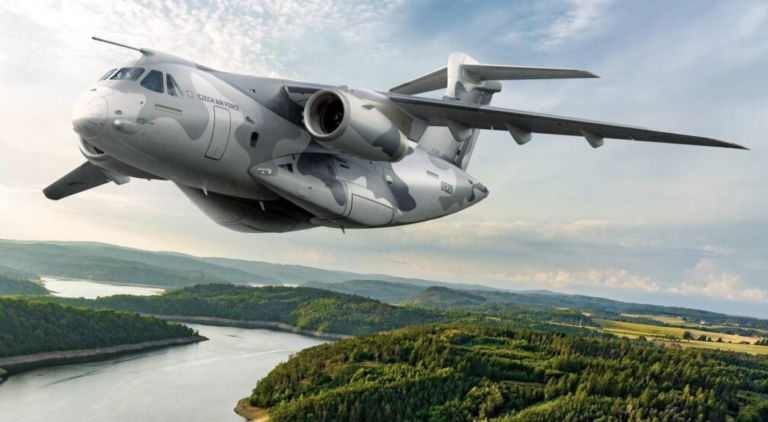
The first KC-390 Millennium for the Czech Air Force landed at Prague-Kbely Air Base on 6 July 2026 and was formally handed over on 16 July 2026, 20 months after the acquisition agreement was signed. A few days later, at the Farnborough International Airshow, the aircraft was named Karel Toman-Mareš, honouring a prominent figure in the Czechoslovak resistance and a pioneer of the Czechoslovak Air Force in exile during the Second World War.
The ceremony gave the aircraft a distinct Czech identity. Its arrival also reflected a wider shift in European defence planning.
Portugal and Hungary already operate the KC-390, while the Czech Republic has now received its first aircraft. The Netherlands, Austria and Sweden have placed firm orders. Slovakia has identified the platform as the preferred solution for its future military transport requirement, and Lithuania has selected it for the planned modernisation of its airlift fleet.
These programmes remain under national control and are progressing at different stages. Together, however, they are creating a connected European KC-390 user community extending from Portugal’s Atlantic coast through Central Europe to the Baltic and Nordic regions.
MOBILITY AT THE CENTRE OF DETERRENCE
Military mobility has returned to the centre of NATO planning.
Collective defence depends on the ability to reinforce Allied territory quickly. Forward-deployed formations need continuous access to personnel, ammunition, vehicles, air-defence systems, spare parts, medical support and fuel. Reinforcement units must be able to enter Allied territory, move between countries and reach their assigned areas without delay.
Airlift forms one part of a wider system that also relies on ports, road and rail corridors, maritime transport, logistics hubs and host-nation support. Aircraft provide the speed and flexibility required for priority personnel, urgent deliveries and destinations where surface transport is unavailable, disrupted or too slow.
NATO already addresses elements of this requirement through pooled and shared capabilities. Its strategic airlift arrangements allow participating nations to benefit from commonality, interoperability and economies of scale while retaining access to aircraft that would be difficult for some countries to acquire independently.
The same requirement is becoming increasingly important at the tactical level.
Air forces are preparing to operate from a larger number of locations rather than concentrating aircraft, weapons and support assets at a few large bases. Dispersal improves resilience against long-range missiles and unmanned systems, but it also increases the logistics burden.
Every additional operating site needs crews, ground equipment, communications, weapons, spare parts and maintenance support. Personnel and material may have to move repeatedly as the operational situation changes.
Transport aircraft therefore contribute directly to the generation of combat power. Fighters, air-defence units and deployed ground forces cannot maintain operational tempo without the logistics network behind them.
THE KC-390’S PLACE IN NATO AIR MOBILITY
The KC-390 Millennium was designed to combine strategic reach with tactical flexibility.
The aircraft can carry up to 26 tonnes and fly at speeds of up to 470 knots. Its mission portfolio includes troop and cargo transport, equipment and personnel airdrop, medical evacuation, search and rescue, aerial firefighting and humanitarian operations. Its ability to operate from temporary and unpaved runways increases the number of locations from which it can support deployed forces.
When fitted with quick-installation air-to-air refuelling equipment, the aircraft can operate as both tanker and receiver.
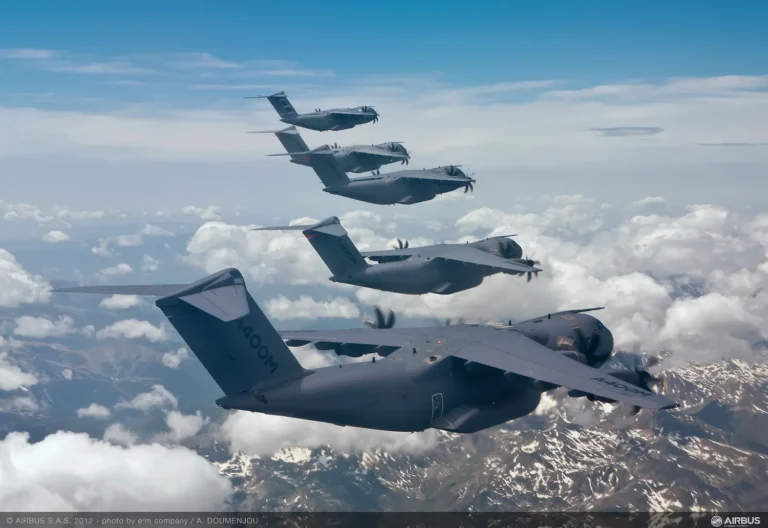
Within NATO’s air-mobility structure, the KC-390 complements heavy strategic airlifters and lighter tactical transports.
Heavy aircraft remain essential for carrying large and outsized loads over intercontinental distances. Medium airlifters such as the KC-390 are well suited to a broad range of daily missions: connecting logistics hubs with smaller airfields, moving loads that do not require a heavy transport and supporting operations closer to deployed forces.
This balance is particularly relevant for European air forces operating relatively small fleets. A single aircraft type can support troop transport, medical evacuation, tactical resupply, humanitarian relief and, when equipped for the task, air-to-air refuelling.
The KC-390 also brings jet speed to the medium-airlift category. Faster transit between bases can shorten mission cycles, increase aircraft utilisation and improve responsiveness when personnel or equipment must be moved at short notice.
Operational value will ultimately depend on readiness and sortie generation. Payload and range define what an aircraft can carry and how far it can fly; availability determines whether it is ready when the mission begins.
A EUROPEAN COMMUNITY GAINS CRITICAL MASS
Portugal became the first NATO country to operate the KC-390 in a configuration incorporating standard Alliance equipment. Hungary subsequently introduced the aircraft and completed its two-aircraft fleet in November 2025.
The Netherlands and Austria jointly ordered nine KC-390s, with five intended for the Royal Netherlands Air Force and four for Austria. Sweden added a firm order for four aircraft in October 2025 under a wider cooperation framework with the two countries. The Swedish contract also includes seven options that can support potential future acquisitions by other European nations.
This geographical concentration creates opportunities that individual national programmes could not develop alone.
Pilots and loadmasters can train on comparable systems. Maintenance organisations can build experience around the same platform. Technical support, spare-parts inventories and future upgrades can be coordinated across national fleets.
New training capabilities announced for Sweden and Austria at Farnborough will support pilots, loadmasters, other crew members and maintenance personnel as the aircraft enter service.
For countries acquiring only a handful of aircraft, this shared ecosystem is especially valuable. National ownership preserves operational sovereignty, while access to a multinational user community expands the training, technical and logistical resources available to each air force.
A common aircraft type does not by itself create interoperability. National configurations may differ, and each government retains authority over how its fleet is employed. Effective cooperation still requires compatible communications, common procedures, joint exercises and support arrangements that function under operational pressure.
The growing number of European users provides the scale required to develop those structures.
Sweden’s programme offers an early model. Its acquisition framework with the Netherlands and Austria explicitly addresses joint procurement, interoperability and long-term cooperation. Similar coordination across the wider KC-390 community could turn several small national fleets into a significant contribution to Allied mobility.
THE CZECH MILESTONE
The Czech Republic’s two-aircraft acquisition adds nationally controlled medium-airlift capacity in Central Europe.
The country lies close to key transport routes linking Western European ports and logistics centres with NATO’s eastern-flank members. Its KC-390s can support national deployments, multinational exercises, evacuation missions, humanitarian operations and the rapid movement of priority cargo between Allied locations.
The first aircraft gives the Czech Armed Forces the ability to transport heavy and oversized cargo over long distances while strengthening their contribution to NATO operations and emergency response at home.
The programme also builds on Czech participation in the KC-390 supply chain dating back to the aircraft’s development. Czech aerospace companies contribute to the platform, and the national acquisition creates further opportunities to develop technical expertise around its operation and support.
For NATO, the strategic value of such involvement lies in resilience. A broader European production and support base can help sustain aircraft availability as the fleet grows and operational demand increases.
The name Karel Toman-Mareš links this modern capability with the history of Czechoslovak airmen who served alongside their Allies in Britain. The context has changed, but the principle remains familiar: national air power gains strength through close Allied cooperation.
FARNBOROUGH OPENS THE NEXT CHAPTER
Farnborough 2026 also signalled that the KC-390’s development will extend beyond its established transport and tanker roles.
Embraer and Anduril signed a memorandum of understanding to jointly pursue the integration of the pallet-launched Barracuda-500M stand-off cruise missile with the aircraft.
The proposed system uses roll-on, roll-off mission equipment carried inside the cargo compartment. Palletised weapons would be released through the rear ramp using procedures derived from conventional aerial delivery, allowing the aircraft to return to its transport configuration once the mission equipment is removed.
The initiative responds to a broader operational requirement. NATO members need to increase the number of available long-range effects while maintaining flexibility across limited aircraft fleets.
Palletised systems offer a way to introduce additional missions without permanently modifying the aircraft. Transport platforms could be configured for a specific task and subsequently returned to their primary airlift role.
The KC-390’s payload, speed, cargo volume and rear-ramp design provide a strong basis for this approach. Its ability to operate from dispersed locations also supports concepts in which aircraft, weapons and support assets are distributed across a wider network of bases.
The Barracuda-500M initiative expands the KC-390’s potential role from moving forces to delivering stand-off effects. It also illustrates Embraer’s approach to the platform as an aircraft capable of evolving alongside changing operational requirements.
For Allied users, this flexibility can support a division of tasks across the European community. Individual countries do not need to reproduce every capability nationally when aircraft, training and mission systems can be coordinated across several operators.
MATCHING THE AIRCRAFT TO THE MISSION
The same principle shapes Embraer’s second major defence programme within NATO.
Portugal became the launch customer for the A-29N Super Tucano, ordering 12 aircraft in a configuration developed to meet NATO operational requirements. The first five were delivered to the Portuguese Air Force in December 2025, one year and one day after the acquisition agreement was signed.
The A-29N combines advanced training and operational capability in a single platform. Its mission set includes pilot preparation, armed reconnaissance, light attack, close air support, border surveillance and air patrol.
Its developing counter-UAS role addresses one of the most pressing challenges facing NATO air forces.
One-way attack drones can be produced and deployed in large numbers. Engaging them with high-performance fighters and advanced air-to-air missiles may be operationally effective, but it places pressure on aircraft availability, weapon stocks and operating budgets.
The A-29 offers an additional option for selected targets and operating environments.
Its endurance supports persistent patrols, while its flight characteristics are suited to operating against slower unmanned aircraft. Existing sensors and weapons provide the basis for detecting, identifying and engaging different categories of target.
Embraer and Valkyrie Aero are expanding this capability through the integration of the AI-enabled Gunslinger system. The technology is designed to support real-time counter-UAS decision-making and enhance the aircraft’s ability to find, track and engage unmanned threats. Guns, guided rockets and other effectors provide scalable responses to different threat profiles.
The A-29N complements the highest-performance elements of NATO air power. Fighters and advanced surface-to-air systems remain essential against complex, fast-moving threats. A turboprop platform offers an efficient additional layer for missions that do not require those assets.
Portugal’s operation of both the KC-390 and A-29N gives the country a central role in introducing Embraer’s latest defence platforms into the NATO environment.
The two aircraft address different requirements under the same principle: matching capability, availability and operating cost to the mission.
GROWTH SUPPORTS THE PROGRAMME
The expansion of the KC-390 and the introduction of the A-29N coincide with strong growth across Embraer Defense & Security.
Embraer closed the second quarter of 2026 with a company-wide backlog of USD 34.5 billion, its seventh consecutive record. The Defense & Security backlog reached USD 6.1 billion, representing year-on-year growth of 42 per cent.
The increase was driven in part by the landmark United Arab Emirates agreement covering ten firm KC-390 orders and ten options. It is the programme’s largest international order from a single country and its first selection in the Middle East.
The KC-390 has now been selected by 12 countries across Europe, Latin America, Asia and the Middle East.
This international scale supports continued investment in production, training, maintenance and future capabilities. It also benefits each operator through a stronger supply chain, a wider support network and a broader base for upgrades during the aircraft’s service life.
European customers are therefore joining a global programme rather than an isolated regional fleet. At the same time, the concentration of NATO users gives Europe an increasingly important role in the aircraft’s operational development.
The A-29N is following a complementary path. Portugal provides the first NATO reference, while advanced training and counter-UAS respond directly to current European requirements.
FROM PROCUREMENT TO COLLECTIVE CAPABILITY
Military transport was often treated as a supporting function during the post-Cold War period. Today, reinforcement and sustainment sit at the heart of collective defence.
NATO must be able to move forces across the continent, supply dispersed operating locations and respond rapidly when infrastructure or surface routes come under pressure. This requires heavy strategic airlift, medium transports, tankers, commercial capacity and resilient multinational logistics networks.
The KC-390 is becoming a meaningful part of that structure.
Its growing European user community connects national sovereignty with Allied interoperability. Each country retains control of its aircraft, while common training, support and procedures increase their collective value.
The Czech delivery and the Farnborough announcements captured the programme at a decisive stage. The KC-390 is operating with NATO air forces, entering additional European fleets and moving towards new mission areas.
The A-29N adds a second dimension, offering an efficient platform for advanced training, light-combat operations and the developing counter-UAS mission.
Together, the two programmes position Embraer within two central NATO air-power requirements: moving and sustaining forces across Europe, and responding to emerging threats with the platform best suited to each mission.
Readiness begins before the first combat sortie. It begins with the ability to move people, equipment and capability to where they are needed.
The KC-390 Millennium was built for that task.
Text: Katerina Urbanova
Photo credit: Embraer
About the Author