King Air Simulator
New Airtech Flight Test Academy is entering its next phase, combining modular knowledge training, advanced simulation projects, certification support and flight test execution for civil and military customers.
New Airtech Flight Test Academy, better known as NAFTA, has never positioned itself as a conventional training provider. From the beginning, the academy has built its identity around operational reality: training that is modular, competency-based, simulation-driven and tailored to the exact needs of pilots, engineers, operators and organisations working in complex aviation environments.
Now, NAFTA is moving into a new phase. Building on its established role in flight test and advanced aviation training, the academy is expanding its portfolio into integrated training systems, simulator development, LMS-based knowledge training, certification support and the actual conduct of flight test campaigns.
For an industry facing increasing technical complexity, tighter certification demands and a growing shortage of highly specialised aviation expertise, this marks a significant step. NAFTA is no longer only delivering courses. It is developing complete training solutions.
FROM COURSES TO TRAINING ARCHITECTURE
At the core of NAFTA’s development is a customised LMS knowledge training solution designed to support anything from short courses to transition training and preparation modules within larger, more complex training programmes.
This approach reflects one of the academy’s key principles: not every customer needs the same training product. Some require a focused refresher module. Others need a structured preparation course before entering aircraft or simulator phases. Military and governmental customers may require training architectures that combine theory, simulation, operational procedures and assessment. Industry partners may need highly specific knowledge modules linked to certification, flight test or maintenance activities.
NAFTA’s answer is modularity. The academy is developing and delivering training courses for flight test personnel as well as for affiliated specialist topics. These can be adapted to pilots, flight test engineers, maintenance engineers, operators and organisations that need a deeper understanding of how aircraft behave, how systems are tested, and how risks are managed before entering operational service.
The result is a training model that is flexible without being generic. Every module has a purpose, but every programme can be shaped around the customer.
COMPETENCE BEFORE ROUTINE
NAFTA’s philosophy remains rooted in Competency-Based Training and Assessment. Instead of measuring progress only by hours, attendance or standardised course completion, the academy focuses on demonstrated competence: what a trainee can understand, apply, explain and execute under realistic conditions.
This matters in flight test and special mission aviation because routine is not enough. Flight test personnel are expected to work with uncertainty. Maintenance check flight crews must understand abnormal system behaviour. Engineers supporting certification campaigns need to translate data, cockpit behaviour and operational limits into meaningful conclusions. Military and governmental customers often require training that goes beyond civil baseline standards, without compromising safety or structure.
NAFTA’s approach is therefore active rather than passive. Training is built around decision-making, scenario logic, operational consequences and instructor feedback. The aim is not simply to transfer information, but to develop judgement.
SIMULATION AS A STRATEGIC TOOL
A major part of NAFTA’s future growth lies in simulation. The academy already has a strong association with advanced simulator-based training, including high-risk scenarios that are difficult or impossible to reproduce safely in real aircraft. The next phase broadens this concept into platform-specific simulator projects and customer-specific training systems.
One of the new initiatives is the project start of a PC-9 VR/MR Flight Training Device. The system is based on a PC-9 cockpit, using its actual size, dimensions and cockpit logic, including the respective controls and switches. This gives trainees a realistic physical environment and supports authentic procedure training, cockpit familiarisation and muscle memory.
At the same time, the concept is designed to be flexible. While the cockpit architecture is based on the PC-9, the displays will use touchscreen technology, allowing the simulator to mimic other turboprop aircraft with different cockpit layouts and underlying flight models. This makes the device not only a PC-9 training tool, but a scalable platform for turboprop familiarisation, transition training and scenario-based instruction across multiple aircraft types.
The PC-9 project is therefore not just about visual immersion. It is about building a training environment that can support procedures, decision-making, mission preparation and scenario-based learning in a way that complements aircraft and higher-level simulator training.
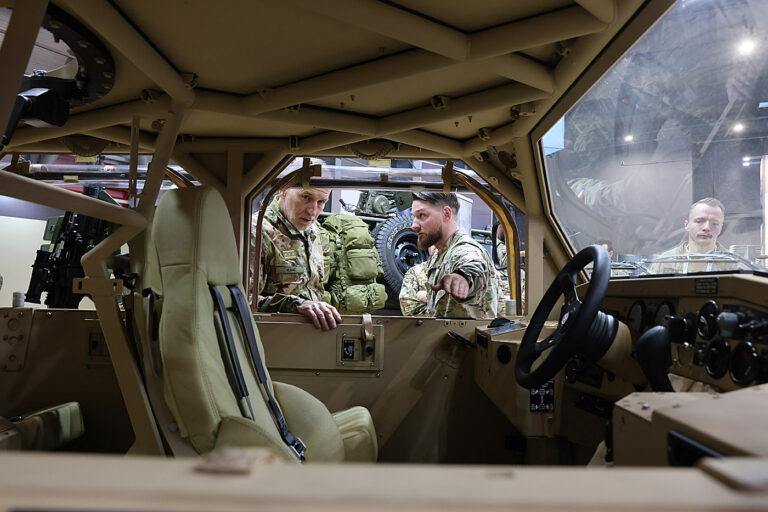
In parallel, NAFTA is involved in the design and development of a King Air simulator and a corresponding training programme for an international military customer. This project underlines the academy’s ability to move beyond classroom instruction and into the development of complete training ecosystems. Aircraft type, customer mission, training objectives and operational culture all become part of the design process.
This is where NAFTA’s strength becomes visible: the academy is not simply asking what simulator a customer wants. It is asking what competence the customer needs to build.
SUPPORTING THE F-35 ENVIRONMENT
Another forward-looking area is NAFTA’s offering of an F-35 simulator solution, developed by MultiSim, with a focus on maintenance engineer training for F-35 user nations.
The emphasis here is highly practical. Modern combat aircraft are not only operated by pilots; they depend on a sophisticated ecosystem of engineers, technicians and maintenance specialists who must understand complex systems, procedures and safety-critical ground operations. Training for maintenance engineers, including areas such as engine ground runs, requires a realistic and controlled environment in which personnel can practise procedures without unnecessary operational risk or aircraft availability constraints.
For F-35 user nations, such a capability can support readiness, standardisation and confidence among technical personnel. It also reflects a wider shift in defence aviation training: simulation is no longer only a pilot-training tool. It is becoming part of the full operational and technical training chain.
By focusing on maintenance engineer training, NAFTA and MultiSim address a specialised but essential part of fifth-generation aircraft operations: preparing technical personnel for complex ground procedures in a safe, repeatable and highly realistic environment.
FROM TRAINING PROVIDER TO FLIGHT TEST PARTNER
NAFTA’s expansion is not limited to simulation and courseware. The academy is also active in supporting flight test campaigns and in the actual conduct of test flights.
One current example is that NAFTA has been approached to support the certification of a new Satlink antenna on a business jet. This type of work requires more than flying experience. It requires a structured flight test mindset: understanding certification requirements, planning test points, managing risk, collecting meaningful data and translating aircraft behaviour into a defensible technical result.
For customers, this combination is valuable. NAFTA can support the intellectual framework of a test campaign and also contribute to its practical execution. The academy’s expertise therefore connects training, research and development in real-world flight test operations.
It is a natural extension of NAFTA’s identity. The academy teaches flight test because its team understands flight test as an operational discipline.
THE TEAM BEHIND THE ACADEMY
NAFTA’s credibility is closely tied to the people behind it. The academy brings together experience from civil aviation, military aviation, flight test, instruction, airline operations, simulation, certification and business development.
This mix is essential. Flight test training cannot be built only from textbooks. It requires instructors who understand how aircraft behave, how customers operate, how engineers think, how pilots make decisions under pressure, and how aviation organisations manage risk.
The leadership team has repeatedly positioned NAFTA as a place where experience is translated into practical training value. The academy’s strength is not only technical knowledge, but the ability to turn that knowledge into structured, customer-specific programmes.
That is particularly important as the customer base broadens. Civil operators, military organisations, governmental agencies, aircraft manufacturers, maintenance organisations and special mission operators all have different needs. NAFTA’s team expertise allows the academy to speak across those worlds.
CUSTOMISATION AS A CORE CAPABILITY
Customisation is one of the strongest themes in NAFTA’s current development. The academy is not only building a catalogue of fixed products and asking customers to fit into it. Instead, it is developing training solutions around the customer’s aircraft, mission, personnel, regulatory environment and operational goals.
A short course can become part of a larger transition pathway. A simulator project can be linked to a knowledge training programme. A maintenance training concept can be designed around a specific platform. A flight test campaign can be supported by preparatory training and execution.
This flexibility is increasingly important in modern aviation. New aircraft, new mission systems, new connectivity solutions, advanced avionics, special mission modifications and fifth-generation platforms all create training demands that do not always fit traditional schoolhouse models. NAFTA’s answer is to build around the need, not around the template.
BUILDING TOWARD LBA ATO APPROVAL
A key institutional step was the project start of LBA ATO approval for flight test and special training programmes.
For NAFTA, this is more than an administrative milestone. It is part of the academy’s long-term ambition to formalise and expand its training capability within a recognised regulatory framework. LBA ATO approval would support the development of structured flight test and special training programmes and strengthen NAFTA’s position as a serious provider for both civil and governmental customers. It also sends a clear signal: NAFTA is building for the long term.
FLEET DIVERSITY AND TRAINING DEPTH
NAFTA’s future training concept is increasingly defined by diversity. Not diversity for its own sake, but diversity as a training advantage.
Different aircraft and simulators teach different lessons. A PC-9 VR/MR FTD can support military-style training logic, cockpit familiarisation and procedural preparation. Its adaptable touchscreen display concept and underlying flight model architecture also allow it to support broader turboprop training applications beyond one single aircraft type.
A King Air simulator can support multi-engine operations, mission profiles and military customer requirements. An F-35-focused simulator, developed by MultiSim, can serve maintenance engineer training in a high-end defence environment. Business jet flight test support connects the academy to certification and modification work in civil aviation.
Together, these projects point toward a comprehensive training approach. NAFTA is creating a flexible ecosystem in which aircraft, simulators, digital learning, instructor expertise and customer-specific training programmes can be combined.
This is the future of specialised aviation training: not one platform, one syllabus or one method, but a carefully designed mix of tools.
WEEZE FLY-IN: A SELECTIVE LOOK AHEAD
This summer, NAFTA is also supporting the invitation-only fly-in in Weeze for selected guests.
The event is intended as a focused opportunity to present NAFTA’s direction, connect with selected partners and customers, and demonstrate how the academy’s evolving portfolio fits the needs of modern aviation organisations. Rather than a broad public showcase, the fly-in reflects NAFTA’s preference for direct, expert-level engagement with people and institutions who understand the challenges of advanced aviation training.
It will also offer a glimpse of where the academy is heading: deeper simulation capability, stronger regulatory positioning, broader customer-specific training programmes and a growing role in flight test and certification support.
THE NEXT PHASE
NAFTA’s direction is clear. The academy is growing from a specialist flight test training provider into a broader training and development partner for organisations that need more than standard courses.
Its future focus combines team expertise, competency-based methodology, customised training architecture, simulator and aircraft diversity, and a strong ambition to support both civil and military customers in highly demanding environments. The message is simple: aviation training must evolve at the same pace as aviation itself. For NAFTA, that evolution is already underway.
Text: Thomas Reinert
Photo credit: NAFTA
About the Author