A350F
The Airbus A350F has completed its maiden flight from Toulouse, opening a new chapter in a widebody freighter market that Boeing has dominated for decades. But the significance of the aircraft goes far beyond today’s first flight. Airbus is entering the market at a moment when older freighters are approaching replacement, environmental rules are changing and demand for high-capacity air cargo remains strategically important.
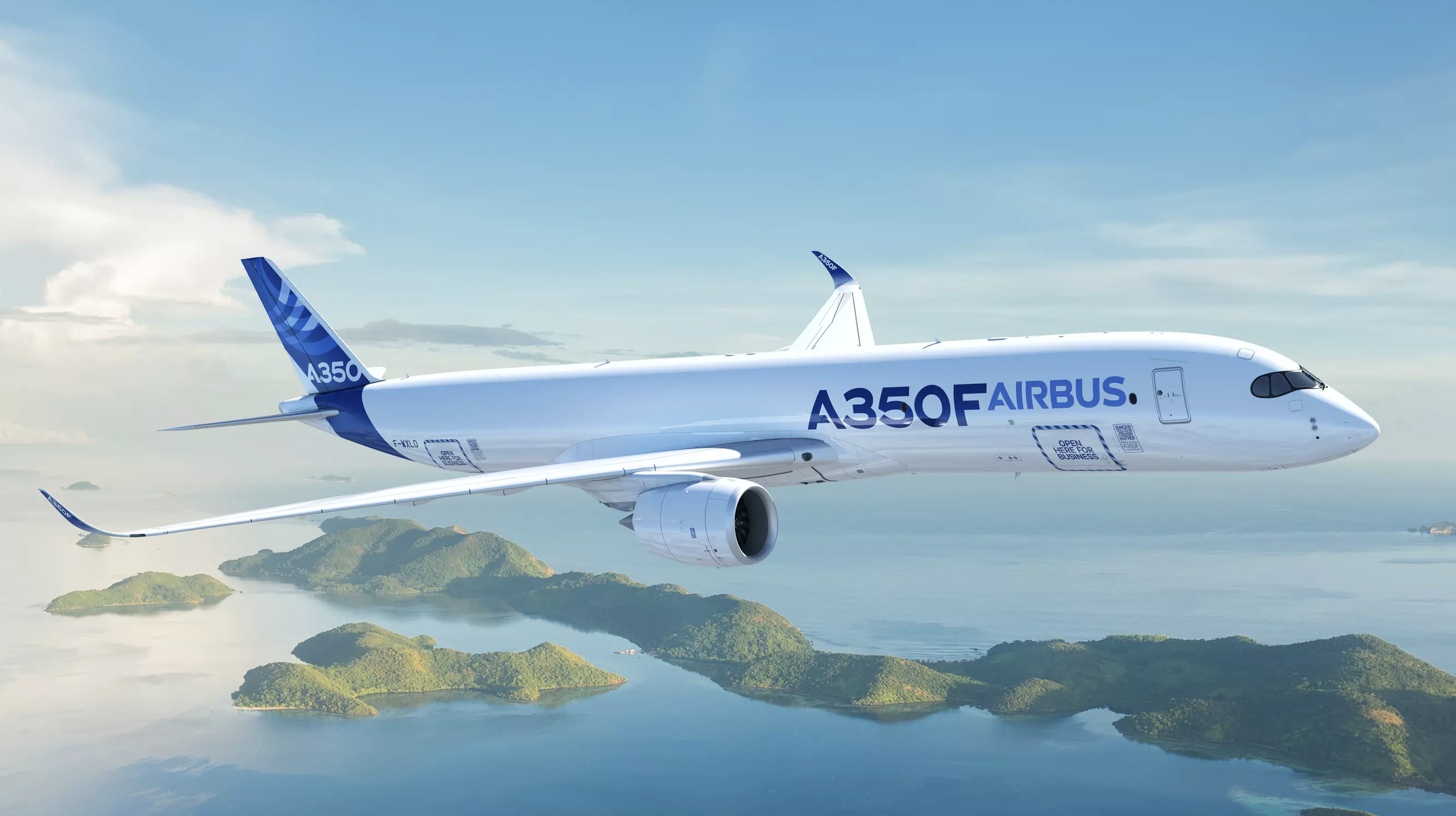
The Airbus A350F took to the skies for the first time from Toulouse on 29 September 2026, beginning a flight-test and certification campaign expected to last around nine months.
The first aircraft, MSN700, departed Toulouse for an initial flight planned to last approximately four hours.
For Airbus, however, the milestone represents much more than another derivative of the successful A350 family.
It is the company’s most serious attempt in decades to challenge Boeing’s dominance of the large purpose-built freighter market.
And this time, Airbus may be entering the fight with a much stronger hand.
Not simply an A350 with the windows removed
Although the A350F shares much of its technology with the A350 passenger family, the freighter is effectively a new configuration.
Airbus describes its fuselage geometry as combining approximately the forward fuselage length of the A350-900 with the rear fuselage length and wings of the larger A350-1000.
At 70.8 metres, the resulting aircraft sits between the 66.8-metre A350-900 and 73.8-metre A350-1000.
That apparently modest difference has important consequences.
The changed fuselage geometry creates a different aerodynamic model and affects the aircraft’s flight-control characteristics. Changes associated with the landing gear geometry also influence ground handling.
That is why Airbus is conducting a dedicated flight-test campaign rather than relying largely on the existing A350 certification.
Around 400 flight-test hours are planned using two aircraft.
MSN700 will concentrate primarily on aerodynamic performance, handling qualities, flight controls and autopilot behaviour.
The second aircraft, MSN701, will focus more heavily on systems testing, including air conditioning, fire and smoke detection and hot- and cold-weather trials.
EASA pilots and flight-test engineers are expected to participate directly in parts of the certification campaign.
111 tonnes of cargo
The numbers explain where Airbus is positioning the aircraft.
The A350F is designed to carry up to 111 tonnes of payload over approximately 4,700 nautical miles / 8,700 kilometres, depending on configuration and payload.
Its 64.8-metre wingspan is shared with the A350 passenger family.
The aircraft is powered by Rolls-Royce Trent XWB-97 engines, the same basic powerplant used on the A350-1000.
More than 70% of the airframe is manufactured from advanced materials, including extensive use of carbon-fibre composites.
Airbus says this makes the A350F approximately 46 tonnes lighter than competing aircraft and allows fuel consumption and CO₂ emissions to be reduced substantially compared with previous-generation freighters with similar payload-range capability.
The aircraft is also designed to comply fully with the ICAO CO₂ emissions standard applicable to newly produced freighters from 2028.
That regulatory point is important.
It means the A350F is not merely competing for growth in the cargo market. It is positioning itself for a replacement cycle that will eventually affect some of the aircraft currently carrying much of the world’s long-haul freight.
The biggest cargo door Airbus has ever built
One of the most distinctive engineering elements of the A350F is its main-deck cargo door.
At 4.3 metres wide, Airbus describes it as the largest main-deck cargo door in the industry.
The door and surrounding structure required extensive development because cutting such a large opening into a carbon-composite fuselage creates very different structural challenges from those encountered on a conventional aluminium aircraft.
Its size is not simply an engineering exercise.
It is designed to simplify loading of standard pallets and containers while also allowing particularly large cargo – including modern aircraft engines – to be loaded more easily.
That matters increasingly as the physical diameter of modern high-bypass turbofan engines grows.
The cargo-door development was also one of the areas that contributed to delays in the programme.
When Airbus launched the A350F in 2021, entry into service was originally targeted for 2025. The programme subsequently slipped amid supply-chain difficulties and development challenges.
Entry into service is now planned for 2027.
Airbus is returning to difficult territory
Airbus has been here before – without much success.
The A330-200F entered service in 2010 but was heavily outsold by Boeing’s larger 777F.
An A380 freighter was planned but never reached production.
Meanwhile Boeing built an extraordinary position in global air freight.
The 747 became synonymous with intercontinental cargo operations, while the 767F established itself particularly strongly in the express-parcel market.
The 777F then became the benchmark large twin-engine freighter.
As a result, Boeing has for decades enjoyed a position in purpose-built freighters far stronger than its overall share of the commercial aircraft market would suggest.
The A350F is Airbus’s attempt to change that.
This time Airbus already has 115 orders
The early commercial numbers are therefore significant.
Airbus has accumulated 115 firm orders for the A350F.
That compares with 81 orders for Boeing’s competing 777-8 Freighter, according to current figures reported by Reuters.
The comparison requires some caution.
Orders can change, customers have different delivery requirements and the two aircraft do not occupy precisely identical positions in terms of payload and capability.
But 115 orders before the A350F has even entered service represents a considerably stronger market position than Airbus achieved with its previous freighter programmes.
Customers already include major cargo operators and airline groups across several regions.
Air China Cargo, for example, increased its commitment this year to ten A350Fs.
For Airbus, the customer base is important because the freighter market is comparatively small but strategically valuable.
A350F versus 777-8F
The battle will ultimately be defined by two very different propositions.
Boeing is emphasising maximum capability.
The 777-8F is derived from the 777X family and is designed as the largest and most capable twin-engine production freighter.
Airbus is placing greater emphasis on structural weight, efficiency and compatibility with the broader A350 ecosystem.
For cargo airlines, the decision will therefore not simply come down to which aircraft carries more.
Payload, range, fuel consumption, maintenance costs, fleet commonality, cargo volume, engine support and acquisition price all matter.
So does delivery availability.
That last point could become particularly important.
The 777-8F is tied to the wider 777X programme, which has experienced substantial delays. Airbus has also delayed the A350F, but today’s first flight means its certification campaign is now physically underway.
The race is therefore no longer theoretical.
Both manufacturers are preparing aircraft intended to define the next generation of long-haul air freight.
Why freighters matter more than their numbers suggest
Cargo aircraft represent only a relatively small part of global commercial aircraft production.
Their economic importance is much larger.
Roughly one-third of world trade by value moves by air, according to industry estimates cited by Reuters, with dedicated freighters carrying a substantial portion of that traffic.
Semiconductors, pharmaceuticals, electronics, industrial components and high-value machinery depend heavily on air transport.
Recent geopolitical disruption has reinforced that role.
Conflict affecting maritime routes, disruption to global supply chains and the rapid expansion of e-commerce have all highlighted the value of being able to move high-value goods rapidly between continents.
Boeing estimates that the global market will require approximately 930 new production freighters over the next 20 years, alongside around 2,000 passenger aircraft converted into freighters.
That makes the segment too important for Airbus to leave largely uncontested.
A very European aircraft
The A350F is also a particularly European industrial programme.
Its carbon-fibre wings are engineered at Filton and manufactured at Broughton in the United Kingdom.
Spain supplies structures including the rear fuselage, horizontal stabiliser and the enormous main-deck cargo door.
Germany produces major forward and aft fuselage structures, the vertical tail plane and upper wing covers, while also contributing the cargo-door surround structure and actuation system.
France provides numerous aerostructures, engine pylons and final assembly in Toulouse.
Some component panels are now also manufactured in the United States following Airbus’s integration of former Spirit AeroSystems assets.
The result is a cargo aircraft assembled in Toulouse from one of the most geographically distributed aerospace supply chains in the world.
The first flight changes the conversation
Until today, the A350F was fundamentally a programme promise.
Now it is a flying aircraft.
That does not mean Airbus has won anything yet.
MSN700 and MSN701 still face roughly 400 hours of flight testing. The aircraft must complete certification, demonstrate reliable cargo operations and transition from development into serial production.
Airbus must then deliver the aircraft reliably – no small challenge at a time when the wider aerospace supply chain remains under pressure.
Boeing, meanwhile, brings decades of freighter experience, an enormous installed customer base and the 777-8F, an aircraft designed specifically to defend its position at the top end of the cargo market.
But the numbers already suggest something has changed.
With 115 orders secured before entry into service, Airbus is not entering the next-generation freighter market as a marginal challenger.
For the first time in decades, Boeing may face a serious Airbus competitor in one of the commercial aviation sectors it has traditionally dominated.
The first flight of the A350F is therefore more than another milestone in an aircraft development programme.
It marks the beginning of a genuine two-manufacturer contest for the future of the large widebody freighter market.
Editorial note: This article was researched and edited with AI assistance. All key facts and figures were verified against Airbus and other publicly available sources.
Photo Credit: Airbus
Photo Credit: Airbus
About the Author