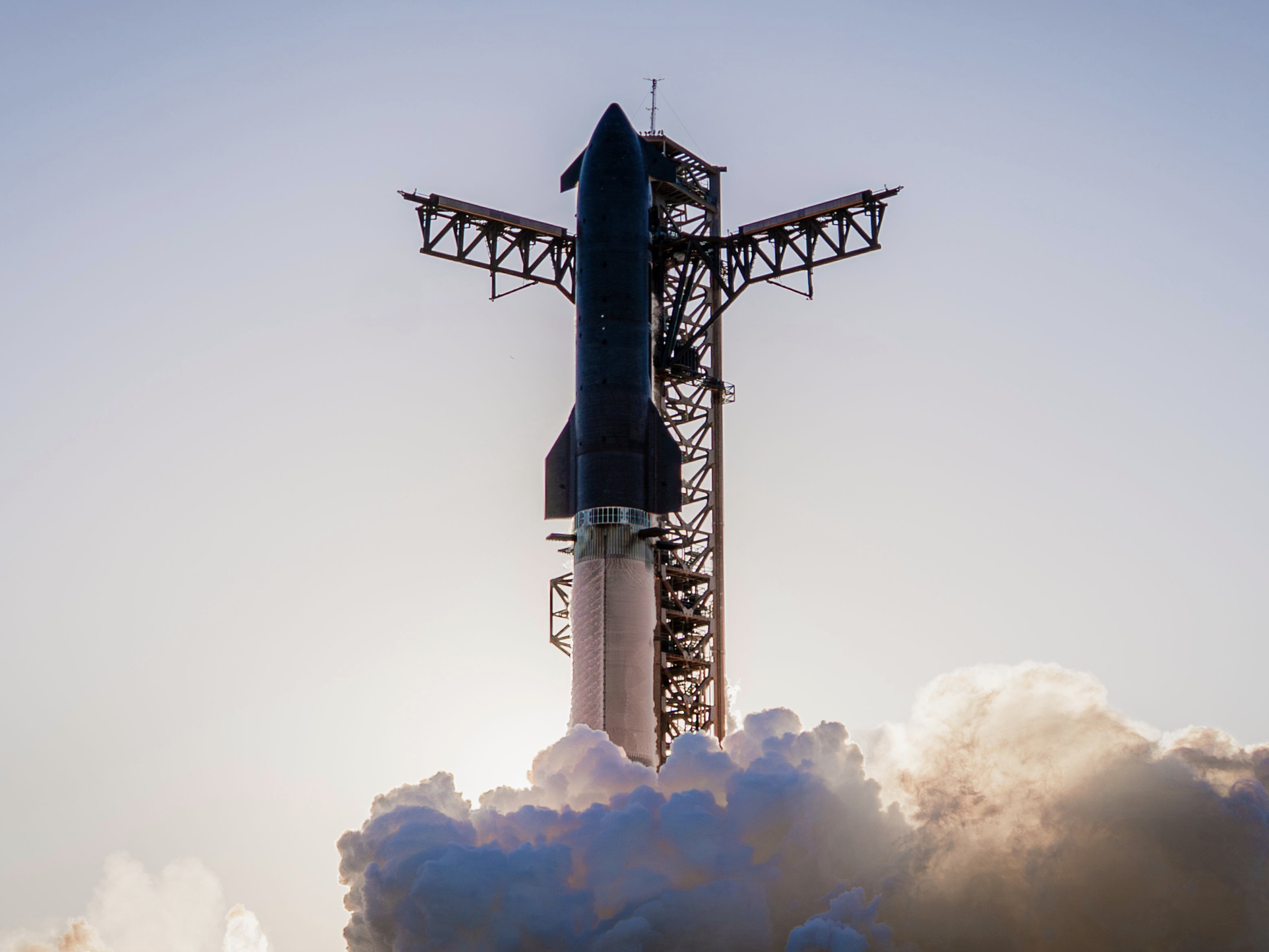
SpaceX has achieved one of the most important milestones in the development of Starship, sending the world’s largest launch vehicle into Earth orbit for the first time and successfully deploying 26 next-generation Starlink V3 satellites.
Flight 14 lifted off from Starbase, Texas, on 28 September, marking the first Starship mission designed to enter orbit. All previous integrated Starship flights had followed deliberately suborbital trajectories.
The mission represented an important transition from experimental flight testing toward operational use of the system.
After reaching an approximately 275-kilometre orbit, Starship successfully deployed all 26 Starlink V3 spacecraft – the first operational satellites ever carried to orbit by Starship.
Each Starlink V3 satellite is designed to provide approximately 1 Tbps of network capacity, meaning the payload could eventually add around 26 Tbps of capacity to the Starlink constellation.
The flight, however, did not proceed entirely as planned.
One of Starship’s engines shut down prematurely during ascent. Although the spacecraft was able to continue to orbit and complete the satellite deployment, SpaceX subsequently decided to shorten the mission as a precaution.
Instead of remaining in orbit for approximately ten hours and completing six revolutions around Earth, Starship returned after roughly three hours.
The spacecraft subsequently performed its deorbit and re-entry sequence before splashing down in the Pacific Ocean north of Hawaii.
Despite the shortened mission, Flight 14 achieved its two most important milestones: demonstrating Starship’s ability to reach a stable Earth orbit and deploying an operational payload.
The achievement represents a significant step for SpaceX’s plans to use Starship as a high-capacity launch vehicle for the next generation of Starlink satellites.
Its importance extends considerably further.
A derivative of Starship is also central to NASA’s Artemis lunar programme, while SpaceX ultimately intends to develop the vehicle into a fully and rapidly reusable transportation system capable of carrying large payloads – and eventually crews – to Earth orbit, the Moon and Mars.
Flight 14 therefore did not demonstrate a fully mature Starship.
But for the first time, Starship went to orbit carrying an operational payload, and delivered it.
About the Author