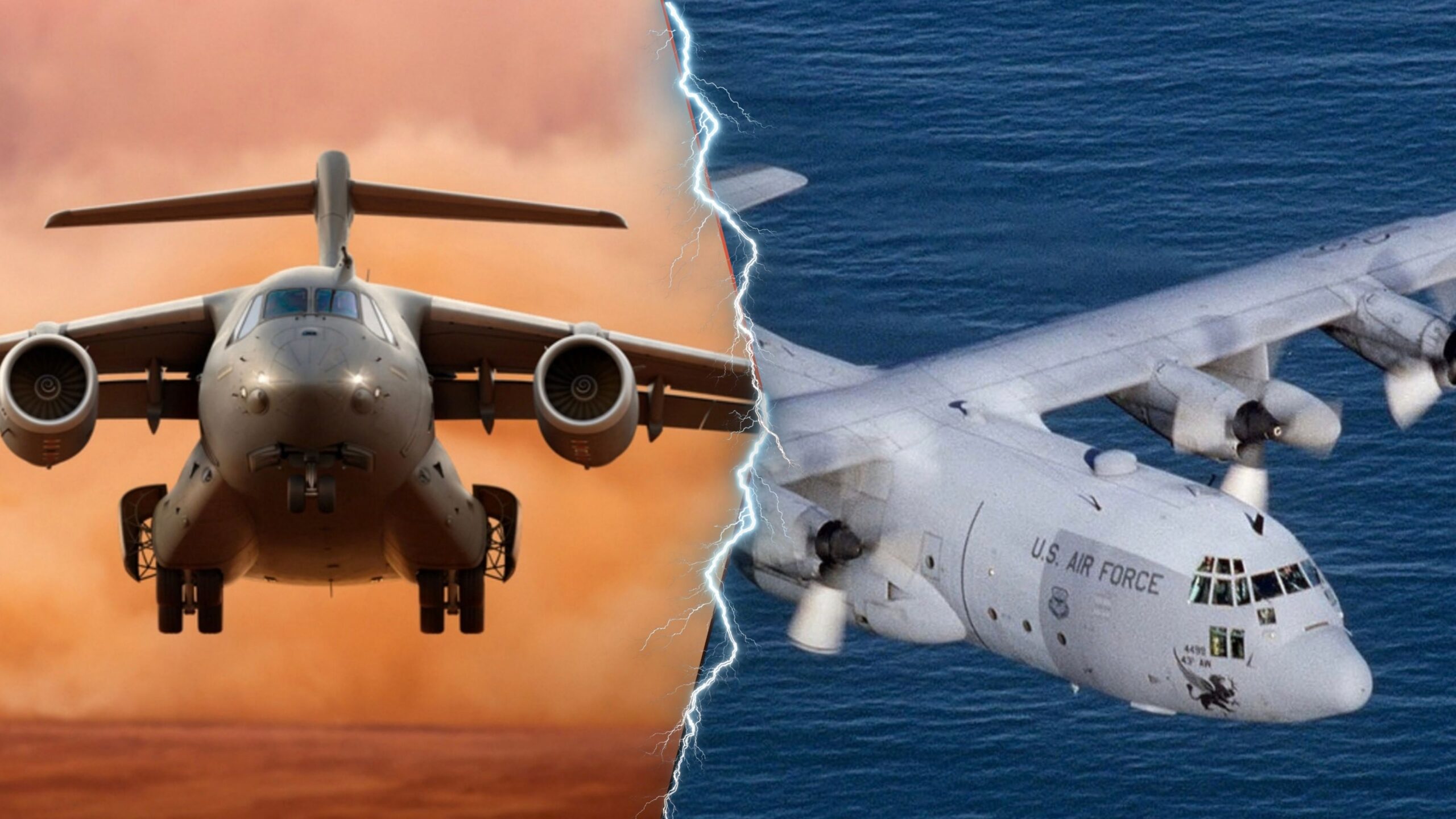
India’s competition for 60 new medium transport aircraft looks, at first sight, like a straightforward contest between two very capable machines: Lockheed Martin’s C-130J Super Hercules and Embraer’s C-390 Millennium. It is not.
With an estimated value of around $10 billion, local production of 48 aircraft and potentially decades of operation ahead, India is deciding much more than which aircraft should replace ageing transport capacity. It is choosing how much airlift capability each aircraft can generate, how much that capability will cost to sustain, what industrial ecosystem will remain in India — and how much room the chosen platform will have to grow over the next 30 or 40 years.
That changes the comparison considerably.
The safe choice and the future choice
Lockheed Martin enters the competition with an advantage that should not be underestimated.
The Indian Air Force already operates 12 C-130Js. India therefore knows the aircraft, has trained crews and maintainers, possesses infrastructure and has operational experience with the platform. Tata Advanced Systems is already part of the global C-130J industrial ecosystem.
The Super Hercules also brings something that cannot be created quickly by any competitor: maturity.
The wider C-130 family has accumulated decades of operational experience across almost every imaginable environment. The C-130J represents a substantially modernised aircraft within that lineage and remains one of the world’s most established tactical airlifters.
For India, selecting additional C-130Js would therefore minimise transition risk and maximise commonality.
That is probably Lockheed Martin’s strongest argument — and it is a very good one.
But it raises another question.
Should familiarity determine the architecture of India’s military airlift fleet for the next four decades?
Because India is not selecting an aircraft for yesterday’s requirements. The aircraft delivered under the MTA programme could still be serving well into the 2060s.
The relevant comparison is therefore not simply between what the C-130J and C-390 can do today.
It is between where each platform begins that journey.
Sixty aircraft do not necessarily provide the same airlift capability
Procurement programmes naturally count aircraft. Operational commanders ultimately need something different: transport output.
The C-130J-30 has a maximum allowable payload of 44,000 lb, or just under 20 tonnes, according to Lockheed Martin, and a published cruise speed of 356 knots.
Embraer publishes a maximum concentrated payload of 26 tonnes for the C-390 and a maximum cruise speed of 470 knots.
On paper, that gives the C-390 roughly 30% greater maximum payload and approximately 32% higher cruise speed.
Neither number alone decides an airlift competition. Range-payload profiles, runway performance, loading constraints, mission type, fuel consumption, maintenance, dispatch reliability and many other factors matter.
But together they point toward a metric that deserves more attention.
The important question is not simply how much one aircraft can carry.
It is how much useful transport work an entire fleet can generate over a day, a month and ultimately its service life.
An aircraft that carries more payload and completes sectors faster can potentially generate more transport output with the same number of tails — provided availability and maintenance performance support that advantage.
And there is unusually useful independent evidence on precisely this point.
The Dutch comparison deserves India’s attention
In 2022, the Netherlands conducted something particularly valuable for anyone assessing the Indian competition: an institutional comparison of the C-390 and C-130J.
The Dutch Ministry of Defence, supported during the selection process by the Netherlands Aerospace Centre, had identified both aircraft as potential candidates for replacing its C-130H fleet.
Its conclusions went considerably beyond comparing specification sheets.
The Dutch Ministry of Defence stated that the C-390 required less maintenance and could provide more effective flying hours per aircraft than the C-130J.
The numbers are striking.
For a requirement of at least 2,400 tactical airlift flying hours annually, the Netherlands concluded that four C-390s could meet the requirement. At least five C-130Js would have been required to provide the same number of hours.
When the Dutch requirement increased to 4,000 hours, five C-390s could provide the required capacity.
Five C-130Js, according to the information available to the Dutch Ministry during its study phase, could not.
The Dutch government also concluded that the C-390 was better suited to strategic movements in addition to its tactical role.
Perhaps most importantly, its estimated lifecycle costs fitted within the allocated budget. The estimated lifecycle costs of the C-130J did not.
This does not automatically mean that the same result would apply to India. Fleet size, labour costs, mission profiles, geography, infrastructure, industrial arrangements and contractual terms are different.
But it demonstrates why the Indian evaluation should look beyond acquisition price and individual aircraft performance.
The relevant unit of measurement may be airlift generated per aircraft over its lifetime.
For a fleet of 60 aircraft, relatively small differences in availability, maintenance burden or mission productivity become very large numbers over 30 or 40 years.
South Korea provides another interesting precedent
The Netherlands is not the only useful comparison.
South Korea selected the C-390 in 2023 under its Large Transport Aircraft II programme after evaluating it against the C-130J and Airbus A400M.
The decision was particularly interesting because the Republic of Korea Air Force already operated the C-130J.
In other words, Seoul had the same powerful commonality argument that exists in India — and still selected another aircraft.
South Korea’s Defense Acquisition Program Administration evaluated cost, performance, operational suitability and industrial considerations. Korean reporting following the decision indicated that contract terms, offsets and participation of domestic industry were among the differentiators.
That point matters enormously for India.
A new aircraft type inevitably creates transition costs. Commonality has real economic and operational value.
But South Korea demonstrated that an existing C-130J fleet does not necessarily make another C-130J purchase inevitable if the overall capability and industrial package points elsewhere.
There is also a broader pattern emerging.
European operators including Portugal, Hungary, the Netherlands, Austria, the Czech Republic, Sweden and others have selected the C-390, creating an expanding multinational support, training and operational ecosystem.
The C-390 can therefore no longer reasonably be characterised as an interesting Brazilian newcomer competing against an established global aircraft.
It is becoming an established multinational programme in its own right.
Lockheed Martin’s strongest card may be the Himalayas
There is one area where India should be particularly cautious about paper comparisons: austere operations.
The Indian Air Force operates in conditions few other air forces routinely encounter. High altitude, heat, short runways and demanding forward operating locations are not theoretical requirements.
Here the C-130J has a formidable argument.
India has already operated the aircraft in its own environment and understands its behaviour, limitations and maintenance requirements. There is considerable operational evidence behind the platform.
Embraer therefore needs to demonstrate rather than simply claim that the C-390 can reproduce the tactical utility India expects under its most demanding conditions.
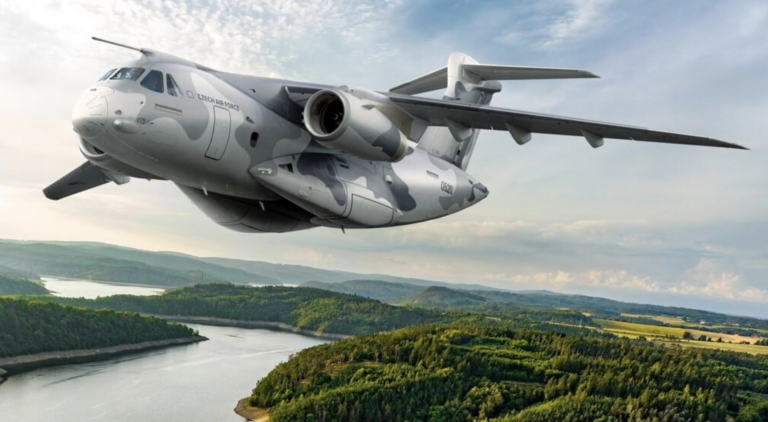
The C-390 was designed for operations from temporary and semi-prepared surfaces and uses a robust landing gear arrangement. It has operated in demanding climates and its V2500 turbofan engines are installed with relatively high ground clearance.
But Indian evaluation should be uncompromising.
Payload at altitude, take-off distance, landing performance, engine margins, FOD susceptibility, runway classification, turnaround time and dispatch reliability under Indian conditions matter more than brochure maximums.
If the C-390 wins those tests, however, one of the strongest remaining arguments for choosing the familiar platform becomes substantially weaker.
Speed is more important than it looks
The approximately 470-knot maximum cruise speed of the C-390 versus 356 knots published for the C-130J-30 can easily look like another specification-sheet comparison.
Operationally, it can mean considerably more.
Consider a transport network connecting bases separated by thousands of kilometres. Faster transit reduces sector time. Reduced sector time can increase aircraft utilisation, accelerate reinforcement, reduce crew duty exposure and potentially allow an aircraft to perform additional missions within a given period.
The advantage compounds across a fleet.
This becomes especially relevant for India because its strategic geography is enormous.
The same transport force may need to support the Himalayan frontier, the western border, Indian Ocean territories and international deployments.
Military airlift is therefore not simply about lifting the heaviest object.
It is about moving the required object to the required place quickly enough to matter.
That makes fleet productivity potentially more important than individual aircraft capacity.
India is also buying an aerospace industry
The MTA competition has another unusual characteristic.
Of the 60 aircraft, 48 are expected to be manufactured in India. Indian companies are intended to lead bids with foreign OEM partners, while final assembly and maintenance infrastructure are to be established domestically.
This changes the nature of the competition again.
India is not merely asking:
Who can supply the best aircraft?
It should also ask:
What remains in India after aircraft number 60 has been delivered?
Both leading contenders understand this.
Lockheed Martin has a substantial head start. Tata Advanced Systems already manufactures C-130J empennage assemblies in Hyderabad, giving India an established position inside the global programme.
A larger Indian C-130J programme could deepen an industrial relationship that already exists rather than creating one from scratch.
Embraer and Mahindra are proposing something different.
On 1 October they identified Nagpur, Maharashtra, as the planned location for a potential C-390 final assembly line if their aircraft wins the MTA competition.
Their stated concept extends beyond final assembly toward an Indian C-390 industrial and support ecosystem, involving local manufacturing, suppliers, maintenance, training and lifecycle support.
The distinction may prove critical.
Final assembly creates jobs.
A programme that integrates Indian suppliers into a global aircraft ecosystem can create capability.
India should therefore look beyond headline localisation percentages and examine which proposal provides Indian companies with the greatest access to engineering, manufacturing, intellectual capability, sustainment and global supply chains.
The most important industrial metric may ultimately not be how much of aircraft number 20 is manufactured in India.
It may be how much Indian aerospace industry has changed by the time aircraft number 60 leaves the factory.
Customer or strategic partner?
There is another difference that is difficult to express on a conventional technical evaluation matrix but deserves consideration.
India would be an important C-130J customer.
In the C-390 programme, however, an Indian order for 60 aircraft — potentially followed by additional aircraft — could make India one of the central pillars of the programme worldwide.
Those are not necessarily the same industrial relationships.
For India, the strategic question is therefore not simply which manufacturer is willing to localise production.
It is which programme gives India the greatest leverage as that programme develops.
Could an Indian production facility eventually support aircraft elsewhere in Asia?
Could Indian companies manufacture components for C-390s delivered to third countries?
Could India become a regional maintenance and training centre?
Could future mission systems, modifications or special-mission variants involve Indian engineering?
Nagpur becoming an assembly line would be important.
Nagpur becoming an Asian C-390 industrial and support hub would be strategically much more significant.
This is where India’s MTA decision intersects directly with Atmanirbhar Bharat.
The objective should not merely be to manufacture a foreign aircraft domestically.
It should be to use the procurement of a foreign aircraft to expand India’s ability to design, manufacture, maintain and eventually export increasingly complex aerospace systems.
The C-390’s growing European ecosystem changes the risk equation
One of the traditional arguments against selecting a relatively young military aircraft is fleet size.
A smaller installed base can mean greater programme risk, fewer maintenance centres, less operational experience and a less mature supply chain.
That argument was considerably stronger against the C-390 five years ago than it is today.
The aircraft entered Brazilian service in 2019 and has since accumulated operators and customers across Europe and Asia.
More importantly, several European customers are deliberately pooling procurement and support.
The Netherlands acts as lead nation in a joint programme under which the Netherlands, Austria and Sweden are acquiring 13 aircraft in a common configuration. The Dutch Ministry of Defence explicitly identifies economies of scale in training, maintenance and sustainment as advantages of that cooperation.
That matters because fleet economics do not depend only on how many aircraft one country operates.
They depend on the size and resilience of the wider ecosystem supporting them.
For India, a 60-aircraft purchase would itself transform that equation.
India would not simply join the C-390 ecosystem.
It would become one of its largest components.
The real competition is between two philosophies
Reducing the contest to C-390 versus C-130J risks missing what makes India’s decision so interesting.
The C-130J offers continuity.
Its case rests on operational maturity, enormous accumulated experience, an existing Indian Air Force fleet, established infrastructure and an industrial relationship with Tata that already works.
There is very little speculative about that proposition.
The C-390 offers something different.
It starts from a newer design baseline, carries more maximum payload, cruises substantially faster and has produced encouraging operational availability data. Independent Dutch analysis found that fewer aircraft could generate the required annual flying hours and that estimated lifecycle costs were more favourable in that country’s evaluation.
Its international operator base is expanding rapidly.
And because India could become one of the largest C-390 operators and potentially a major manufacturing centre, the industrial relationship could extend far beyond purchasing 60 aircraft.
One proposition therefore asks India to exploit an ecosystem it already knows.
The other asks India to help build an ecosystem in which it could become one of the most important participants.
Neither is an irrational choice.
But they are fundamentally different choices.
What should India actually measure?
Before selecting the winner, India should perhaps publish — or at least internally define — a different set of metrics.
Not merely maximum payload, but annual tonnes transported per aircraft.
Not merely maximum range, but payload delivered across representative Indian mission profiles.
Not simply acquisition cost, but cost per effective flying hour over the fleet lifecycle.
Not merely aircraft availability, but fleet output after scheduled and unscheduled maintenance.
Not simply percentage of local content, but the value of Indian industrial participation over 30 years.
And not simply how quickly the first aircraft can be delivered, but how much sovereign aerospace capability remains in India after the last one is built.
Those metrics could produce a very different answer from a traditional specification comparison.
The question India should ask
The C-130J has earned its reputation. Its global success, operational record and existing Indian service make it perhaps the lowest-risk option in the competition.
That should carry considerable weight.
But lowest transition risk and greatest long-term value are not necessarily the same thing.
India’s MTA programme is large enough to influence the future of whichever aircraft it selects. It is also large enough to shape a part of India’s aerospace industry for a generation.
The decision therefore deserves to be evaluated not as a purchase of 60 transport aircraft, but as the acquisition of perhaps several hundred thousand future flying hours, decades of sustainment, an industrial ecosystem and a strategic relationship with an aircraft manufacturer.
The most important question may consequently be surprisingly simple:
Which aircraft gives India the greatest amount of usable airlift, industrial leverage and freedom of action over the next 40 years?
The winner should not necessarily be the aircraft that asks India to change the least today.
It should be the aircraft that allows India to do the most tomorrow.
About the Author